electronics help - zener diodes and voltage divider - combined?

Capture.jpg

Lots of explanation for 5 components!

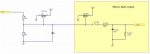
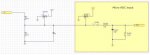
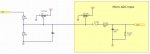
On the left is a typical input conditioning circuit.

On the right is a typical equivalent circuit for a micro ADC input. (I haven’t specifically checked the datasheet for the ARM on the Arduino but it will be similar.)

"Power rail" is a bit of slang which usually refers to the micro's supply connection. In this case it's +3V3.

Choosing potential divider resistors.

When selecting the values for R1 and R2 there are 5 things to take account of;

1. Voltage reduction to scale Vin to the ADC range. The OP has done that.
2. DC input impedance. The value of R1 should be at least an order of magnitude lower than R2ADC because it forms part of another potential divider. 300k is probably fine here.
3. Switching input impedance. This depends on how the micro ADC is programmed. Usually a single ADC is connected to a multiplexer. That is a multi-way switch within the micro that connects one of a number of inputs to the ADC. The switching rate is usually measured in ms or faster.The ADC input has a small capacitance C1ADC. This must be charged after the multiplexer switch S1ADC closes but before the ADC begins its conversion. This is known as the settling time. If R1 is too large or the settling time is too short then C1ADC will not be fully charged when the ADC does its conversion. It’s not unusual to see errors of 10% if this is wrong.
4. R1’s value should be high enough to limit current through D1 caused by “spikes” or other over voltage conditions.
5. Source impedance. R1 should be at least an order of magnitude (preferably 2) larger the the source impedance of Vin.

Choosing D1.

(I've show 2 diodes in one package but 2 individual devices are fine).

As Nigel says; the diode to +3V3 prevents positive over voltage exceeding the limit for the micro. That’s fine for some over-voltage conditions. But "spikes" such as those generated by ESD (electro-static discharge) always have a positive and a negative part. Usually there is a similar amount of energy in each half. The second diode to 0V ensures the negative half of a spike (or indeed a negative connection) is kept within the micro’s limits.

This is how I arrived at the 3000V figure in my previous post. (Although that would likely exceed the limit for R1 which is likely to be a few hundred volts.)

The diodes should be Schottky devices for low forward voltage and preferably fast devices. (The need for fast devices is reduced by C1.)

Without D1, the internal diodes D1ADC will do the same job. That’s fine but they are rarely well characterised on the micro datasheet and I always like to add external diodes, they don't cost much and can be small.

Choosing C1.

C1 serves two purposes.

It will conduct much of the "spike" energy, keeping the voltage on the micro pin low.

It also forms a low pass filter with R1 and can be used to smooth the signal for conversion and form an anti-alias filter.
Google “adc aliasing” for an explanation. I don’t know what your exact requirements are but I suggest you select C1’s value by experiment.

As a start, the value of 100nF will have an impedance of 300k @ 5.3Hz. You should consider that in parallel with R2 and its effect on the potential divider it forms with R1.

Hope that is of some interest.

Have fun.
 

Attachments

  • Capture.jpg
    Capture.jpg
    19.8 KB · Views: 0
  • Capture.jpg
    Capture.jpg
    16.7 KB · Views: 0
Last edited:
thank you all for your contributions, it seems that I'll eventually understand all that :D
If we get a few more, I recon you should start a MOOC on microprocessors and programming ;)

cheers

V.
 
And just to reiterate, the original resistors R1 & R2 are rather large, and could cause this problem. Values are normally chosen to limit the current to 1mA or so, hence 10kΩ or 12kΩ for 12V, or 4k7Ω (4.7kΩ) for 5V etc.

It depends mainly on the source impedance; I'll add that as an item 5. On most systems I see or design these days they are 5 to 50 times bigger. After that buffering is usually preferable.
 
Top