Electronic Navigation; the Downside

Any chart is liable to errors, or misinterpretation.
The delivery medium may or may not exacerbate the situation.
Not all electronic navigation machines are made equal.
Its still down to the user to chose and use the data to the best of their ability.

We all make mistakes.
 

Thanks, already seen the post-mortem. My comment "That sounds to me almost like a definition of operator error" wasn't addressed to the Vestas incident per se, but to Spirit of Glenans' interpretation of it in post #15. He was, of course, the OP of the proposition on "the pitfalls of relying solely on the chartplotter", yet in that post seemed principally to ascribe the fault to operator error.
 
Its just about impossible to zoom in to a featureless area of sea to search for hazards. Going into Wick this year in the dark I completely missed the cardinal which did not show when the chart was zoomed to a suitable scale to show the approach to the harbor using Cmap on my SH plotter but it is very clear on Navionics. I had seen it earlier on my paper chart but forgot in the usual flurry of activity at the end of a passage. Is it may imagination or is there some variability in the zoom level at which certain details disappear. Is there any indication that detail has been omitted on the plotter display. The split screen may have helped but it gets a bit small. Plotting a passage across the north sea must be a nightmare without up to date paper charts.
 
Nice comment by team navigator Wouter Verbraak
“Not zoomin in on the chart was the big mistake that I made”, "but the good thing is that we didn't make any more." Why not, well, there was no boat left. I suppose he can look forward to the next race and practice the lessons he learnt in this one.
 
Interesting that people seem to range for or against electronic charts - both are an AID to navigation.
They rely on operator competence.
The C-Map charts I use are accurate, but only go to commercial shipping levels of detail. The Navionics attempts far more detail but, being the product of human achievement has lots of errors.
My boat would sink under the weight of paper charts I'd perforce carry for the areas I cruise.
So we come back to the fact that all charts have inaccuracies, paper ones as much as electronic ones. The fool who believes he's the navigational equal of Captain Cook, because he has a GPS is just that - a common fool.
IMHO the grounding was impressive, professional incompetence - best to pass over it lest we are the next idiot to be caught out by our amateur skills.
 
My boat would sink under the weight of paper charts I'd perforce carry for the areas I cruise.

so take them electronically.
My boat would suffer also if I carried all the books I take, as PDF files, in their original form. I'm not hung up about any tactile considerations, or I would have a gramophone on board.
 
Thanks, already seen the post-mortem. My comment "That sounds to me almost like a definition of operator error" wasn't addressed to the Vestas incident per se, but to Spirit of Glenans' interpretation of it in post #15. He was, of course, the OP of the proposition on "the pitfalls of relying solely on the chartplotter", yet in that post seemed principally to ascribe the fault to operator error.
My Post was not about the merits, or otherwise, of chartplotters, but the error of relying solely on them, as has been demonstrated by the Team Vestas navigator in that he missed a hazard that would have been obvious, had he merely looked at the relevant paper chart, before proceeding to use the electronic version.
 
My Post was not about the merits, or otherwise, of chartplotters, but the error of relying solely on them, as has been demonstrated by the Team Vestas navigator in that he missed a hazard that would have been obvious, had he merely looked at the relevant paper chart, before proceeding to use the electronic version.

But you are not describing a problem with electronic charts per se. You are simply describing operator error in their use. The same is true of paper charts and you can choose the wrong chart or not adjust for variation etc. You don't need to revert to paper to fix the navigators error you simply need to use the electronic aid properly. If he had done this then there would have been no problem, i.e. zoom in and follow your course. So, the error was not in relying soley on them it was in using them wrong.
 
My Post was not about the merits, or otherwise, of chartplotters, but the error of relying solely on them, as has been demonstrated by the Team Vestas navigator in that he missed a hazard that would have been obvious, had he merely looked at the relevant paper chart, before proceeding to use the electronic version.

I do agree that you should always carry and even look at paper charts but I remember cruising along the Tunisian coast before chart plotters, using GPS routes based on taking way-points from paper charts. Suddenly about 10 metres on my beam I saw a rock awash that I had not observed on the paper chart. When I got into port I looked at the chart more closely and indeed it was charted but the mark was so small I had not seen it and it was supposed to have 4 metres over it.... Just goes to show that once you leave the well charted waters of the UK there are more navigational surprises around.
 
I do agree that you should always carry and even look at paper charts but I remember cruising along the Tunisian coast before chart plotters, using GPS routes based on taking way-points from paper charts. Suddenly about 10 metres on my beam I saw a rock awash that I had not observed on the paper chart. When I got into port I looked at the chart more closely and indeed it was charted but the mark was so small I had not seen it and it was supposed to have 4 metres over it.... Just goes to show that once you leave the well charted waters of the UK there are more navigational surprises around.

I have regularly 'lost' things in the folds and crumpled bits of paper charts.
 
What plotter were they using?

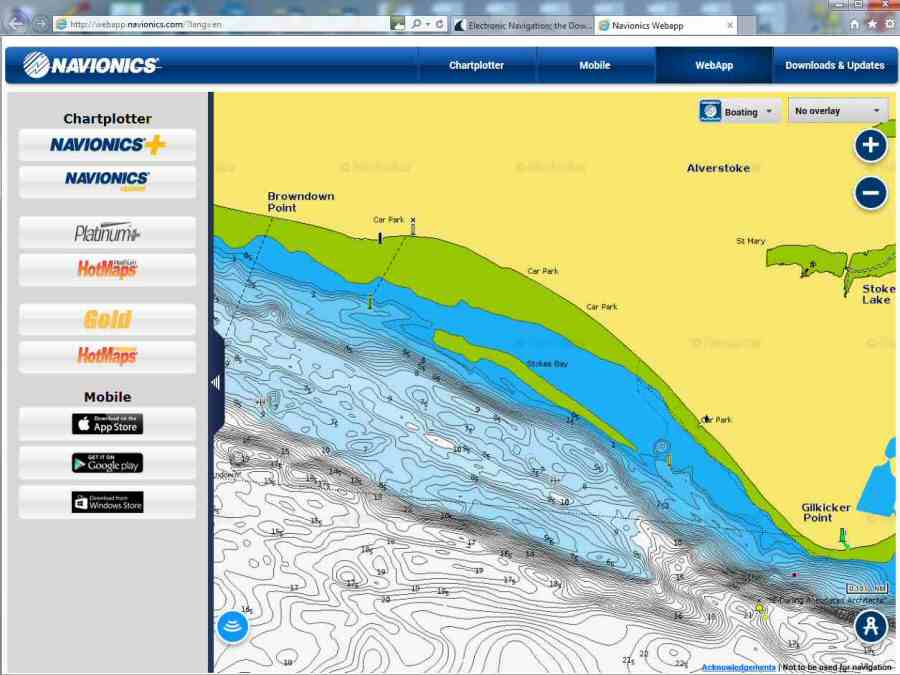
The shoals are near impossible to miss on the navionics web charts even zoomed right out.

http://webapp.navionics.com/?lang=en

about 230Nm 30deg from Mauritious.

Sorry for drift but that Navionics thing came up on the Solent... Is this a new feature in the Solent now? Has anybody seen it?

stokesbay.jpg
 
Its just about impossible to zoom in to a featureless area of sea to search for hazards. Going into Wick this year in the dark I completely missed the cardinal which did not show when the chart was zoomed to a suitable scale to show the approach to the harbor using Cmap on my SH plotter but it is very clear on Navionics. I had seen it earlier on my paper chart but forgot in the usual flurry of activity at the end of a passage. Is it may imagination or is there some variability in the zoom level at which certain details disappear. Is there any indication that detail has been omitted on the plotter display. The split screen may have helped but it gets a bit small. Plotting a passage across the north sea must be a nightmare without up to date paper charts.

Been there had the t shirt. left a bit of keel at Ardglass when I went the wrong side of a mark. as I zoomed in I suddenly realised that none of the entrance buoys were marked. If i had Reeds open I would have had no problem. After that it was back to my good old Yeoman. On my first round Uk trip I hit nothing. On my second - using a chart plotter -i ran aground twice
Your comments about the N sea are correct. one has to zoom right in to get things like shipping lanes & go of course a bit one zooms out & looses all the detail
I only bought a CP for my AIS & quite honestly it is a pain having to keep pressing buttons etc
 
Top