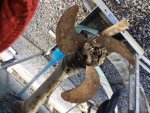
Electrolysis damage to prop blade

jim5099

Active Member
Joined
14 Jan 2006
Messages
51
Location
Crosshaven, Irl
Visit site
I lifted my boat today for its annual scrub to find this electrolysis damage to one of the propellor blades.....boat is in the water since April last year. Did a trip to France and back and on a marina since August. The unit is a Volvo Penta folding propellor on a Volvo saildrive 130. The three-piece anode is totally gone and obviously this allowed the electrolysis to attack the prop. I've had the boat for 5 years and although the anode is usually well worn by the time it gets replaced every year, this is in a different league altogether.

My question is whether the prop can be cleaned up and put back into service ? If it needs replacing, can I replace just one ?, a set of 3 ??, the entire prop ???.
VP prop blade.JPG
 
Goodness me; have you got a pic of the whole prop and where is the boat berthed? And is a galvanic Isolator fitted? In any event I’d suggest a full electrical test before before replacing anything.
 
[" Goodness me; have you got a pic of the whole prop and where is the boat berthed? And is a galvanic Isolator fitted? In any event I’d suggest a full electrical test before before replacing anything."]

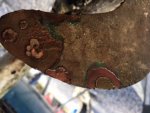
This second pic is before washing or cleaning; straight out of the water. The rest of prop is not badly affected apart from one pit on one other blade (lower blade in photo). No Galvanic Isolator is fitted as far as I know, unless its part of the standard Dufour set up. By the way, the boat is NOT connected to shore power while on the marina. Location is in Irish Sea.

VP prop.JPG
 
Hard to be sure what's going on there, but not good. Anodes really shouldn't degrade quite so fast, although some props are worse than others. It's also possible that a stray current somewhere in the marina is causing/augmenting the problem. Or perhaps something else.

Re the state of the prop, why don't you pm vyv cox and ask him to take a look at the photos; he is a true metal expert. There are also some scientific minded electrical wizzos on here!

Any ideas?
 
Last edited:
Firstly it would be useful to know the composition of the prop. There does seem to be a rash of very similar problems with supposedly bronze after-market propellers, I have a collection of photos. The damage looks very much like dezincification to me, notice how the loss of metal is about the same depth, which would be expected with surface attack that is normal with DZ. Props on Volvo legs are completely isolated from everything, which should rule out any electrolytic effect. A zinc anode cannot do much to prevent dezincification, there is very little voltage between the zinc of the anode and the zinc rich phase of the brass.

Firstly, I would ask Volvo for an explanation. Try comparing the colour of freshly abraded propeller with known brass such as a compression fitting. Info on this in 'brass and bronze on the website. I think you may be looking at the other blades through rose coloured spectacles! They look to me to be going the same way, although your photo is not quite in focus. I would replace all three blades, but check the hub carefully first.
 
May I suggest fitting a new anode on full sight of the prop connected to the saildrive for future protection.

I have had issues with the saildrive corroding but not the prop.

New sailidrive looks wonderful!

Tony
 
May I suggest fitting a new anode on full sight of the prop connected to the saildrive for future protection.

I have had issues with the saildrive corroding but not the prop.

New sailidrive looks wonderful!

Tony

What you seem to be describing is not possible. While you may add an extra anode to the saildrive housing, this has no effect on the prop. The anode on the saildrive just protects the housing and is usually more than enough to gt a season's protection, particularly the larger anode on the 130 drive.

However the prop (as has already been noted) is electrically isolated from the prop which is reliant on its own anodes. On the photo you can see the recess where one of the prop anodes sits and according to the OP they have gone completely. There is no way of fitting additional anodes. However as Vyv says they are not particularly effective for reducing dezincification as their main purpose is to deal with the interface between the stainless steel gears and the teeth on the blades. This is where you normally see corrosion. The dezincification is more likely to be the related to the type of alloy used in the blades.
 
What you seem to be describing is not possible. While you may add an extra anode to the saildrive housing, this has no effect on the prop. The anode on the saildrive just protects the housing and is usually more than enough to gt a season's protection, particularly the larger anode on the 130 drive.

However the prop (as has already been noted) is electrically isolated from the prop which is reliant on its own anodes. On the photo you can see the recess where one of the prop anodes sits and according to the OP they have gone completely. There is no way of fitting additional anodes. However as Vyv says they are not particularly effective for reducing dezincification as their main purpose is to deal with the interface between the stainless steel gears and the teeth on the blades. This is where you normally see corrosion. The dezincification is more likely to be the related to the type of alloy used in the blades.


WEll, if you are talking about my situation, firstly, the facts speak for themselves, drive is scrap, cheese, leaking oil on haul out! Prop is as new!

Prop has anode on the trailing hub and beneath the rope cutter.

Prop is seated and secured by a nut which bears on the trailing face and screws onto the saildrive shaft!

Tony.
 
WEll, if you are talking about my situation, firstly, the facts speak for themselves, drive is scrap, cheese, leaking oil on haul out! Prop is as new!

Prop has anode on the trailing hub and beneath the rope cutter.

Prop is seated and secured by a nut which bears on the trailing face and screws onto the saildrive shaft!

Tony.

There is no anode on the prop between the rope cutter and the prop - the anode is attached to the saildrive housing. The Prop nut should have an isolating washer underneath it and the prop a rubber hub. So the prop is isolated electrically from the drive.

If your housing has corroded look at the continuity between the ring anode and the housing.

What you are describing is not typical - thousands of drives have been in use over more than 30 years with all types of props without any problems. So your problem will be specific to your situation and not general.
 
Two known primary causes of premature saildrive leg corrosion are: non standard anode and poor quality paint film. Cheap anodes may not have the correct composition that is crucial for the protection of a metal that is itself quite anodic. The paint film reduces the size of the cathode, thus increasing anode life.
There may of course be more but these are the most well-known.
 
Top