Electrically challenged plus naked enthusiasm

Malabarista

Well-Known Member
Joined
23 Aug 2016
Messages
444
Location
Rye
Visit site
Hi everybody
What lovely shiny new fora we have.
i am unable to post the photo of the drawing i did for your amusement and advice. Maybe i am unworthy. Anyway i have some questions for the learned panel.
1. I rather foolishly believed that my alternator was 120 Amp and based on this erroneous assumption bought myself a rather lovely 120A Cyrix thingy following advice from the archives here. It turns out that it is actually a 125A alternator which i am assuming will need me having to upgrade?
2. I am putting a 200A breaker before the unswitched busbar ( to run separately fused bilge pumps, sniffers and the battery bay extractor fan etc) and then to the switches and a second busbar to feed the panel with all the usual gubbins powered from there. Is this ok?
3. I am using 35mm2 stranded welding cable for all the ‘heavy duty’ stuff but my starter motor has a label which says 817A. This is a scary number if it is indeed ‘amps’ which will fry my cable ( 240A rated). So do i need to use monster cable for this or is it ok for short bursts of this amperage?
I have about a million other questions too but i will eke them out as my brain hurts already
Thanks in advance
Dave
 
120A 125A .. whatever, makes no difference.

125A is the rated continous maximum, it may at times do more than that, most of the time it will do way less than that, and it is at best an estimate ... pay it no heed, 120A is well within the margin of error.

Same with the starter motor .. if you were planning to run the starter motor at full load all day off a battery bank the size of a house, you would indeed need 817A rated cable, but since you are only going to be running it for a few seconds or tens of seconds, 35mm^2 cable will be absolutely fine ... 240A is its continuous rating, it will do something like 480A for 10 minutes, 960A for 2.5 minutes etc
 
120A 125A .. whatever, makes no difference.

125A is the rated continous maximum, it may at times do more than that, most of the time it will do way less than that, and it is at best an estimate ... pay it no heed, 120A is well within the margin of error.

Same with the starter motor .. if you were planning to run the starter motor at full load all day off a battery bank the size of a house, you would indeed need 817A rated cable, but since you are only going to be running it for a few seconds or tens of seconds, 35mm^2 cable will be absolutely fine ... 240A is its continuous rating, it will do something like 480A for 10 minutes, 960A for 2.5 minutes etc
This makes me feel much better about my task ahead. Many thanks
Dave
 
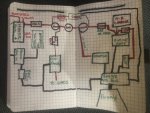
Ok here goes. After some coaching , outright plagiarism and a second draft ( thanks Paul)
to follow the first disastrous attempt i am now hoping for improvements, advice or derision. Please excuse the crayon etc etc …967E37AD-4035-4748-89CC-280C39BA8E12.jpeg
 
Hi everybody
What lovely shiny new fora we have.
i am unable to post the photo of the drawing i did for your amusement and advice. Maybe i am unworthy. Anyway i have some questions for the learned panel.
1. I rather foolishly believed that my alternator was 120 Amp and based on this erroneous assumption bought myself a rather lovely 120A Cyrix thingy following advice from the archives here. It turns out that it is actually a 125A alternator which i am assuming will need me having to upgrade?
2. I am putting a 200A breaker before the unswitched busbar ( to run separately fused bilge pumps, sniffers and the battery bay extractor fan etc) and then to the switches and a second busbar to feed the panel with all the usual gubbins powered from there. Is this ok?
3. I am using 35mm2 stranded welding cable for all the ‘heavy duty’ stuff but my starter motor has a label which says 817A. This is a scary number if it is indeed ‘amps’ which will fry my cable ( 240A rated). So do i need to use monster cable for this or is it ok for short bursts of this amperage?
I have about a million other questions too but i will eke them out as my brain hurts already
Thanks in advance
Dave
1/ I would be amazed if you ever got your alternator to dish out 125Amps and even more amazed if your Cyrix thingy was sensitive to the difference between 120 and 125. Its your decision but I wouldnt think twice about it. I have never ever got my 60A alternator to produce 60A.
2/ Sounds like too high to me. What do you have running off this circuit?
3/ You dont say what engine you have but the starter motor is likely to be 1000w which is more like 80A than 817A

Got to say Dave that it sounds to me like you are tackling a job outside your skill set and capabilities, and would be better paying for a leccy. I have seen a boat that got a dead short at sea with matching fire and it wasnt funny.
 
Hi everybody
What lovely shiny new fora we have.
i am unable to post the photo of the drawing i did for your amusement and advice. Maybe i am unworthy. Anyway i have some questions for the learned panel.
1. I rather foolishly believed that my alternator was 120 Amp and based on this erroneous assumption bought myself a rather lovely 120A Cyrix thingy following advice from the archives here. It turns out that it is actually a 125A alternator which i am assuming will need me having to upgrade?
2. I am putting a 200A breaker before the unswitched busbar ( to run separately fused bilge pumps, sniffers and the battery bay extractor fan etc) and then to the switches and a second busbar to feed the panel with all the usual gubbins powered from there. Is this ok?
3. I am using 35mm2 stranded welding cable for all the ‘heavy duty’ stuff but my starter motor has a label which says 817A. This is a scary number if it is indeed ‘amps’ which will fry my cable ( 240A rated). So do i need to use monster cable for this or is it ok for short bursts of this amperage?

1) No need to upgrade the Cyrix, it's highly unlikely your alternator will ever output 125A.
2) Not sure I understand this, in the light of your subsequent diagram. The 200A (or 250A as on the diagram) breaker should be fine, obviously the cable needs to be sized to suit and be capable of handling the starter current if you use the emergency "Both" switch. However, the breaker should be installed next to the house bank, to protect the cable between the battery bank and the house bus bar.
3) Do you have a Yanmar engine? Many of them use a starter motor which has a part number ending in "817A", so it's not the current rating! If your starter motor cable is fairly short, 35mm2 would be OK.

Your diagram shows the Sterling charger connected to the negative bus - this is wrong, it should be connected to the non-battery end of the BMV shunt, so that all the current in and out of the house battery is properly measured.

Your diagram also has "No fuse? " written alongside the cable to the starter. You don't need a fuse here, as the cabling is protected by the two 250A breakers/fuses, which should be as close to the batteries as possible.

You have "Fuse?" written alongside the Cyrix wiring. Yes, you should have a 120A fuse, and the cable should be sized to handle that current.
 
Whjat is the point of having the 'Cyrix' which I take to be a VSR, as well as the A to B charger?
There is potential for the solar power to vercharge the engine battery via the VSR.
The battery isolators are of questionable value, since they dn't actually isolate the batteries, and merely replicate the finction of the breakers, which can be switched manually? It's all extra resitance and potential failure points.
Turning the isolators off should make the system 'safe' which it would not.
The starter currnet goes through too many connections IMHO.
Likewise the alternator looks a long way from the house battery, what will the resistanxce be?
 
1) No need to upgrade the Cyrix, it's highly unlikely your alternator will ever output 125A.
2) Not sure I understand this, in the light of your subsequent diagram. The 200A (or 250A as on the diagram) breaker should be fine, obviously the cable needs to be sized to suit and be capable of handling the starter current if you use the emergency "Both" switch. However, the breaker should be installed next to the house bank, to protect the cable between the battery bank and the house bus bar.
3) Do you have a Yanmar engine? Many of them use a starter motor which has a part number ending in "817A", so it's not the current rating! If your starter motor cable is fairly short, 35mm2 would be OK.

Your diagram shows the Sterling charger connected to the negative bus - this is wrong, it should be connected to the non-battery end of the BMV shunt, so that all the current in and out of the house battery is properly measured.

Your diagram also has "No fuse? " written alongside the cable to the starter. You don't need a fuse here, as the cabling is protected by the two 250A breakers/fuses, which should be as close to the batteries as possible.

You have "Fuse?" written alongside the Cyrix wiring. Yes, you should have a 120A fuse, and the cable should be sized to handle that current.
thanks very much for this Yes it’s a Yanmar and yes it’s probably a part number.
 
1) No need to upgrade the Cyrix, it's highly unlikely your alternator will ever output 125A.
2) Not sure I understand this, in the light of your subsequent diagram. The 200A (or 250A as on the diagram) breaker should be fine, obviously the cable needs to be sized to suit and be capable of handling the starter current if you use the emergency "Both" switch. However, the breaker should be installed next to the house bank, to protect the cable between the battery bank and the house bus bar.
3) Do you have a Yanmar engine? Many of them use a starter motor which has a part number ending in "817A", so it's not the current rating! If your starter motor cable is fairly short, 35mm2 would be OK.

Your diagram shows the Sterling charger connected to the negative bus - this is wrong, it should be connected to the non-battery end of the BMV shunt, so that all the current in and out of the house battery is properly measured.

Your diagram also has "No fuse? " written alongside the cable to the starter. You don't need a fuse here, as the cabling is protected by the two 250A breakers/fuses, which should be as close to the batteries as possible.

You have "Fuse?" written alongside the Cyrix wiring. Yes, you should have a 120A fuse, and the cable should be sized to handle that current.
thanks mate taken onboard please see new diagram hopefully showing yours and Pauls upgrades. apologies for being such a dunce
 
Thanks to all for great advice received.
i have been taking lessons from my sister in law. Here is the result.
Bin the A-B charger and connect the alternator output to the starter positive cable (i suspect it's there already).
Thanks Paul i will check tomorrow.
 
Whjat is the point of having the 'Cyrix' which I take to be a VSR, as well as the A to B charger?
There is potential for the solar power to vercharge the engine battery via the VSR.
The battery isolators are of questionable value, since they dn't actually isolate the batteries, and merely replicate the finction of the breakers, which can be switched manually? It's all extra resitance and potential failure points.
Turning the isolators off should make the system 'safe' which it would not.
The starter currnet goes through too many connections IMHO.
Likewise the alternator looks a long way from the house battery, what will the resistanxce be?
Thanks for this i have changed my plans. The alternator is approx 1.5 meters ( cable length) from the battery. I have also ‘binned’ the a to b charger. It was something i had already before i was advised to buy a Cyrix. Thanks for the heads up ?
 
Bin the A-B charger and connect the alternator output to the starter positive cable (i suspect it's there already).
Just checked and it is thanks Paul. C’mon you knew this was going to be a
Bin the A-B charger and connect the alternator output to the starter positive cable (i suspect it's there already).
Thanks Paul it is.
you know this is going to be slog right ? ?
 
Top