Electrical wiring - troubleshoot or re-wire?

Docktor

Member
Joined
30 Dec 2011
Messages
37
Location
Ireland
Visit site
I need help regarding my 33 foot Pedro - Dutch built 1980 steel cruiser.

It is a 1980 boat with most of the original wiring in situ. The original engine loom is in situ and the original loom wiring from the domestic batteries to the distribution busbars at the lower helm position is in situ.

Recently there has been a complete re-wiring of the upper helm position with connections made from here to the lower (inside) helm position - at the same time, some redundant wiring has been removed from the lower helm position.

In addition, a new diesel generator was installed last year and at the same time the two domestic batteries were replaced.

Since this work has been done it has been impossible to maintain charge in the domestic batteries for more a 24 hours - either by charging them using the genny or by running the boat engine.

I'm concerned that the re-wiring of the helm and/or the genny/charging system is causing a current leak or has been done incorrectly.

Ultimately, the lower helm position and the original wiring between the domestic batteries and the main distribution busbars needs updating. But in the first instance, I am more concerned about the current problem - the boat is unusable as such.

Is there anything glaringly obvious in that summary that points to a possible cause or do I need to consider moving ahead with a re-wire of the domestic system?

Help appreciated - thanks!
 
Is there anything glaringly obvious in that summary that points to a possible cause or do I need to consider moving ahead with a re-wire of the domestic system?

Help appreciated - thanks!

What battery is the genny connected to ?

Brian
 
Nigel - thanks. Where should I measure the current drain - at the domestic batteries?

Halcyon - The genny has its own cranking battery - separate one to the engine cranking battery. As far as I am aware, the genny is then wired to the battery charger - Victron - which is wired to two battery as the domestic battery bank. The engine is also wired to the battery charger.
 
Nigel - thanks. Where should I measure the current drain - at the domestic batteries?

Halcyon - The genny has its own cranking battery - separate one to the engine cranking battery. As far as I am aware, the genny is then wired to the battery charger - Victron - which is wired to two battery as the domestic battery bank. The engine is also wired to the battery charger.

If the batteries are isolated, do you still loose charge to service battery ? is it only service that is draining ? have you checked that they are not faulty from new ?

Brian
 
It's pretty obvious that you need to monitor the current into and out of each battery bank, and the voltages. Installing a battery monitor such as a Xantrex Link 20 would do the trick. I prefer to monitor my banks using voltage and current rather than to rely on an amp-hour meter that may not be telling the truth.

As said before, you can trace any leakage by switching the circuits off one by one and checking the current.

You say that your generator is charging the cranking battery and the house bank through the same charger. There are a few chargers on the market that treat each bank separately, but the cheaper chargers may not ...... so the charger tends to be controlled by the charge on the cranking battery and not the house bank. You could also have corroded connectors that would cause resistance to the charging current.

What is the amp-hour capacity of your house bank? What are the loads? For instance my house bank is 750 Amp hours and regularly has a 6-8 amp constant load from computers/nav kit with a 35 amp load from the freezer every few hours, but is charged by a 360W solar bank and 2 x 80 amp alternators ..... all this adequately monitored with a digital voltmeter and a digital ammeter, both switchable between banks.

As for rewiring ..... it rather depends on the quality of the current installation. If plain copper wiring has been used, rather than marine quality tinned copper of the correct gauge, or if the wiring harness is routed through the bilge I would rewire. I would also rewire if some idiot has been pushing the points of the multimeter probes through the wire's insulation ......
 
Brian - haven't isolated the domestic batteries to check their ability to hold charge - will do.

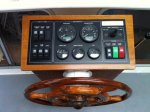
TWS - good thinking - because of the age of the boat and, with the exception of the new instrument panel at the upper helm (here's a photo), the wiring and systems are all original to the build, the batteries are not monitored at all. In fact, the only monitoring is the voltage gauge and amp gauge for the engine cranking battery on the instrument panel. Ultimately, at battery monitor is planned as part of a new distribution panel project.

The battery charger is an older type Victron Pallas 12/25 (http://www.victronenergy.com/Manuals/pallas/pallas 12-25/Pa03001e.PDF) - it take the 220V input, either from shore-power or the genny, to charge the domestic batteries only. The engine cranking battery is charged directly from the engine - that might have been ambiguous in my last posting - sorry! My understanding is that this charger does not treat more than one battery banks separately - but then, it is just charging one bank, the domestic bank. I will definitely check again for corrosion.

The amp hour of the new domestic batteries adequate cover the load demand from the domestic services - but again, without a battery monitor/ammeter installed the calculations are all theoretical - by the way of electric audit.

I personally installed and re-wired the upper helm instrument panel using fully tinned marine grade wire but I am unaware whether the genny wiring is marine grade for sure - despite specifically requesting this when it was installed by our marina. The genny is in situ one year now - is it likely the wiring could fail due to oxidisation in that period?

Upper Helm - Pedro 33.jpg
Very much appreciate the excellent advise and potential (pardon the pun!) problem points to check out.
 
Brian - haven't isolated the domestic batteries to check their ability to hold charge - will do.
.

If you turn of all equipment and measure battery voltage on the terminal posts, then isolate the batteries, check voltage again, i the voltage stays constant you have no major leakage, if the voltage goes up 0.1 / 0.2 you have something draining the battery.

Next turn on the battery charger, check terminal voltage, should be 13.0 / 26 volt - 14 / 28 volt plus, voltage should rise to the upper level, if it stays low end you are under charging.

Do same check with engine running, you should have the same range, discharge to a low level, then lowl charge will give sulphation and surface charge, which will give you a rapidly discharging battery.

Brian
 
Thanks Brian - that's a great algorithm - will do. Not fully clear what you mean in the last sentence - check terminal voltage at the battery terminal posts with the engine running and expect to get the 13 / 26 - 14 / 28 volt plus range? Then, discharge the batteries to low level? Could you explain that bit to me please - many thanks.
 
Top