
Electrical Slip-up - I’m in Disgrace!

Frayed Knot

Well-Known Member
Joined
3 Nov 2011
Messages
525
Location
Suffolk - Home and boat
Visit site
Although I’m far from being an electrical expert, I’ve always been quite proud of my wiring: I try to keep it neat, use tinned cable, properly supported, & good quality connectors & always err on the side of caution when choosing wire sizes. Unfortunately, it all counts for nothing if you miss tightening one of the screws…
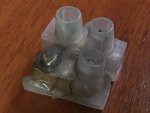
E65DA4E0-BF8E-4281-AF86-08EECE954BC4.jpeg
Fortunately, I spotted this this morning when doing a routine check around - it connected the 5amp B2B charger that serves the windlass/thruster batteries & has been in place for more than a year.
 
Choc block is not a good quality connector. Waco would be better, even twisted and soldered is better.
I do use choc block but both wires go under both screws, the twisted wire has to be filling the connector before tightening, doubling it back if necessary.
 
Choc block is not a good quality connector. Waco would be better, even twisted and soldered is better.
I do use choc block but both wires go under both screws, the twisted wire has to be filling the connector before tightening, doubling it back if necessary.
I use chock blocks- I hate Wagos- But I always put bootlace ferrules on the wires & before lightly crimping the ferrules on, I run a drop of solder through them. Then the screw has a solid piece of metal to clamp. There are no wires to push aside or cut as the screw is tightened. The plastic part does supply a degree of support for the wire as it exits the fitting
 
Last edited:
Yup, that happens.

Like "right on red returning" for boaters, electricians remember "clean and tight" for connections.
Choc block is not a good quality connector (No basis. Of course, quality varies.) . Waco (spelled Wago) would be better (No basis, and in fact, Wago does not meet the ABYC or UL pull-out strength requirements (look it up)), even twisted and soldered is better (Does not meet ABYC).
I do use choc block but both wires go under both screws, the twisted wire has to be filling the connector before tightening, doubling it back if necessary.
(Not in any manual I can find... and I just looked at several. In fact, it is PROHIBITED to put two wires under the same screw in a chock block. The impression is that you would know this.)/QUOTE]


Really? See above.

And the root cause was human error, which the OP openly shared.
 
Glad my shame has generated some interest. We all have preferences & prejudices but I don’t have a problem with choc blocks (obviously) inside the cabin & well above the bilges. I also use ferrules but to be honest I think soldering them is a little OTT.
I think the moral of the tale, apart from ensuring you’ve actually done the job properly, is that regular checking around is a sensible idea.
 
Glad my shame has generated some interest. We all have preferences & prejudices but I don’t have a problem with choc blocks (obviously) inside the cabin & well above the bilges. I also use ferrules but to be honest I think soldering them is a little OTT.
I think the moral of the tale, apart from ensuring you’ve actually done the job properly, is that regular checking around is a sensible idea.

Soldering the wire ends before insertion into chock blocks is forbidden by the code. The solder can soften when heat cycled, allowing the connection to loosen. Crimp-on ferrules are accepted. If stranded wire is used, the chock blocks must have integral pressure plates (if there is no palte, it is intended for solid wire--the screw makes a good grip, but it damamges stranded wire).
 
I'm using wago now on boat and at home. Just had a property rewired and the eletrican used wago rather than junction boxes.

... Wago connectors, like wire nuts, are only approved inside boxes. They look neat, but the pull-out strength is not there. Compare it to a good crimp and you will see (about 1/3 of standard and 1/4 actual performance). Boxes provide strain relief and protection.

I've used lots of Wago connectors, and they are connectors, not splices. Wires can pull out.
 
... Wago connectors, like wire nuts, are only approved inside boxes. They look neat, but the pull-out strength is not there. Compare it to a good crimp and you will see (about 1/3 of standard and 1/4 actual performance). Boxes provide strain relief and protection.

I've used lots of Wago connectors, and they are connectors, not splices. Wires can pull out.

My objection to Wago connectors is the size of the damned things. Very bulky items for the simple job of joining two cables.
 
Prefer circular crimps bolted together myself. You can attach great wodges of different sized cable reliably.
I'm probably a proper rebel with that one.

Spades seem to jam or come undone, screws in chock blocks always work loose where you can't see them and anything with solder is a faff.
 
Last edited:
... Wago connectors, like wire nuts, are only approved inside boxes. They look neat, but the pull-out strength is not there. Compare it to a good crimp and you will see (about 1/3 of standard and 1/4 actual performance). Boxes provide strain relief and protection.

I've used lots of Wago connectors, and they are connectors, not splices. Wires can pull out.

Wire nuts are not allowed here. Good job, they are horrible things.
 
Yup, that happens.

Like "right on red returning" for boaters, electricians remember "clean and tight" for connections.
But of course as you would know, the USA still uses Screwits, wire nuts, a damnably bad connector. UL standards? I consider them to be very poor.
I did not say 2 wires under one screw, rather that both wires from either end of the choc block should be under both screws.
 
Last edited:
Top