Electrical hell or boating life?

Just one piece of advice (which made de-bugging my NMEA plotter to autopilot connection a breeze) ...

.... whenever you re-wire a bit of your boat, draw yourself a circuit diagram of what you want to create before you start. It is very easy to get carried away and just build the system as you go along - try and avoid this as you will forget what you did 6 months down the line.

A diagram gives you something to check and think about, it also helps you visualise all the connections and makes calculating wire lengths, sizes, fuses etc. easier, and gives you a sound basis for ordering all the bits.

Follow the diagram during the install, and if you have to deviate from your plan, update the diagram.

Then store it somewhere safe for later reference.

It takes a bit of discipline, but the payback is well worth it.

I'm sure you probably do this anyway, but I am always tempted to just get on with it, promising myself I'll do the documentation later .... yeah right .... :cool:

PS: At the beginning of last season, I convinced myself that the plotter was no longer talking to the autopilot. I dismantled the instrument binnacle to trace through all the connections and couldn't find any faults .... depressed, I opened a beer and sat down to think .... then I realised that I'd had a mental blank, I had pressed the wrong button sequence on the plotter and autopilot - I looked up the process, tried it and everything worked. If I hadn't had an accurate wiring diagram to check the connections I would have wasted perhaps another day on the non-existent problem. :disgust:
 
I feel your pain!
I've become especially wary of tradesman recommendations from other boat owners (same thing with home owners for domestic work) - frequently it's for someone who's a complete cowboy. I don't understand why this is, I'm developing the theory that people like to feel in the know, and to be able to make recommendations, to appear knowledgeable. I had some work done on my boat by someone who's well-liked by fellow boaters, but who I won't let set foot on my boat again!

I inherited a mixed bag of boat electrics. One owner clearly knew his stuff, kept neat hand-drawn wiring diagrams, but at least one other was a total numpty. First year, I figured out what wire went where, made the electrics safe and functional. This year I'm rewiring the charging side with proper-sized cable and adding solar; next winter I may pull out all the rest and replace it.
 
I'm developing the theory that people like to feel in the know, and to be able to make recommendations, to appear knowledgeable. I had some work done on my boat by someone who's well-liked by fellow boaters, but who I won't let set foot on my boat again!

This is the exact same conclusion that we have come up with ......and no, they will never set foot on our boat either.
 
I have used someone from here and all I can say is that he found what was a very difficult electrical problem at a very reasonable rate and I will be using him again later this year.
So not all professionals should be grouped together.
 
Most boatowners have a wide ranging degree of practice skills to hand regardless of their actual social and career backgrounds. It has surprised me. I don't think boat ownership has taught them these skills, indeed its probably the chance to use such skills that leads to them owning a boat and indeed sailing. If it was easy, no one would do it. So in the main if you find yourself owner a boat, even if you have just taken on the challenge, youll probably be the best person to carry out most DIY. That said id really like my electrics checked over by our resident marine electrician. hed have a field day on my boat.

Steveeasy
 
I agree with you there. A basic wiring diagram even if done by someone like me with no great knowledge is in.
Just one piece of advice (which made de-bugging my NMEA plotter to autopilot connection a breeze) ...

.... whenever you re-wire a bit of your boat, draw yourself a circuit diagram of what you want to create before you start. It is very easy to get carried away and just build the system as you go along - try and avoid this as you will forget what you did 6 months down the line.

A diagram gives you something to check and think about, it also helps you visualise all the connections and makes calculating wire lengths, sizes, fuses etc. easier, and gives you a sound basis for ordering all the bits.

Follow the diagram during the install, and if you have to deviate from your plan, update the diagram.

Then store it somewhere safe for later reference.

It takes a bit of discipline, but the payback is well worth it.

I'm sure you probably do this anyway, but I am always tempted to just get on with it, promising myself I'll do the documentation later .... yeah right .... :cool:

PS: At the beginning of last season, I convinced myself that the plotter was no longer talking to the autopilot. I dismantled the instrument binnacle to trace through all the connections and couldn't find any faults .... depressed, I opened a beer and sat down to think .... then I realised that I'd had a mental blank, I had pressed the wrong button sequence on the plotter and autopilot - I looked up the process, tried it and everything worked. If I hadn't had an accurate wiring diagram to check the connections I would have wasted perhaps another day on the non-existent problem. :disgust:
 
I have used someone from here and all I can say is that he found what was a very difficult electrical problem at a very reasonable rate and I will be using him again later this year.
So not all professionals should be grouped together.
Agreed. Most professionals I've used have done a quick reasonably priced, competent job. I'm not one of these 'must do it yourself to get a proper job' types. Most tradesmen are good at what they do - that's how they stay in business. I've got more competent with time but know my limitations.
 
So much good advice!

No insult to the good boat sparkies on here, but sorting out problems with aged wiring is not a job for them. It's time-consuming, try this, try that stuff and they simply can't charge enough to make a living like that, so they have to rip it all out and start again, which may be what's needed, but often isn't.

Unless wiring is ancient and untinned (like much on my boat...) it's unlikely to be the problem, whatever the problem is; it's far more likely to be the connections and, especially, those to the bits and bobs that the owner before last fitted - a quick fix before the summer cruise that he was going to do properly when he had the time.

If I've got one recommendation, it's don't do a quick job to get it working; if you're anything like me and most of the people I know, you'll never go back to it until whatever vital bit of kit fails at the most inopportune moment.
 
Wasn't sailing so much simpler when one just had 3 lamps - one left, one right, and one at the back - to worry about. Just a supply of paraffin - or fish oil - and some wicks, and Bob's Yer Uncle.....
 
Attached is a very basic diagram. Please wait for others to say whether it is of any use or correct. I learnt from others on here and books and internet.
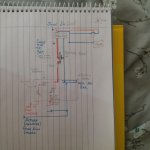
I would say try to start small (but have infrastructure to expand). E.g. start with the bare necessitates.
A circuit for the echo sounder, then the nav lights. A circuit to the cigar socket outlet(s) for your laptop charger firstly. For me, I would forget mast for now in your situation (but get an emergency aerial that can be held up high for the handheld vhf to extend range)
Laptop.
Echo.
Nav lights. Or forget nav lights and do interior lights if not sailing anywhere. Good luck.
 

Attachments

  • 20190515_173925.jpg
    20190515_173925.jpg
    392.4 KB · Views: 0
I won't lecture about electrics as I'm only a beginner.

What I have found out is that it's best to do as much as you can do yourself, then stretch and do a bit more, and ask for help on this forum or wherever and again do it yourself with friends. That's the best way of getting to know the boat and be able to fix stuff when it (invariably goes wrong). And learn about they way to do things, and the way not to because it all falls apart quickly.

It also seems to me that the marine trade is a bit of a "mare" with loads of bodgers, and people who never work to any timetable....So if you have to offload a job (maybe rigging or replacing an engine or making big holes in the deck) then ask around lots first.

good luck! it's worth it
 
Top
