Electrical crimps - your opinion on these, please.

Way too much bare metal showing. They may have been used on purpose to facilitate easy disconnection. I would have used bullet connectors. Already enough said about proper tools etc.

 
Another problem with any solder joint is that sooner or later you're going to have to disconnect it, by cutting the wire. OK if there is spare length, but if not it means introducing two new joints. 6mm spades actually seem pretty reliable to me, though I sometimes slide 8mm plain heatshrink over the whole pair of male/female connectors and half an inch of wire each side and shrink it on. Guarantees they won't pop undone and helps keep it dry, and you can always carefully slit it and peel off if you need to unplug.
 
Another problem with any solder joint is that sooner or later you're going to have to disconnect it, by cutting the wire. OK if there is spare length, but if not it means introducing two new joints. 6mm spades actually seem pretty reliable to me, though I sometimes slide 8mm plain heatshrink over the whole pair of male/female connectors and half an inch of wire each side and shrink it on. Guarantees they won't pop undone and helps keep it dry, and you can always carefully slit it and peel off if you need to unplug.

Hate insulated crimps, cannot check crimping for quality, also crimps in sea air can be subject to zinctivication and go brittle, you end up with two male connectors. Would prefer waterproof multiway connector, neat, dry and cable supported.

That said if it looks okay, clean and works why change.

Brian
 
Hello,

I was wondering the committee's thoughts on my new-to-me boat's electrics. My feelings are that they are above average for a 25-year-old boat, probably because it was with a single owner that whole time.

These connectors look a bit basic and DIY, but I don't see an immediate need to to renew them - I think it's the sheer number of spade connectors that make them look so ugly (to my eye at least), but surely these are up to the job?

XDl1QoS.jpg


dvC9sjF.jpg


fIkTLUY.jpg


iZ0pnUr.jpg

I'm inclined in future to use some of those connectors that heatshrink and solder in one. Assuming this proposal meets your approval, what should I heat them with? Gas-powered soldering iron?


Thanks in advance for any thoughts you might have.

If it works now, you keep it reasonably dry and it's not subject to much movement or vibration, I expect it will continue to work for a long time.

What are the consequences of it developing a fault? If it would prevent the engine working, then maybe improvement is a higher priority than if it's just going to affect your wind instrument or something.

It looks like a lot of multi-core cables in there, if you're going to do anything to it, there is a distinct possibility the job will escalate or you could make things worse instead of better. It would be annoying to get it really neat with permanent soldered joints, only to have to rip it apart due to say an instrument needing repair.

Generally, the best wiring looms simply do not have connectors or joints in the middle of bundles. However, it's a leisure boat not a Eurofighter.
 
Hate insulated crimps, cannot check crimping for quality, also crimps in sea air can be subject to zinctivication and go brittle, you end up with two male connectors. Would prefer waterproof multiway connector, neat, dry and cable supported.

That said if it looks okay, clean and works why change.

Brian

Yes they vary in quality enormously too and it’s hard to tell one from another. I won’t ever buy the non heat shrink ones, but I am a fan of those as stated above. They are semi transparent of course so you can check your crimp.
 
Yes they vary in quality enormously too and it’s hard to tell one from another. I won’t ever buy the non heat shrink ones, but I am a fan of those as stated above. They are semi transparent of course so you can check your crimp.

Brand names like AMP, TE etc, together with the right tool (and preferably the right technician) are very reliable.
 
Spade terminals shouldn't really be used as they have been in your situation, as already mentioned, too much (any is too much!) metal showing. Agreed, it looks a lot better than the majority of DIY attempts.

I guess if it ain't broke, don't fix it, but heat shrinkable butt terminals are good for things that do not need undoing. e.g. https://uk.rs-online.com/web/p/heat-shrink-cold-shrink-sleeves/4580702/ but available much cheaper elsewhere.
 
There are only two ways to make an electrical connection on a boat.
Using tinned wire of the appropriate size that has a cable number referring to a correct drawing, with an uninsulated crimp, soldered and then covered with glue lined heat shrink.
And the wrong way
 
There are only two ways to make an electrical connection on a boat.
Using tinned wire of the appropriate size that has a cable number referring to a correct drawing, with an uninsulated crimp, soldered and then covered with glue lined heat shrink.
And the wrong way

What a load or nonsense !!!!
 
There are only two ways to make an electrical connection on a boat.
Using tinned wire of the appropriate size that has a cable number referring to a correct drawing, with an uninsulated crimp, soldered and then covered with glue lined heat shrink.
And the wrong way

every single connection on my boat is blissfully and reliably wrong therefore.
 
Sadly most are and reliable until they go wrong

lets assume you are right and that adding solder to the joint doesn't actually make things worse as I believe it does.

Please explain how your method is any better than a glue impregnated, shrink wrap crimp. How is it mechanically stronger, or less likely to corrode/fail?

A crimp with the right tools is the work of seconds to crimp, and another 30 seconds or so to shrink. I have 100's of connections, many in inaccessible or awkward places.

So again, ignoring the fact that I think soldering makes things worse, why would you do something that is more of a fiddle and takes longer when it isn't actually any better?

If you think it's actually better with solder, fine. Each to their own.
 
Sadly most are and reliable until they go wrong

incidentally, do you solder the 100A+ connections to things like batteries, starters, inverters, thrusters and windlasses? I use 95 or 120 sq mm cable for these.

I use bare crimps (with a giant crimp tool) and separate, glue impregnated shrink wrap for these.

How do you heat it enough to get the solder to melt, and what benefit do you get from it?
 
So why would that be?

Everything about your post was just wrong. For instance, why on Earth would you use a crimp connector and then solder it ? If the crimp is done correctly, soldering is a complete waste of time, the solder cannot get into the joint, it just goes over it.

It's a pointless waste of time using uninsulated terminals and then insulating them with heat shrink. Normal, good quality, insulated terminals are perfectly secure. If the connection is in an area where it needs to be especially waterproof, glue lined, heat shrink crimps are the way to go.
 
Everything about your post was just wrong. For instance, why on Earth would you use a crimp connector and then solder it ? If the crimp is done correctly, soldering is a complete waste of time, the solder cannot get into the joint, it just goes over it.

It's a pointless waste of time using uninsulated terminals and then insulating them with heat shrink. Normal, good quality, insulated terminals are perfectly secure. If the connection is in an area where it needs to be especially waterproof, glue lined, heat shrink crimps are the way to go.

I think, to be fair, Rocksteadee's method is OK for amateur use.

Why would you solder a crimp?
Because you don't have the skills/tools/parts to crimp it properly.
So you squeeze it on to the cable so it stays in place, then solder it.
It's not great, but it works and you can do it with a market stall crimp tool and whatever terminals are in the spares box.

Crimping is great if you've got the right tools. Crimping by unskilled yacht owners is often dire.
The big problem is that a lot of them have special talents in bad soldering too.


In the unlikely event that someone makes a good crimp joint and tries to solder it, the solder will not run through the crimp and up the wire, because a good crimp has no air spaces running through it which are big enough for solder to run through, liquid solder has surface tension, it needs a certain range of gaps to work.
 
There are only two ways to make an electrical connection on a boat.
Using tinned wire of the appropriate size that has a cable number referring to a correct drawing, with an uninsulated crimp, soldered and then covered with glue lined heat shrink.
And the wrong way

Here is what NASA has to say ....

7.2.26 The following requirements apply for crimped connections.
a. Crimped contacts shall be used with stranded wire only.
b. Solid wire shall not be used with crimped contacts.
c. Solid, tinned wire shall not be used in crimped contacts.

13.3 Assembly of Solder-Type Connectors
13.3.1 Wire shall be bent only in flexible, unwicked parts of the conductor to maintain stress
relief for solder dipped conductors. In all instances, stranded conductors will experience solderwicking during attachment. The conductor will be rigid up to the point where the wicking stops
and flexible beyond it. Wire movement concentrates stress at the point where wicking stops and
normal harness handling can produce conductor fatigue and failure.

13.3.2 Solid conductors shall be assembled in contacts by soldering, and cleaned and inspected
in accordance with the latest revision of IPC J-STD-001FS.
13.3.3 Contact mating surfaces and solder joints shall be cleaned to remove flux residue
following the soldering operation.

Note: CAUTION: WHERE SOLDER CONTACTS HAVE FLOAT, FLUX MAY RUN
DOWN ONTO THE MATING SURFACE OF THE CONTACT DURING SOLDERING
AND CAUSE INTERMITTENT AND OPEN CIRCUITS.
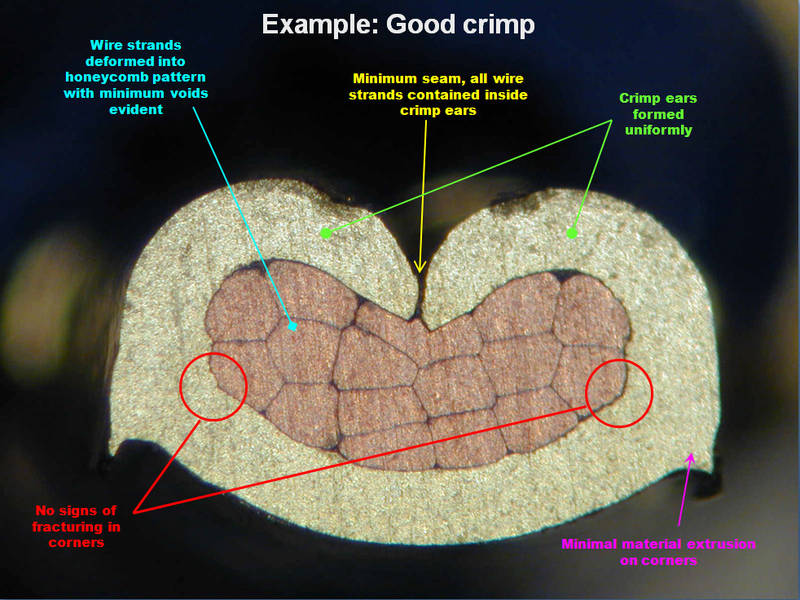
Assuming the crimp connection is done correctly with the correct tool for the connector then the conductor and the connector will be permanently mechanically and electrically connected.

When then applying solder, iIt is more likely that the use of heat and solder will leave flux residue, deposit solder only on the outside of the connection, possibly damaging or hardening the insulator and/or wicking up the wires at the rear of the connection creating a potential fracture point where the wicking stops.

Subsequent temperature cycling will also stress the solder connection because, while crimp connections remain secure when temperature cycled, solder joints are prone to fatigue.

https://standards.nasa.gov/standard/nasa/nasa-std-87394

e81fd2e62a.jpg


Solderless Makes Sense

We tend to think of soldered joints as the king of electrical connections. Something about the act of heating up a joint and flowing molten solder into it lends a feeling of permanence and quality to the finished product. And soldering was basically the only show in town for the early days of the commercial electronics industry.

But soldered joints have their problems, both electromechanically and in terms of production – after all, an assembly worker can only sling solder around so fast. In the early 1950s, AMP Corporation came out with the first crimp connections for production use, the F-Crimp or open-barrel design. Using this crimping design, AMP sold a wide range of connectors that could be rapidly and repeatably applied to conductors, and that lent themselves to automated fabrication methods in a way that soldering would never be able to achieve.

Squeeze Play

Crimping takes advantage of the properties of metals to achieve electrically and mechanically sound connections. Metals used in crimp connectors, like copper, brass, aluminum, or bronze, are both ductile and malleable. A metal’s ductility is the degree to which it can deform under tension, while malleability is a measure of how metal deforms under compression. Crimping involves applying significant compressive forces onto the crimp connector and the wire, so the malleability of each element is an important factor in crimp quality. But ductility plays a role too as both connector and wire undergo significant stretching during the crimping process. .......

Read the rest here ...

https://hackaday.com/2017/02/09/good-in-a-pinch-the-physics-of-crimped-connections/

My opinion, a properly executed crimp needs no solder and heating it all up, smearing it with solder and flux is likely to do more damage than good.
 
I think, to be fair, Rocksteadee's method is OK for amateur use.

Sorry, but i strongly disagree. He said his way was the only correct way, all others are wrong. That is absolutely incorrect, his was is most definitely not correct.

Quality insulated crimps cost peanuts and a reasonable crimping tool is only a few quid.
 
Right then,
My original post, one way and the wrong way, was said somewhat tongue in cheek.

However:-
Correct size cables: sized correctly for the current taken, too small and can melt and set light to the insulation and burn your boat down;
Too small to allow for volt drop for length of run and at load will not supply voltage, had a vhf supplied by too small a cable, it would receive but cut out when trying to transmit;
Too small for connector and it may not even crimp;
Too large and wastes money, may not fit in trunking.

Unnumbered: (not colour coded): don’t know if it is the correct cable, where it runs to and from.

Correct drawings: try working with an unmodified drawing or even worse no drawing at all.

Tinned cable: more expensive but worth every penny, a high humidity environment with salt will tarnish conductors for yards, this tarnish (dark red to black) is an insulator and will not allow solder to take.

Uninsulated crimp: you cannot see through an insulated crimp (some you can) but I am talking about the standard automotive red blue and yellow, has the joint made? are all strands crimped? was the insulation stripped sufficiently?
Cannot then be soldered;
Expensive ratchet crimpers required;
Difficult to crimp in confined spaces;
Often the wrong size is used;
The insulation can sometimes take up too much room, eg wiring onto a multi connection fuse box;
Does not provide the strongest mechanical joint if cable is too small (0.5 cable into a red 1.0 connector).

Uninsulated connector: the joint can be seen;
Can be the strongest joint, provided correct tool is used;
Does need subsequent insulation

Soldered: there are differing opinions on this.
It does provide an electrically sound joint if in a high humidity area and using untined cable (many original installation are);
Can be difficult if not experienced at soldering;
Impractical on large battery cables due to large amount of heat required;
Can be difficult to hold solder, soldering iron, joint and cable at the same time;
Flux can be corrosive;
Does give a ridged interface where solder has stopped tracking but then so does an unsoldered joint to connector;
Can damage insulation;
Should not be relied on alone for mechanical security;
If connecting a tarnished cable I will clean it up with fine emery and solder after crimp as I cannot guarantee future good conductivity;

I have had a crimped joint fully covered in glue lined heat shrink give a high resistance fault as water had tracked past the glue and corroded the crimp connector, if the joint was soldered it would not have corroded. The cause was 1. Frequent moisture as it was below an area where water skiers came back onboard and were still draining off.
2. Insufficient restraint, clips etc to give mechanical support and isolate movement and vibration, as there was no where to get an adjacent clip

Heatshrink solder joints: these are lengths of heatshrink with a small slug of solder; bare the wires slide then in and heat with gun, they work but only if you have newish cables; solder has lower melting point so is not so mechanically strong;
Not so practice to disassemble;
Heatshrink glue is not sufficient due to heating incompatibility with solder;
Ideal to use where submersion is likely eg sump bilge pump

Glue lined heatshrink: will provide a water tight joint with some mechanical security (don’t rely on this alone);
If using a two part connector eg spade and receptacle for removable parts the heat shrink can be utilised over the whole joint if water ingress is likely to occur. Can be a faff to cut it off if joint needs to be separated;
A decent hot air gun is preferable as a naked flame can burn the heat shrink.

So which bit of that is nonsense?
Or incorrect?


Glue lined heatshrink crimps:
It would seem to be the preferred method but is it the best?
The crimping process can damage the heatshrink as this is quite a soft plastic for its shrinking properties and crimping thus thins the glue and plastic.
An unsoldered joint can still corrode, (see above).
Having said that I still use them as soldering is not always necessary or practical
 
Top