Electric Motor Conversion

big_s

Active Member
Joined
17 Dec 2021
Messages
49
Visit site
Hi all,
I am trying to create a new wiring system for an electric conversion for a small yacht that supports shore power charging and solar charging. The motor battery bank is 48V and the house 12V. Shore side AC is taken care of with a Victron Multiplus 48V unit (to be discussed later). I want to keep the system as simple and cheap as possible, so not using loads of Victron goodies!
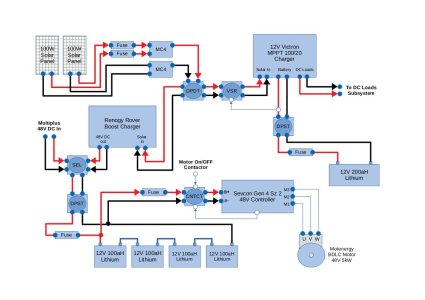
Here is a first draft of the system:
charge_drive_system.jpg
The blocks that show a circle inside a square are my representation of various switching types; double pole single throw, double pole double throw, voltage sensitive relay, input selector, contactor.

The solar power can be directed to either the motor side or the house side of the system using a DPDT switch.

If directed towards the house side, a VSR initially detects that the house battery is connected to the Victron charge controller before allowing solar power through. The house battery is fused close to the battery and has an isolator switch.

If directed towards the motor side of the system, the solar power feeds into the Renogy Rover boost charger which outputs 48V. A switch then selects between the 48V output of the boost charger or the 48V output of a Victron Multiplus (probably 800VA) and passes this to the motor battery bank. The motor battery bank can be isolated from charging inputs using a DPST isolator switch.

The motor system connects directly to the motor battery bank. It is fused and has an isolation contactor (key operated) to isolate the motor subsystem from the motor battery bank.

I would like to support charging of the house battery from shore power but not sure how that would integrate neatly and cheaply into this draft setup. Any suggestions appreciated.

Anyone out there got any initial comments? Trying to get as close to ISO compliance as possible eventually, so any tips in that direction also well received.
Many thanks,
S
 
Last edited:
So what sort of range do you expect to get under power from that setup?
Am I right in thinking you have a theoretical max 4.8kWh battery pack (if used in theory from 100% to 0%)? So effective safe usage perhaps 3kWh to allow a bit of margin?
Also, check with your proposed insurers at an early stage - some reports of insurers being very reluctant to insure after DIY installations of electric propulsion, or even sometimes just batteries (if that is what you intend).
 
So what sort of range do you expect to get under power from that setup?
Am I right in thinking you have a theoretical max 4.8kWh battery pack (if used in theory from 100% to 0%)? So effective safe usage perhaps 3kWh to allow a bit of margin?
Also, check with your proposed insurers at an early stage - some reports of insurers being very reluctant to insure after DIY installations of electric propulsion, or even sometimes just batteries (if that is what you intend).
Hi Dunedin.

Those questions have already been addressed, but to answer your query, not a great distance. Knowingly. Already addressed the build with my insurer too.

You got any thoughts on the schematic?

Cheers.
 
Is there a particular reason to switch all your grounds? This seems like it just adds cost and complexity.

The Multiplus is an inverter/charger, do you actually need the inverter functionality?

When I did my conversion I decided that connecting the 48V and 12V systems was too complex, so I have them entirely separate.
 
Is there a particular reason to switch all your grounds? This seems like it just adds cost and complexity.

The Multiplus is an inverter/charger, do you actually need the inverter functionality?

When I did my conversion I decided that connecting the 48V and 12V systems was too complex, so I have them entirely separate.
Hi,
I believe it is best practice to switch pos and neg on battery banks and the solar power. Please correct me if I am wrong.
I cant find a 48V charger from a reputable manufacturer at a price lower than the Multiplus. I dont need the inverter functionality, its just a nice consequence of this device. If you know of one then please let me know.
Separating out the 48V from the 12V systems only seems feasible if you dont want to use a single solar system to charge both battery banks? What was your solution here?
Thanks.
 
Hi,
I believe it is best practice to switch pos and neg on battery banks and the solar power. Please correct me if I am wrong.

Where did you get this from? I followed the instructions on my 400W Solar install and no mention of switching both pos and neg in those.

My three yachts have never had dual pole switching either.

Confused of Littlehampton...............................
 
Where did you get this from? I followed the instructions on my 400W Solar install and no mention of switching both pos and neg in those.

My three yachts have never had dual pole switching either.

Confused of Littlehampton...............................
Here is just one of many examples I have found. This is on the Victron site...

solar double pole switch

This example uses a double pole breaker/isolator MCB but similar to separate fuse and double pole switch.
 
To charge the 12v battery system from mains probably simplest to buy a charger and have it connected to the mains input. Assuming lithium battery has it's buillt in charge controller.
If you have not bought the Renogy boost charger and solar panels then far cheaper to buy domestic style 40v panels 2 in series to a 48v MPPT controller for much better efficiency. It may be practical to switch this arrangement to charge 12v lithium but better still depending on space fit additional panels dedicated to 12v system. ol'will
 
Thanks Will.
To charge the 12v battery system from mains probably simplest to buy a charger and have it connected to the mains input. Assuming lithium battery has it's buillt in charge controller.
If you have not bought the Renogy boost charger and solar panels then far cheaper to buy domestic style 40v panels 2 in series to a 48v MPPT controller for much better efficiency. It may be practical to switch this arrangement to charge 12v lithium but better still depending on space fit additional panels dedicated to 12v system. ol'will
I will add use of a victron Blue Smart charger to the system. Will go for 5A so don't trip those shore power outlets limited to 6A.
Unfortunately boost charger and panels already purchased.
S
 
Is there a particular reason to switch all your grounds? This seems like it just adds cost and complexity.

The Multiplus is an inverter/charger, do you actually need the inverter functionality?

When I did my conversion I decided that connecting the 48V and 12V systems was too complex, so I have them entirely separate.

Just thought I would follow this up with a more solid response to the query regarding switching grounds.

The double pole switching of +ve and -ve is only a requirement for an isolated DC system, i.e. one that does not have an earth to external water. In an earthed DC system, only the +ve cables need to be switched.

My system will be earthed and so the initial diagram can be simplified accordingly. DC main negative busbar and AC earth busbar will both be connected to earth via the propeller shaft. This supports earthing of the DC system as well as the AC system driving the multiplus and the onboard generator. (The AC system will also incorporate a galvanic isolator and an RCD/MCBs on the incoming shore AC power).

Cheers,

S
 
Last edited:
Just thought I would follow this up with a more solid response to the query regarding switching grounds.

The double pole switching of +ve and -ve is only a requirement for an isolated DC system, i.e. one that does not have an earth to external water. In an earthed DC system, only the +ve cables need to be switched.

My system will be earthed and so the initial diagram can be simplified accordingly. DC main negative busbar and AC earth busbar will both be connected to earth via the propeller shaft. This supports earthing of the DC system as well as the AC system driving the multiplus and the onboard generator. (The AC system will also incorporate a galvanic isolator and an RCD/MCBs on the incoming shore AC power).

Cheers,

S
You need an RCD/MCB on the incoming shore power, plus you also need one on the inverter output and one on the generator output. I would use RCBOs. You then need appropriate MCBs for individual circuits.
 
Reading the victron documentation about smart solar controllers, it seems that the PV can be connected before a battery as this is necessary to allow setting the battery parameters before battery connection. This implies that the VSR for the 12v house battery may be unnecessary and the victron controller will operate correctly regardless of previous switch position of 12v battery and PV.

Has anyone else done this and can confirm?
 
Separating out the 48V from the 12V systems only seems feasible if you dont want to use a single solar system to charge both battery banks? What was your solution here?
I just have a couple of small motorbike batteries as domestic batteries and take them ashore if they need charging! For long trips this wouldn't work of course
 
Reading the victron documentation about smart solar controllers, it seems that the PV can be connected before a battery as this is necessary to allow setting the battery parameters before battery connection. This implies that the VSR for the 12v house battery may be unnecessary and the victron controller will operate correctly regardless of previous switch position of 12v battery and PV.

Has anyone else done this and can confirm?
You would normally connect the batteries first. You can disconnect the PV array and the controller will remember it's settings when reconnected. So i can't see any point of fitting the VSR.

I would connect the controller straight to the battery, omitting the switch but keeping the fuse. Then connect the DC loads to the battery, with a fuse close to the battery and a single pole isolator switch. This way you can isolate the loads, but leave the solar panels charging the domestics, if you want to. A 10-20A 12V charger will keep the domestic battery charged when on shore power.

For the Multiplus, look at the Multiplus 2, usually much cheaper and has the same features.
 
You would normally connect the batteries first. You can disconnect the PV array and the controller will remember it's settings when reconnected. So i can't see any point of fitting the VSR.

I would connect the controller straight to the battery, omitting the switch but keeping the fuse. Then connect the DC loads to the battery, with a fuse close to the battery and a single pole isolator switch. This way you can isolate the loads, but leave the solar panels charging the domestics, if you want to. A 10-20A 12V charger will keep the domestic battery charged when on shore power.

For the Multiplus, look at the Multiplus 2, usually much cheaper and has the same features.
Thanks, sound idea. VSR removed and isolator placed on DC load side rather than between controller and battery.
 
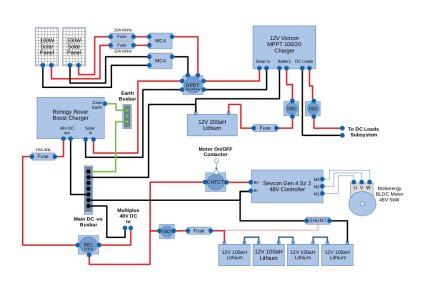
Taking onboard feeback received so far I have modified the original by simplifying ground switching, introducing a negative busbar, introducing an earth busbar (which will be connected to the propeller shaft and thus to external earth), and amending some use of the isolators.

The DC loads from the victron charger are now isolatable from the charger as is the house battery. The victron charger can monitor loads and isolate or it can be done manually.

The Renogy boost charger output is effectively isolated by the on-off-on PV switch at the input and also by the 1-off-2 selector at the output. This may be better simplified to a simple 1-2 selector?

The 48v battery bank is fused and isolated from all input and outputs. The sevcon controller can additionally be fused at the controller housing using an ANL fuse on the dummy b+ terminal.

I would really appreciate any thoughts folk have on this update, especially with respect to fusing, switching and earthing.

Many thanks all.

charge_drive_system.jpg
 
Last edited:
Thanks, sound idea. VSR removed and isolator placed on DC load side rather than between controller and battery.
That's not how your latest schematic shows it.

Looking at that schematic;

1) Remove the isolator between the solar controller and the battery.
2) Disconnect the two load wires from the controller and move them to the fuse, keeping the switch.

This differs slightly from my suggestion in post #15, but saves a fuse. Use the same size cable from the battery to the fuse, from the fuse to the controller and from the fuse to the DC distribution board, rate the fuse for the cable, using a T class or NH fuse.
 
Top