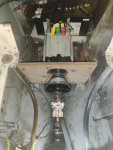
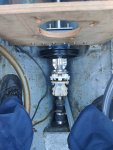
Electric inboard belt driven drive bearing

weliwarmer

New Member
Joined
21 Nov 2019
Messages
20
Visit site
Hey,
I'm replacing my 50-year-old marine diesel with an inboard electric motor and need some advice with the thrust bearing please.

My design is based on a couple of other electric installations that I've see, including this one:
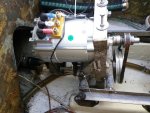
e6ea51e77666870caddfcf7028c8f8e3.jpg

My propeller shaft will come through the cutlass and onto a bearing - that was not a problem with the diesel because it took the thrust but with the electric motor now driving the shaft via a belt, the shaft moves back and forth with the force from the prop. I don't want to have the cutlass bearing take the force or the current bearing, which is not suitable for axial loads.

I don't want to go the aquadrive way and pay £££ for this part so....

I would think that the normal ballbearing bearings would not be suitable for the axial load but that's only me guessing. Anyone know different?

The thrust should be about 100kg) - would the grub screws that seem to be fitted to most bearings/collars be enough or would the bearings/collars need welding to the shaft?

Thanks, Tim
 
Tim, what was your final solution to this? I'm starting a similar conversion and would be interested to hear of your experiences converting yours.
Cheers,
Shaun
 
The end thrust needs to be taken by either taper roller bearing or thrust races. Either way you need two to take thust both forward and astern. If you still have the gearbox from the diesel engine can you use that to take the thrust? Another idea is to look at car front or rear hubs. If you were to bolt a car wheel hub to a cross member and use the wheel bolts to fit to the prop shaft flange you might get a good thrust set uo for the cost of a bit of time at your local car dismantlers searching for a suitable one, and a few beer tokens. They are not hugely expensive new. Rear Left or Right Wheel Bearing Hub Fits Ford Mondeo ST220 Jaguar X-Type 2.0 D | eBay
Car wheel bearings have to take the side thrust from cornering forces, which are substantial in a heavy car, and hubs usually contain a pair of opposed taper roller races, or deep groove ball bearings. Its the former you really want.
 
You could use either a Python or Halyard thrust bearing, with or without the CV joint.
Thrust Bearing for P60K Python 1-1/2" | Midland Chandlers
Moduline B10 Series
Expensive, but designed to do the job.
I've used these on two boats I've owned, they are fit and forget. The current one has been in service for 10 years now, I occasionally look at it to see if it's still there, and that's the total maintenance its had.
 
Last edited:
Tim, what was your final solution to this? I'm starting a similar conversion and would be interested to hear of your experiences converting yours.
Cheers,
Shaun

Hi Shaun,

I ended up using two thrust bearings and two load bearings. It works but it's not ideal because it's difficult to align. The I've now run the motor for ~15 hours and it's great, I wouldn't go back to a diesel for day sailing but next time I would...
- use a smaller motor, the 7.5kw drives my 23 foot boat at 4knots using 24v and only 25% throttle. 4.5kw would probably be ok
- mount the motor the other way around so the belt can be changed more easily
- not bother with 48v because it's difficult to charge, sparks and covert to/from 12 or 24v
- use a higher gear/pulley ratio so the the regenerative breaking charges the batteries (currently it does not spin fast enough while sailing)

Other points of note:
- The solar panels charge from 20% to 80% in about 3 summer days but don't charge it at all in the the deep winter months.
- Charging from shore power from 20% to 80% takes about 11 hours.
- The motor has so much torque that I'm a little worried about someone applying full throttle. It's currently limited by software but it's still very powerful.
- This model of motor is splash proof - I'd never get one of the brushless motors that are exposed since they would probably only last 10 minutes
- at ave 3.7 knots, 80% to 20% battery is about 4 hours - the batteries are 2 LifoPo4 24v in parallel

I hope that helps and good luck with your project. If you are up in Edinburgh, let me know and I'll show you this motor running.

Tim
 

Attachments

  • IMG_20210918_200327.jpg
    IMG_20210918_200327.jpg
    744.9 KB · Views: 54
  • IMG_20210918_173605.jpg
    IMG_20210918_173605.jpg
    713.9 KB · Views: 49
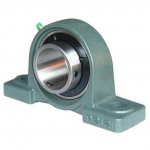
Standard plummer block or flange bearing bolted to a cross member like the Aquadrive used will do the job. They are designed for axial loading. You don't need the rubber spacers that the Aquadrive used though. The grub screws will take the load if you drill into the shaft where they sit.

1646297781827.png
 
Standard plummer block or flange bearing bolted to a cross member like the Aquadrive used will do the job. They are designed for axial loading. You don't need the rubber spacers that the Aquadrive used though. The grub screws will take the load if you drill into the shaft where they sit.

View attachment 131173
Note that these plummer blocks are also available with axial float, so are self aligning
 
Hi Shaun,

I ended up using two thrust bearings and two load bearings. It works but it's not ideal because it's difficult to align. The I've now run the motor for ~15 hours and it's great, I wouldn't go back to a diesel for day sailing but next time I would...
- use a smaller motor, the 7.5kw drives my 23 foot boat at 4knots using 24v and only 25% throttle. 4.5kw would probably be ok
- mount the motor the other way around so the belt can be changed more easily
- not bother with 48v because it's difficult to charge, sparks and covert to/from 12 or 24v
- use a higher gear/pulley ratio so the the regenerative breaking charges the batteries (currently it does not spin fast enough while sailing)

Other points of note:
- The solar panels charge from 20% to 80% in about 3 summer days but don't charge it at all in the the deep winter months.
- Charging from shore power from 20% to 80% takes about 11 hours.
- The motor has so much torque that I'm a little worried about someone applying full throttle. It's currently limited by software but it's still very powerful.
- This model of motor is splash proof - I'd never get one of the brushless motors that are exposed since they would probably only last 10 minutes
- at ave 3.7 knots, 80% to 20% battery is about 4 hours - the batteries are 2 LifoPo4 24v in parallel

I hope that helps and good luck with your project. If you are up in Edinburgh, let me know and I'll show you this motor running.

Tim
Many thanks for all the info Tim, very informative.

I've been looking at using a 5kW motor for my 26ft boat but not sure how to choose a specific motor - there seem to be so many variables - voltage, current, torque,max power, rpm, etc! How did you decide on yours? Thinking maybe 4 x 12v in series to rduce current going to motor. 4 x 100aH lithium would be ideal but that would cost more than my boat did!

Also struggling to see how a victron style solar charge controller (love the bluetooth) can charge 48V battery bank and have the motor as a load due to high current requirements. My guess is that the solar charge controller would just charge and then the motor controller (sevcon or similar) would be responsible for load current control?

Did you buy or make a throttle? I'm thinking of going the Arduino route as the throttles I have seen for sale online look to be nothing more than a fancy 5k pot and cost a fortune.

Not sure what bearings this system uses but it looks nice - just too pricey for me - <LINK>. Interestingly, they also use 'open' brushless motors.

Any thoughts much appreciated.
Cheers,
S.
 
Last edited:
Standard plummer block or flange bearing bolted to a cross member like the Aquadrive used will do the job. They are designed for axial loading. You don't need the rubber spacers that the Aquadrive used though. The grub screws will take the load if you drill into the shaft where they sit.

View attachment 131173

Agreed. I once coupled up a 40hp inboard petrol engine to the shaft using a plummer block to take thrust. It worked fine for the few years I had the boat.
 
Top