EGT temps on idle and with no load-gbox not engaged?

vas

Well-Known Member
Joined
21 Jun 2011
Messages
8,200
Location
Volos-Athens
Visit site
evening all,

another question that easily fits on the subject line :D
So managed to fit my stbrd engine custom NMEA2000 box that does a few measurements and dumps them in the N2K bus only to find that EGT is 80-90C on idle, is that okay or too low?
EGT probe is around 200mm after the turbo outlet flange on the "hot" gasses only part of the elbow as it goes up before turning back down and mix with the seawater.
I'm stuck in port, port engine heat exchangers about to be taken out for cleaning, so no way of doing a proper test.

Value is digitally calculated with the MAX31855 board integrated in my box, so not an issue of accuracy of the value reported, mainly wanting to compare with what others see. No doubt that will go up to over 200C once moving, just want to confirm that others see 100C only after revs go up to 1000 or so on idle.

cheers

V.
 
can't tell you vas, In have EGT sensors and display's still in its box, and still need to be installed (if I find someone todo that, and don't have other priority's)
I can test when next onboard,
but others who have EGT sensors and display's in place can give better advice
where is the EGT specialist ;-)
also I'm not sure if my engines are any reference to yours..
 
vas;6747490 No doubt that will go up to over 200C once moving said:
BartW;6748114 but others who have EGT sensors and display's in place can give better advice where is the EGT specialist ;-) [/QUOTE said:
:)

Feels bang on Vas
65424806-F585-4F8A-A94E-BAE747008AC3.jpg
Tick over in N.

09E74E8A-DEE8-4FDB-9977-20713B7B5DEA.jpg
D speed just at or behind pushing a bow wave .So it’s got some load pushing the boat .

340FDFEB-1E24-4C7B-8F15-30F6823FF1FC.jpg
View attachment 76938
Cruise .

It almost instantaneous the movement with load .
Goes up with fouling .

They say 550 - 630 ish is good for a proper burn and best agglomeration minimisation .
As you can see 580 for near 30 knots hopefully is diet of longevity and low bills for me .
But each to there own on that - nice to know imho than run blindfold because “ it went that fast at Easter “

North of 650 for long periods they say the exhaust valve ( hottest of the pairs ) start to distort / mushroom .
It’s insidious you don,t really notice on the day(s) but eventually the valve don’t quite close as they should and there’s premature power loss over natural aging .
That heat has to be evacuated form the cylinder so the oil temps rise too and extra stress on the lub and rings dealing with it .

Water Heat exchange jacket temp which we all have hardly moves from 900 to 1800 rpm - steady 85/86 .
However it drops to 82 at tickover .
So to be clear looking at the jacket water temp is useless to indicate what’s happening in the cylinders.
 
Last edited:
Bear in mind the temperature shown will be influenced by the placement of the sensor. Aircraft have them for leaning but the actual temperature is pretty much irrelevant as all you look for is running ( usually) rich of peak. You don’t have a mixture adjustment on a boat so your temp will be your own reference. If it was factory fitted and they hence knew where the sensor was they could then state temps for that installation ( no idea if anyone does)
 
can't tell you vas, In have EGT sensors and display's still in its box, and still need to be installed (if I find someone todo that, and don't have other priority's)
I can test when next onboard,
but others who have EGT sensors and display's in place can give better advice
where is the EGT specialist ;-)
also I'm not sure if my engines are any reference to yours..

all diesels should be more or less the same Bart, placement of sensors is crucial though!
I'd up it in the to-do list of jobs tbh...

:)

Feels bang on Vas
View attachment 76935
Tick over in N.

View attachment 76936
D speed just at or behind pushing a bow wave .So it’s got some load pushing the boat .

View attachment 76937
View attachment 76938
Cruise .

It almost instantaneous the movement with load .
Goes up with fouling .

Thanks Porto, do you happen to know where the thermistors are placed? in the exhaust manifold, just before the turbo, or on the riser after the turbo? That should count for 50+C difference I recon!

Vehicle wise my td5 Landrover is around 100 to 130 on idle PRE turbo I can't imagine deisels vary much on idle regardless of brand?

Steve
True Steve, yours is where the sensors should really be, just not easy to do it as a retrofit and not too keen to drill holes there as if I'd bugger anything I'd have to remove the whole manifold to remedy...

Bear in mind the temperature shown will be influenced by the placement of the sensor. Aircraft have them for leaning but the actual temperature is pretty much irrelevant as all you look for is running ( usually) rich of peak. You don’t have a mixture adjustment on a boat so your temp will be your own reference. If it was factory fitted and they hence knew where the sensor was they could then state temps for that installation ( no idea if anyone does)
Jeremy,

you're talking about petrol and not diesel engines where stoichometric (sp?) value of CO (or is it CO2?) in the gasses is an indication of the quality of burn thus exhaust temps, you get it wrong you get a whole in a piston and a plane in that case crashing down (probably...) It's long since my time reverse engineering 90s ECUs and pushing petrol motors. My 2lt 4cyl 16V integralle engine pushing 330whp has all that and a pyrometer and AFR meter combo and that's how I used to drive it at WOT, on diesels you just want to make sure EGTs are where they should be, hence the question in the first place.

Anyway minor issue is that the NMEA2000 sentence dealing with EGTs is flawed and can report up to 283C (then it goes - and slowly ups again...) so need to get it reported somewhere else and not on the Maretron that JFM kindly donated...
On the plus side, just moving about at 7-8kn I should be under the 280C and I'll be fine :D

cheers

V.
 
No EGT sensors on my engines. They are indeed in the wish list, but with a relatively low priority.
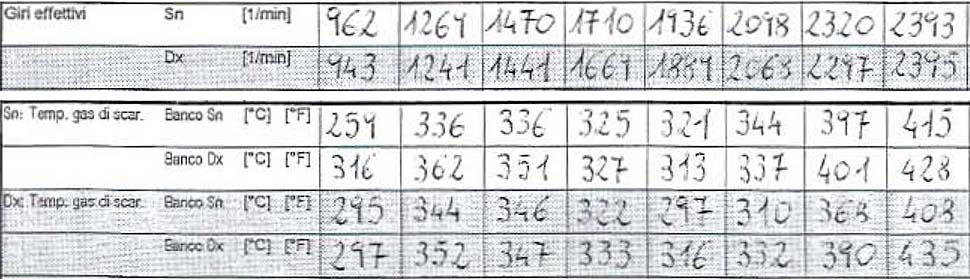
Otoh, below is an abstract from the initial sea trial, with the numbers you are interested in.
Except idle, sorry - since that's not even included in the engine manufacturer's scheme, I suppose it's considered irrelevant.
Btw, I have it on good authority that they were measured (together with about two dozens of other parameters) with a large set of workshop calibrated instruments, that took the MAN official dealer hours just to connect them all, before actually going at sea. So, I suppose it's safe to assume that they were pretty accurate.
I'm not 100% sure about the position where he fitted the probes, but there's a specific provision for it right after each turbo (obviously still in the dry section of the exhaust), so I'd be surprised if it weren't the setup actually used for the test.
For further reference, the seatrial was made with full load of fuel and water - though obviously with a clean bottom.
dOSp6bZL_o.jpg
 
@ MapisM after the turbo takes a slug of heat out approx 200 degrees plus or minus - could be 10 or 20 % who knows .Making your WOT or thereabouts nudging or even exceeding 650 degree like for like .
But ballpark 200 seems about right and inline with my numbers .Fits .

Using that means yours are the same as mine at those rpms over turbo spooling say over 1600 rpm .
My MAN elbows have post turbo inspection threads too , I think they all have helpfully, about 8or 9 ,or 10 mm bolt .A good place to insert a probe or camera .

@ Vas reply to the location q On my engines the sensors are not on the individual manifolds which are in a water jacket .Its in the pipe immediately before the turbo where 6 goes into 1 .
The 6 mini elbows from the exhaust ports are 90 degree bends connecting to each other and covered in a large water jacket ( close liquid cooling side ) , then one larger collector pipe goes to the turbo .
I think this pipe is water cooled from the closed circuit too as is the turbo casing .
As said the gas temp probe samples the gas temp .

The jacket closed cooling temp is basically a constant 84/86 ( depends on the season ) .A normal seawater heat exchanger maintains that .
 
Top