EGT internal or external ?

simonfraser

Well-Known Member
Joined
13 Mar 2004
Messages
7,613
Location
Outboards 4 mobo’s, unless you do a lot of miles
Visit site

Attachments

  • Turbo Temp internal external.JPG
    Turbo Temp internal external.JPG
    265.6 KB · Views: 0
obviously internal gives a faster response, external easier to set up
more accurate ? hm, depends if you want an immediate Temp or more of an average measurement i recon

found this paper
https://spiral.imperial.ac.uk/bitstream/10044/1/14305/2/Applied Thermal Engineering_38_2012.pdf

see image 6, shows the external temp to be up to 40K lower than internal

any views on how useful the external Temp might be vs the internal Temp ?

After anchor cams and under water lights ( both of which I have) egt seems the new forum must have.

I know there are posters with engines that monitor 16 variables and write page after page on the topic but I can’t really see what you are going to do with it in practical terms.

Fouling leads to more power to retain a given rpm. This will likely rise egt. All good so far - but you know this anyway as 2000 rpm used to give you 20 lots and now gives you 17. So you either put up with it or get a lift.

On a plane egt is essential as it is used for leaning. You can control it. On a boat you can’t other than by removing the overload condition that you know about anyway due to lack of speed.

Unless the system is fitted by the engine manufacturer in a location that has been calibrated the reading obtained is meaningless as you don’t know the maximum allowable temp anyway as it will vary with sensor location. Even aircraft have no interest in the egt I’m absolute terms, only if you are rich or lean of peak

Some forum inventions as brilliant. Boost using tyre pressure gauges is legendary but I can’t really see what monitoring an uncalibrated egt temp is going to do !
 
very difficult/impossible to measure real EGT on a water cooled marine engine externally as all the exhaust components are sea water cooled. As an example the external temp of your exhaust elbow is around 50 degs C. The external turbo housing will be about 80 - 90 degs C. The exhaust gases running into it are 400 - 500 degs C plus.
 
And Fairline nicely fit an exhaust temp overheat alarm ( which sadly is prone to connection corrosion and goes off when unhappy) which will tell you of a gross overheat due to either cooling flow interruption or engine overload. I have had it once does to overload ( boat was heavily fouled and I tried wot ). The overheat went off and the ecu turned off the engine at the same time ( total shut down ) so there are protections in there somewhere !
 
very difficult/impossible to measure real EGT on a water cooled marine engine externally as all the exhaust components are sea water cooled.
That actually depends on the exhaust installation, which depends on the boatbuilder rather than the engine builder. Anyway, I can't remember to have ever seen boats without at least a very short dry section of the exhaust, right after the turbo and before sea water is re-injected in the exhaust.
In some boats, such dry section is actually pretty long, wherever the exhaust pipe goes straight upward before going down again - typically, in boats where the e/r height allows such installation, which is obviously safer for water reversal.

That said, the answer to the OP question is definitely internal, imho.
Leaving aside the temp difference, I can't for the life of me see the point of getting a DELAYED warning on a potentially critical running condition, as is necessarily the case with an external sensor.

Ref. exhaust temp alarms sometimes fitted by builders, they are a totally different kettle of fish vs. EGT measurement.
EGT is useful to not keep going in conditions that might shorten the engine(s) life.
Monitoring the temp of a wet exhaust is useful to not go on fire.
Not saying that the latter is irrelevant of course, just different.
 
Last edited:
That actually depends on the exhaust installation, which depends on the boatbuilder rather than the engine builder. Anyway, I can't remember to have ever seen boats without at least a very short dry section of the exhaust, right after the turbo and before sea water is re-injected in the exhaust.
In some boats, such dry section is actually pretty long, wherever the exhaust pipe goes straight upward before going down again - typically, in boats where the e/r height allows such installation, which is obviously safer for water reversal.

+1

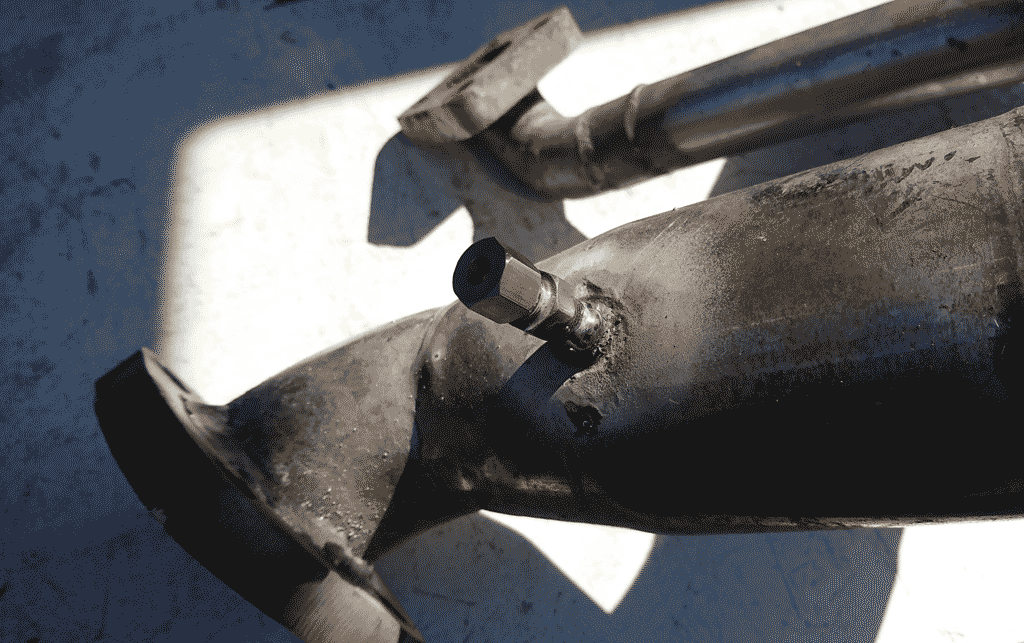
following a stuck turbo due to seawater seasoning the exhaust part of the turbo, I built some proper ss elbows (following some teaching by LS1)
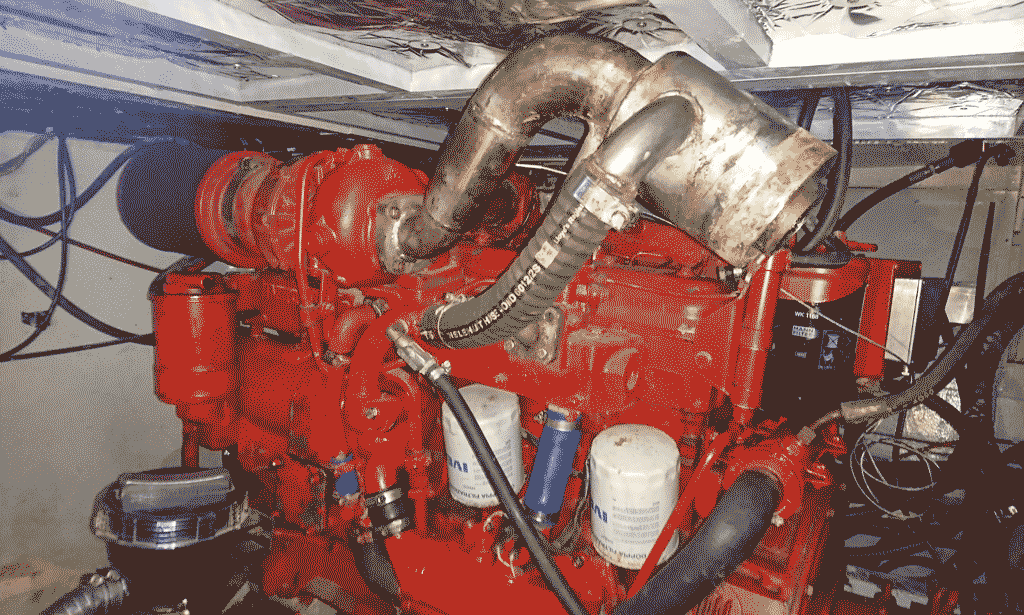
couple of years ago I welded a pathetic k-type thermocouple that promptly dissintegrated when I tried to seal it in place, this year got some decent quality (obviously again chinese) probes and that's how they are fitted. Second pic you have to look hard for it, sorry haven't got a better one.
Mind having them in, doesn't mean much, you got to test at different conditions and load, record values and see how these values change with fouling or weight. For my position AFTER the turbo, I have to add a couple of hundred C to get the before value which is the one usually considered.

exhaustelbow_EGT_1.gif


exhaustelbow_EGT_2.gif


cheers

V.

PS. apols too busy with work-work, made the pics into gifs, no time to redo in jpg :(
 
I managed to get EGT readings via my Raymarine Axiom. I had sensors installed very similar to Vas's pic above, in my case, just after the turbo but before the cooling water and a box of tricks to send signal to Axiom. Both sensors and box of tricks were from Maretron. Then a paid a few hundred quid to have some clever chap design a custom page on my Axiom that shows all 3 EGT's...... they are fabulously accurate and tell me when belts are loose or if sterngear is dirty as well as their more obvious potential !
 
I managed to get EGT readings via my Raymarine Axiom. I had sensors installed very similar to Vas's pic above, in my case, just after the turbo but before the cooling water and a box of tricks to send signal to Axiom. Both sensors and box of tricks were from Maretron. Then a paid a few hundred quid to have some clever chap design a custom page on my Axiom that shows all 3 EGT's...... they are fabulously accurate and tell me when belts are loose or if sterngear is dirty as well as their more obvious potential !

What sort of temps do they say and with what rpms .
I appreciate you have a triple S Hawk , hows it going ?
I was over @ Cogolin recently.
 
Hi Porto,

I am berthed just opposite the fuel dock on the inland side if that makes sense ! Hope to bump into you this summer (not literally !)

Your question is straightforward but as with so much to do with boats the answer is not as precise as I would like. Firstly the outer motors turn 6 bladed props whilst the centre engine turns a 5 blade. They are differently pitched too I believe although I am not certain. The point is that the 3 engines are not working identically so I get varying readings, Couple that with the fact that reading my analogue tacos is not especially precise and I get something like : 140 at 1200 revs, 300 To 320 at 2600-2800 revs, And about 370 to 390 at Wot which is 3100 to 3300 revs. The centre engine revs higher than the outer 2. The port engine runs slightly hotter than the other two. I can sync the engines by EGT which is fun ! If I have a loose belt then the offending engine runs a bit hotter and doesn’t rev as high. I imagine that this is related to the circulation pump which is belt driven........ I am slightly surprised that it makes such a difference but I guess there is some logic to that.
 
Tried to post a photo that shows the EGT readings and the speed just above at 6.3 knots and 1100 revs. File wouldn’t load. Sorry !
 
3 x Yanmar 6ly2a-STP. 420hp each.

Lovely :encouragement:

Very nice set up and congratulations on the refurb looks stunning .
For the benefit of UK boaters a quite a few guys do similar stuff with older Italian boats Riva and of course Itama . S/Skrs updated the Don Shead long n thin variants are popular in the SoF .
Labours of love like classic cars , nice to see and appreciate.

EGTs. , great idea to look after the motors properly.
They say turbos take a slug of 200 degree out so if we notional add that back then you are right in the ball pack 550 to sub 600 .
That add back could be 10% plus or minus .CATs run hot for example around 600 pre turbo .
Anyhow the point is you have a baseline each trip .It does move btw for the benefit of none EGT boaters .
Fouling of props makes a huge difference , seasonal growth adds a bit say 20 degrees by OCT , and weight .
Weight is relative in % terms easy to see a difference the smaller the boat .
Adding full tanks 2000 L fuel + 500 water , near enough 2-1/2 tons on a dry 17 ton and I see raised EGTs .They fall back as the fuel burns off .

I “nurse “ my 15 year old engines using EGTs and fortunately for me load as well .

They seem to mirror each other with throttle movements.
Recently ( freshly serviced ) it’s been running at a lowish 540 EGT at 77 % load with equates to 28/29 knots burning 90 L per side .
Ease those numbers to 30/32 and load hits 80 % and EGTs 560 ish .

All that equates to 1760/1840 rpm from a WOT of 2200 so I hope longevity beckons .

I know a lot on here esp Volvo owners will rubbish using EGTs .
Elevated EGTs knacker your injector tips , mushrooms your exhaust valves etc .
Theses things are insidious, come on slowly so owners don’t know what damage they done until some time later .

Great to see another fellow boater who understands .
 
Are you implying... "as opposed to anyone else here in the asylum", maybe? :rolleyes: :D

Anyway, ref...
quite a few guys do similar stuff with older Italian boats Riva and of course Itama
Indeed.
I suppose that the following empty e/r will look familiar to you!
Feast your eyes on the final result below... :encouragement:
ITAMA%2038%20001.jpg


ITAMA%2038%20021.jpg
 
Top