Eberspacher Exhaust

3663Ian

Active Member
Joined
30 Sep 2010
Messages
57
Visit site
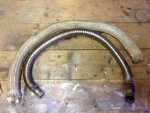
The attached photo shows the exhaust pipe for an Eberspacher D3L heater. I have removed it because it had developed a small leak which was allowing some fumes to enter the stern locker where the heater is mounted. I have removed the lagging, pressure tested the pipe in a bath of water and found a small hole in the flexible section of the pipe. I plan to replace it with a new one. The pipe is 1 meter long . The heater end has and ID of 24mm and the skin fitting end has an ID of 29.5mm (may be it's 30mm as it still has some sealant in it!). The end fittings appear to be braised to the flexible pipe. Can I buy a part like this pre-assembled or will I need to get someone to make one up for me. I can see plenty of 24mm pipe available will that attach directly to the heater with a appropriate clamp or does it need an end fitting?

Ian
 

Attachments

  • exhaust.jpg
    exhaust.jpg
    94.2 KB · Views: 5
Last edited:
That's something that's been brazed up to compensate for an oversize skin fitting, a new length of 24mm pipe and an adapter (or the right skin fitting) will sort it. Best solution though costly, would be to fit a proper gas tight sealed silencer with integral 24mm tube as I bet it's a bit LOUD like that.
 
I have the same problem with the eber exhaust on my Hydronic 10, I'm fairly sure there is a leak in the exhaust pipe, I can smell exhaust fumes in the aft locker and feel gas coming out between the two pipes (the exhaust is pipe in pipe with insulation in between). I haven't taken the exhaust pipe off yet, so I don't know the extent of the damage, but I guess it will require a new exhaust pipe.

Question: I've noticed that Webasto tend to use a simple exhaust pipe wrapped in insulation. Eber use a pipe in pipe system with insulation in between. Which is the best option? Pros and cons for each?
 
Best option is a bare pipe you can see and inspect easily, but that's not often a good idea when routing is taken into account so sleeve lagging is the next best option as you can see staining where there is a blow. The Eber system of putting the lagged exhaust in PEK duct is not a good idea at all in my view as it makes service inspection without dismantling impossible.
 
Best option is a bare pipe you can see and inspect easily, but that's not often a good idea when routing is taken into account so sleeve lagging is the next best option as you can see staining where there is a blow. The Eber system of putting the lagged exhaust in PEK duct is not a good idea at all in my view as it makes service inspection without dismantling impossible.
Thanks, David2452, I'll just lag the pipe when I replace the exhaust pipe.
 
Is the hole damage or drilled? Eberspacher installation instructions specify a 5mm hole to be drilled in the lowest part of the exhaust to drain condensate.

That would be for installation in a vehicle I suspect. I have recently installed a Webasto and chose not to create an exhaust leak in my locker. The Webasto exhaust fits the skin fitting and there is a reducer sleeve to fit inside the pipe and over the heater exhaust outlet. If you clamp them up they are completely gas tight without any need for sealant. I am told these parts are interchangeable for Ebers but can't verify that.
 
Last edited:
Is the hole damage or drilled? Eberspacher installation instructions specify a 5mm hole to be drilled in the lowest part of the exhaust to drain condensate.

Its damage, just a little split in the flexible section. There is no drain hole on this pipe.

I am still struggling to find an adaptor to reduce the 30mm OD of the skin fitting to a new piece of 24mm pipe that can go straight on the heater.
 
The condensate drain was also specified in the installation instructions which came with the D3LC boat kits I've installed.

A proper condensate drain is gas tight (the one with a looped coil) I dip it in water before installing to fill it, really only needed on very long runs close to the max allowed anyway and I hardly ever use them, regular annual inspection of the exhaust is all that's really needed, on such an important component and at the price of it having to replace it every five or six years is no big problem.
 
A proper condensate drain is gas tight (the one with a looped coil) I dip it in water before installing to fill it, really only needed on very long runs close to the max allowed anyway and I hardly ever use them, regular annual inspection of the exhaust is all that's really needed, on such an important component and at the price of it having to replace it every five or six years is no big problem.
Dont forget to fit a CO detector as well.
 
I have just ordered the parts from butlertechnik.com. Thanks to everyone particularly Salar and David2452 for your help.
 
Top