Eberspacher Control Unit Failed?

Yes Alan if there is good power there then that connection will work. That is an expensive type timer but don't bin it yet ( there is one on eBay at £58 just now though!) (NOT MINE!) They rarely fail. If you don't want the time setting function then you can get something much cheaper.
Good luck
Thank you Pete (and Paul), I shall give that a try. It will be some days before I get back to the boat, so I shall have to keep you in suspense until then.
Regards, Alan.
 
That £58 timer is still on ebay! I always buy these when I see them if I can get them for £40ish but for a one off £58 is ok. Ensure that if you do buy one that the logo is blue as the one with the white logo has no diagnostics and only runs for two hours.
 
Thank you Pete (and Paul), I shall give that a try. It will be some days before I get back to the boat, so I shall have to keep you in suspense until then.
Regards, Alan.
UPDATE
Unfortunately my belief/hope that the fault lay with the timer/controller now seems unlikely to be the case. Shorting together the yellow and red wires at the back of that unit had no effect, and indeed I was unable to replicate my earlier finding of 12 volts between the red and brown wires there. (I don't think I imagined it - I wonder if I was just detecting residual charge in a capacitor.)

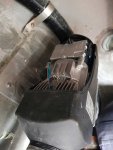
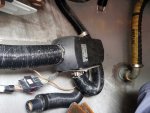
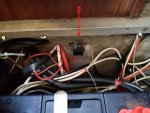
I have now found the wiring connector next to the heater unit itself (it had been tucked up behind the ducting) and there are 12 volts between the thick red and thick brown wires there, so it seems as though the problem must lie within the main unit itself. Access is restricted, but I was able to take the cover off and althogh I couldn't see what was under it I was able to take a photo (which disclosed nothing helpful).Eber-cover-removed.jpegEber-in-situ.jpg

It seems to me that to go any further I will have to remove the unit, which I imagine involves disconnecting the wiring connector, air inlet, exhaust and heat output pipes and the fuel feed, then removing the four nuts securing it to the bracket.
Once I have it on the bench, is there anything I can usefully check using a multimeter? Otherwise I guess I will have to take or send it to an Eber specialist. The boat is ashore at Dunstaffnage, by Oban, I live near Perth, 90 miles away, and there is no hurry as I shall not be launching until next Spring.

Various people have suggested buying a different make of heater, but I don't imagine any of them would be a drop-in replacement. I don't feel up to doing anything complicated in that locker - I am 73 and not as spry as I was (and I wasn't very spry then), so any cost-savings would probably be eaten up by paying someone to fit the replacement.
 
There are very many threads on here on the subject of diesel heaters and while I have had no hands on experience with said heaters, one thing I do know is that yes there are Chinese and Russian clones of your Eber that are a direct, slot-in replacement using the existing wiring, fuel supply,exhaust and hot air ducting. Go to the search box and enter key words like 'eberspacher copy' , ' planar' or 'chinaspacher'.
 
There are very many threads on here on the subject of diesel heaters and while I have had no hands on experience with said heaters, one thing I do know is that yes there are Chinese and Russian clones of your Eber that are a direct, slot-in replacement using the existing wiring, fuel supply,exhaust and hot air ducting. Go to the search box and enter key words like 'eberspacher copy' , ' planar' or 'chinaspacher'.
Thank you. That has given me more to think about.
 
UPDATE
Unfortunately my belief/hope that the fault lay with the timer/controller now seems unlikely to be the case. Shorting together the yellow and red wires at the back of that unit had no effect, and indeed I was unable to replicate my earlier finding of 12 volts between the red and brown wires there. (I don't think I imagined it - I wonder if I was just detecting residual charge in a capacitor.)

I have now found the wiring connector next to the heater unit itself (it had been tucked up behind the ducting) and there are 12 volts between the thick red and thick brown wires there, so it seems as though the problem must lie within the main unit itself. Access is restricted, but I was able to take the cover off and althogh I couldn't see what was under it I was able to take a photo (which disclosed nothing helpful).View attachment 95811View attachment 95812

It seems to me that to go any further I will have to remove the unit, which I imagine involves disconnecting the wiring connector, air inlet, exhaust and heat output pipes and the fuel feed, then removing the four nuts securing it to the bracket.
Once I have it on the bench, is there anything I can usefully check using a multimeter? Otherwise I guess I will have to take or send it to an Eber specialist. The boat is ashore at Dunstaffnage, by Oban, I live near Perth, 90 miles away, and there is no hurry as I shall not be launching until next Spring.

Various people have suggested buying a different make of heater, but I don't imagine any of them would be a drop-in replacement. I don't feel up to doing anything complicated in that locker - I am 73 and not as spry as I was (and I wasn't very spry then), so any cost-savings would probably be eaten up by paying someone to fit the replacement.
Alan, out of interest, is the connection block in your photo part of the heater’s wiring harness? Wish mine were that posh.
An advantage of removing the heater is that you should then have easy access to all relevant wiring to enable you to carry out continuity checks. If after that you decide replacement is the best action, you will at least have cleared the space and ensured that the wiring is free from defects
Mike

Mike
 
Alan, out of interest, is the connection block in your photo part of the heater’s wiring harness? Wish mine were that posh.
An advantage of removing the heater is that you should then have easy access to all relevant wiring to enable you to carry out continuity checks. If after that you decide replacement is the best action, you will at least have cleared the space and ensured that the wiring is free from defects
Mike

Mike
Yes, it seems to be Eber original equipment. It is because it is such a tidy installation and had worked perfectly for 12 years that I am a bit reluctant to replace it with something unknown.
 
Thank you. That has given me more to think about.
There are very many threads on here on the subject of diesel heaters and while I have had no hands on experience with said heaters, one thing I do know is that yes there are Chinese and Russian clones of your Eber that are a direct, slot-in replacement using the existing wiring, fuel supply,exhaust and hot air ducting. Go to the search box and enter key words like 'eberspacher copy' , ' planar' or 'chinaspacher'.
UPDATE
Unfortunately my belief/hope that the fault lay with the timer/controller now seems unlikely to be the case. Shorting together the yellow and red wires at the back of that unit had no effect, and indeed I was unable to replicate my earlier finding of 12 volts between the red and brown wires there. (I don't think I imagined it - I wonder if I was just detecting residual charge in a capacitor.)

I have now found the wiring connector next to the heater unit itself (it had been tucked up behind the ducting) and there are 12 volts between the thick red and thick brown wires there, so it seems as though the problem must lie within the main unit itself. Access is restricted, but I was able to take the cover off and althogh I couldn't see what was under it I was able to take a photo (which disclosed nothing helpful).View attachment 95811View attachment 95812

It seems to me that to go any further I will have to remove the unit, which I imagine involves disconnecting the wiring connector, air inlet, exhaust and heat output pipes and the fuel feed, then removing the four nuts securing it to the bracket.
Once I have it on the bench, is there anything I can usefully check using a multimeter? Otherwise I guess I will have to take or send it to an Eber specialist. The boat is ashore at Dunstaffnage, by Oban, I live near Perth, 90 miles away, and there is no hurry as I shall not be launching until next Spring.

Various people have suggested buying a different make of heater, but I don't imagine any of them would be a drop-in replacement. I don't feel up to doing anything complicated in that locker - I am 73 and not as spry as I was (and I wasn't very spry then), so any cost-savings would probably be eaten up by paying someone to fit the replacement.
Alan, I had hoped that silence from you meant that you were sorted! sorry to hear that your saga continues.
You need to have 12 volts at the switch ! without power there you cannot start the heater. Nothing you can do 'inside the heater' will help. There could/should be a fuse 5amp protecting the switch as well as a bigger one protecting the heater itself? If you can reach the main connector that you show and can just bridge ( lets not use the 'short' term ! ) the yellow to the red then the heater should start, then we can start to look at the switch issue.
I am pleased to see that the cable from the heater appears to be cloth wrapped indicating that it is the more modern and far more reliable HELLA unit. Yes there are checks you could do with the heater in situ and especially if you can pull out the ecu ( a bit) to get at the leads attached. They include checking the glow pin circuit, the fan, and the flame/overheat sensor, you should really check their resistance values against the manual but often a simple open or short circuit is enough.
Have you been able to locate the pump leads or the pump in case there is a circuit issue there? Any circuit issues may result in the heater not even trying to start as the first thing the ECU does is check that all circuits and their components are in place and at value.
I think we will find its something simple and inexpensive!
 
Thanks for your response ,Pete.
You need to have 12 volts at the switch ! without power there you cannot start the heater. Nothing you can do 'inside the heater' will help. There could/should be a fuse 5amp protecting the switch as well as a bigger one protecting the heater itself? If you can reach the main connector that you show and can just bridge ( lets not use the 'short' term ! ) the yellow to the red then the heater should start, then we can start to look at the switch issue.
I haven't been able to find any such fuses, what should I be looking for? I should be able to bridge the red and yellow at the main connector to see what happens, though.
I am pleased to see that the cable from the heater appears to be cloth wrapped indicating that it is the more modern and far more reliable HELLA unit. Yes there are checks you could do with the heater in situ and especially if you can pull out the ecu ( a bit) to get at the leads attached. They include checking the glow pin circuit, the fan, and the flame/overheat sensor, you should really check their resistance values against the manual but often a simple open or short circuit is enough.
Unfortunately the heater is too close to the deckhead for me even to see inside the casing without removing it from its bracket, but I would be able to check the resistances you suggest at the connector.
Have you been able to locate the pump leads or the pump in case there is a circuit issue there? Any circuit issues may result in the heater not even trying to start as the first thing the ECU does is check that all circuits and their components are in place and at value.
I know where the pump is and have given it a cursory glance, but I can certainly examine it more closely. I had (perhaps naively) assumed that if the ECU had detected a fault it would have sent an error code to the timer/switch rather than just shutting down completely.
I think we will find its something simple and inexpensive!
I hope you are right, and thank you very much for your help. Do you have a link to an online manual?

It may be a week or two before I can report back.

Regards,

Alan
 
It's worth disconnecting that multiway connector and checking for corrosion.
Give a squirt of contact lube or GT85 or similar.

Does the heater attempt to start or just do nothing?
On mine, a bad connection caused the heater to 'lock out', there is some reset ritual to try but I forget what it is.
 
Thanks for your response ,Pete.

I haven't been able to find any such fuses, what should I be looking for? I should be able to bridge the red and yellow at the main connector to see what happens, though.

Unfortunately the heater is too close to the deckhead for me even to see inside the casing without removing it from its bracket, but I would be able to check the resistances you suggest at the connector.

I know where the pump is and have given it a cursory glance, but I can certainly examine it more closely. I had (perhaps naively) assumed that if the ECU had detected a fault it would have sent an error code to the timer/switch rather than just shutting down completely.

I hope you are right, and thank you very much for your help. Do you have a link to an online manual?

It may be a week or two before I can report back.

Regards,

Alan
Tried to send the online manual by PM but ( apparently) the file is too big for our system. They can be found online at....at... sorry brain gone dead well known UK heater and parts dealer someone on the forum will help ( please) If the control switch has no power then that is where we need to start. Many eberspacher looms had the two fuses next to each other so if you can find one you may find the other or try to trace back from the control switch. Usually the positive lead for the control switch is just a fused spur from the main positive lead to the heater. Other than the fuse to the control switch there could be issues with a connector from the main heater harness to the control switch, if you cant find that connector then you could check the continuity of the various leads from the main heater connection block ( in your photo) to the connecter plugged into your control switch namely red ( We know that is duff and it could be the small fuse) yellow, brown, brown/white, red/slate, blue/white. If these last 5 have continuity and just the red is suspect then we can forget the connector I refer to and concentrate on finding the small fuse.
Hopefully we will get you sorted before winter sets in!!!
 
[Lots of good advice snipped]
Hopefully we will get you sorted before winter sets in!!!
My plan the next time I am at the boat is to follow every inch of the wiring loom between the control switch, via the pump, to the main connector block, in the hope of finding fuses and identifying where the loom picks up the main 12 volt supply.
I am still puzzling about how I can check continuity between the main heater connection block and the connector adjacent to the control switch - they are about 4 metres apart and neither my arms nor the test leads on my meter will stretch that far.
Found a manual at https://www.eberspaecher-na.com/fil...r_Manual_2015__7th_Draft-Revised__09-15-2.pdf
44 pages, so plenty of information there. Edit: I see it is North American, though, and on page 2 states "The installation instructions and standards described in this document are NOT APPLICABLE TO MARINE INSTALLATIONS ". I'm going to read it anyway.
Thanks again.
Alan
 
Last edited:
The 'American' manual has a very different look to my version but the basic info looks good. All the component values for testing and a good section on ducting etc. Should cover what you need.
My own 'immediate action' plan ( yours may be different depending on practical issues on board) would be to check again that there is no power to the switch. Once that is confirmed you could check continuity of a least one lead from heater to switch.
Yes you will have to make up an extension for your multi meter probe but just proving, via for example the yellow lead, that there is continuity from the heater plug to the switch would be a good indication that it is just lack of 12 volts to the switch that is the issue.
Then search back to establish why there is no power at the switch. There is no reason why you could not bring a temporary lead direct from a power source to the switch and see if that gets things working?
 
[More good advice snipped]
There is no reason why you could not bring a temporary lead direct from a power source to the switch and see if that gets things working?
Now why did I not think of that ?
Anyway, plenty to keep me busy the next time I get to the boat.
 
My plan the next time I am at the boat is to follow every inch of the wiring loom between the control switch, via the pump, to the main connector block, in the hope of finding fuses and identifying where the loom picks up the main 12 volt supply.
I am still puzzling about how I can check continuity between the main heater connection block and the connector adjacent to the control switch - they are about 4 metres apart and neither my arms nor the test leads on my meter will stretch that far.
Found a manual at https://www.eberspaecher-na.com/fil...r_Manual_2015__7th_Draft-Revised__09-15-2.pdf
44 pages, so plenty of information there. Edit: I see it is North American, though, and on page 2 states "The installation instructions and standards described in this document are NOT APPLICABLE TO MARINE INSTALLATIONS ". I'm going to read it anyway.
Thanks again.
Alan
Alan, If your test leads aren't long enough, just extend them. I keep a 20 meter lenth of "bellwire" and crocodile clips for just that purpose. It's possible then to do continuity checks on any of the boat's electrical circuits. Including those going to the masthead.

Mike
 
Alan, If your test leads aren't long enough, just extend them. I keep a 20 meter lenth of "bellwire" and crocodile clips for just that purpose. It's possible then to do continuity checks on any of the boat's electrical circuits. Including those going to the masthead.

Mike
Thanks, Mike, I find this sort of practical detail very helpful.
Alan
 
Progress Report

I have found the fuses.
I traced the wiring loom and found, in the darkest and least accessible place, the spur connecting to the 12 volt supply and by following that I found the fuses.
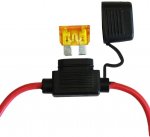
I had been looking for something like this:
Inline fuse 1.jpg
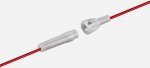
or this:
Inline fuse 2.jpg
But I found this:
Eber-fuse-=-arrow.jpg
A small plastic box close to the batteries which I had previously assumed to be some kind of relay. It even had the Eber logo on the transparent cover, although I could only see that once I had taken it off. Inside were two blade fuses, 15 amp (intact) and 5 amp (blown).
I disconnected the timer/switch from the loom and replaced the 5 amp fuse, and when I turned on the battery switch the fuse remained intact. I then reconnected the timer/switch to the loom and the fuse still did not blow, but the timer/switch did not wake up and display the time (its previous standby behaviour) and pressing its buttons had no effect.
I then tried establishing a connection between the red and yellow wires at the timer/switch and, to my surprise and delight. the heater went into its start-up routine with clicking from the pump and air blowing out of the vents.

The conclusion I have drawn is that at some point something nasty happened to the timer/switch which caused the fuse to blow and that it is now kaput. It seems to me that if I replace the timer/switch there is a good chance that everything will work. Can anyone see a flaw in that reasoning?
 
Progress Report

I have found the fuses.
I traced the wiring loom and found, in the darkest and least accessible place, the spur connecting to the 12 volt supply and by following that I found the fuses.
I had been looking for something like this:
View attachment 96615
or this:
View attachment 96616
But I found this:
View attachment 96617
A small plastic box close to the batteries which I had previously assumed to be some kind of relay. It even had the Eber logo on the transparent cover, although I could only see that once I had taken it off. Inside were two blade fuses, 15 amp (intact) and 5 amp (blown).
I disconnected the timer/switch from the loom and replaced the 5 amp fuse, and when I turned on the battery switch the fuse remained intact. I then reconnected the timer/switch to the loom and the fuse still did not blow, but the timer/switch did not wake up and display the time (its previous standby behaviour) and pressing its buttons had no effect.
I then tried establishing a connection between the red and yellow wires at the timer/switch and, to my surprise and delight. the heater went into its start-up routine with clicking from the pump and air blowing out of the vents.

The conclusion I have drawn is that at some point something nasty happened to the timer/switch which caused the fuse to blow and that it is now kaput. It seems to me that if I replace the timer/switch there is a good chance that everything will work. Can anyone see a flaw in that reasoning?

Seems like it's worth replacing the controller/timer/switch.
 
Progress Report

I have found the fuses.
I traced the wiring loom and found, in the darkest and least accessible place, the spur connecting to the 12 volt supply and by following that I found the fuses.
I had been looking for something like this:
View attachment 96615
or this:
View attachment 96616
But I found this:
View attachment 96617
A small plastic box close to the batteries which I had previously assumed to be some kind of relay. It even had the Eber logo on the transparent cover, although I could only see that once I had taken it off. Inside were two blade fuses, 15 amp (intact) and 5 amp (blown).
I disconnected the timer/switch from the loom and replaced the 5 amp fuse, and when I turned on the battery switch the fuse remained intact. I then reconnected the timer/switch to the loom and the fuse still did not blow, but the timer/switch did not wake up and display the time (its previous standby behaviour) and pressing its buttons had no effect.
I then tried establishing a connection between the red and yellow wires at the timer/switch and, to my surprise and delight. the heater went into its start-up routine with clicking from the pump and air blowing out of the vents.

The conclusion I have drawn is that at some point something nasty happened to the timer/switch which caused the fuse to blow and that it is now kaput. It seems to me that if I replace the timer/switch there is a good chance that everything will work. Can anyone see a flaw in that reasoning?
Congratulations! Your persistence in seeking the fault has paid off.
Mike.
 
Top