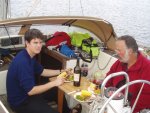
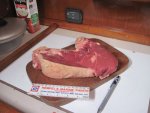
Eating aboard

I have a 'Yachtsman's Weekend Book' (new and revised edition, 1963) which includes several meal suggestions , together with recipes, for each Beaufort Force. The recipes do make use of tinned and dried food, but mainly as ingredients of more ambitious fare. Taken overall the options and recipes do suggest sailors of those days were both hardier and more prepared to spend time on food preparation, almost whatever the conditions. The suggested list of basic provisions runs to 2 pages, and is followed by storage suggestions which include, for instance, rubbing each bacon slice with salt before laying it in a salt box, etc.

Force 6, for instance:
BREAKFAST - Rolled Oats; Dried Haddock and Egg Sauce; or Bacon & Fried Eggs.
LUNCH - Cheese Soup; Baked Sole; Spanish Stew; or Fruit Fritters.
DINNER - Stand-by Soup; Prawn au Gratin; Vegetable Pie; or Scotch Eggs (and they mean making the latter there and then, not buying ready made ones!)

By the time it gets to Force 9:
BREAKFAST, LUNCH, TEA, & DINNER - Dry Biscuits; Tiller Soup.
Force 9 also has appended the following helpful footnote :) :
'Certainly at this stage of the proceedings "prayer and fasting" becomes of the utmost importance if the yacht is still at sea and underway within the meaning of the Order in Council. If, however, her Master has in the past made well digested meal of the laws of tropical revolving storms and has in the present has made research into the weather portents on pages 79 to 94 of this book then presumably he will be in harbour, safely and snugly, and can revert to harbour menus which range from Scale 0 in the inner gate-locked basin to Scale 5 in such delectable spots as Dover Wick.'
 
We have the advantage of two large fridge's - one can be adjusted down into a freezer - but that is too big, leaving not enough fridge only space. We bought a Dometic Fridge/freezer box, 40 litre size. This is the freezer. We have an 8KW genset and 600AH plus of house bank, so electrical consumption is not a problem.

First Mate makes plenty of home cooked stuff, freezes it and it is taken to the boat frozen. We like proper bread, have a breadmaker so can make it, but can also freeze bread.

We do, of course, use pre prepared and tinned stuff, but not too much.

One favorite from a tin is Duck Confit. Nice potatoes and a tin of green beans makes a simple, tasty and quick meal.

We try to live on board for 4-5 months every year, and cant afford to be in a Marina or alongside every day, so spend plenty of time on the hook.
 
Screenshot 2020-03-10 at 02.05.14.jpg
That was my last meal onboard. A bit fancy as I normally limit it to one or two tins. This was evening meal and also breakfast the next morning :-)

I don't have a fridge and I sail singlehanded mostly offshore. Iv'e got enough tins and dry goods on board to see out the Cover-19 epidemic if needs be!
 
The old favourite " What does Lobster Thermidor and a Blow job have in common?

You dont get either at home.

Well, when I am fortunate enough to get suitable lobsters, my version of Thermidor is enthused over by all who taste it.

Quick and simple, cook lobster/lobsters. Allow to cool, remove meat, cut into bite sized pieces. Place in bowl, squirt 50/50 mayo and Heinz salad cream over, stir in, just enough to coat evenly. Place meat back in half shells, cover with grated hard cheese, gruyere or emental, place under hot grill untill cheese is well melted in. Garnish to taste, eat with fresh bread and a good white wine.

Delish!

No blow job jokes please............................
 
I seem to be able to cook an eat as well onboard as at home. Sometimes better.
Same here. Hardly surprising, onboard is home :)
The little pressure cooker is used most days, perfect tasty brown rice every time :cool:
Tin opener never comes out of the drawer. Though great cheap fresh food is never far away in Portugal,a few euros gets enough oranges and olives for the week at the Sunday Market. Freshly squuezed orange juice every day.
 
Being onboard for a week or more is a completely different question to a weekend cruise.
Stores for a long passage will be much different from a summer cruise shopping most mornings.
 
Sail cruising is a pleasure, not a hardship so all creature comforts prevail aboard my fat arsed AWB ? Plenty of room for cooker, microwave, toaster, rice cooker, fridge/freezer and fridge. Being a lovely French boat she has 3 separate wine racks, too.

Comfortable below deck plus large cockpit with nice table for eating al fresco with friends. Eating aboard and/or ashore in pretty equal measure as the mood takes us. My wife is Oriental so we only eat/cook from fresh.

I’ve just crewed long distance for a friend. Morning coffee came with fruit cake drowned in Brandy. Lunch included freshly baked bread, afternoon tea included warm tart with ice cream. Evening meal was usually “catch of yesterday” (24 hours in the freezer to kill any bugs).

I don’t do hardship?
 
I have a 'Yachtsman's Weekend Book' (new and revised edition, 1963) which includes several meal suggestions , together with recipes, for each Beaufort Force. The recipes do make use of tinned and dried food, but mainly as ingredients of more ambitious fare. Taken overall the options and recipes do suggest sailors of those days were both hardier and more prepared to spend time on food preparation, almost whatever the conditions. The suggested list of basic provisions runs to 2 pages, and is followed by storage suggestions which include, for instance, rubbing each bacon slice with salt before laying it in a salt box, etc.

Force 6, for instance:
BREAKFAST - Rolled Oats; Dried Haddock and Egg Sauce; or Bacon & Fried Eggs.
LUNCH - Cheese Soup; Baked Sole; Spanish Stew; or Fruit Fritters.
DINNER - Stand-by Soup; Prawn au Gratin; Vegetable Pie; or Scotch Eggs (and they mean making the latter there and then, not buying ready made ones!)

By the time it gets to Force 9:
BREAKFAST, LUNCH, TEA, & DINNER - Dry Biscuits; Tiller Soup.
Force 9 also has appended the following helpful footnote :) :
'Certainly at this stage of the proceedings "prayer and fasting" becomes of the utmost importance if the yacht is still at sea and underway within the meaning of the Order in Council. If, however, her Master has in the past made well digested meal of the laws of tropical revolving storms and has in the present has made research into the weather portents on pages 79 to 94 of this book then presumably he will be in harbour, safely and snugly, and can revert to harbour menus which range from Scale 0 in the inner gate-locked basin to Scale 5 in such delectable spots as Dover Wick.'
No change then from my early post-war copy, which is probably unchanged from publication in 1938. No doubt you have taken note of the science of sailing which follows.
 
Mine doesn't have the science of sailing, but it does have handy chapters on e.g. wildfowling for yachtsmen! :)
My mistake, it was the science of cookery, giving the formula for working out how much stew was spilled from a cylindrical saucepan when it is tilted.

The book is full of pleasures. I especially like the 'Well-whipped ropes' ends', a collection of advice, such as "When buying: trust all men, yea, even princes - and then cut the cards yourself".
 
Top