
Early Sterling Advanced Regulator Questions

shaula

Member
Joined
14 Apr 2010
Messages
28
Visit site
I have an early universal advanced regulator which I am fitting to my Volvo 2030 which has a standard Valeo regulator. According to the instructions, I have removed the alternator to solder 2 wires to the existing brush connections which allows a test to be carried out to determine if the existing alternator is positive or negative rotor. After removing the end cover I find that there are three wire terminals. Sterling have advised me that they can not advice on alternator questions. My questions are:22A0934F-B37B-4E12-9955-38D62064F9F4.jpeg22A0934F-B37B-4E12-9955-38D62064F9F4.jpeg22A0934F-B37B-4E12-9955-38D62064F9F4.jpeg22A0934F-B37B-4E12-9955-38D62064F9F4.jpeg
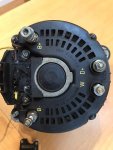
What 2 terminals do I connect too? See 3 soldered wires on left of photo.
Do the brushes actually have to be removed ? I assume another section of the alternator has to be removed to achieve this?
Are the standard Volvo/Valeo alternators negative, so does it really need the test connections to be made?
 
I cannot actually answer you question. But I also have an older Sterling regulator which I bought for an older boat and never fitted. I now too have a VP2030D and have wondered if there is any benefit in fitting it to its modern alternator?
 
I have an early universal advanced regulator which I am fitting to my Volvo 2030 which has a standard Valeo regulator. According to the instructions, I have removed the alternator to solder 2 wires to the existing brush connections which allows a test to be carried out to determine if the existing alternator is positive or negative rotor. After removing the end cover I find that there are three wire terminals. Sterling have advised me that they can not advice on alternator questions. My questions are:
What 2 terminals do I connect too? See 3 soldered wires on left of photo.
Do the brushes actually have to be removed ? I assume another section of the alternator has to be removed to achieve this?
Are the standard Volvo/Valeo alternators negative, so does it really need the test connections to be made?
Maybe someone will be able to tell you from their own experience if the alternator has positive or negative field control, but you still need to identify the brushes to determine which one the field wire fron the Sterling regulator is connected to.

You need to solder the two wires directly on to the brush holders. Luckily the regulator and brush assemlbly is easy to remove (two screws after disconnecting the wiring) so no need to get inside the main part of the alternator.
Take note of what Sterling says about cutting away a little of the case so that the wires are not nipped as you refit the regulator/brush assembly.
 
Last edited:
OK

So positive or negative field control simply means what side of the field coil the controller is connected to.

If the field control is on the positive side it is Positive Control, if on the negative side it is Negative control.

This is determined by the individual alternator.

This might better explain and might even describe whether your Valeo is one or the other ...

alternator handbook.pdf


BTW the wires on the photo you refer to are the connections to the diode block - not the brushes.
 
Thanks for your replies. I managed to find a YouTube video of a strip down of a similar regulator. There was another section to remove to gain access to the brushes and it was all then plain sailing to solder the new wires.
 
Top