DUO GEN in wind mode?

Seven Spades

Well-Known Member
Joined
30 Aug 2003
Messages
4,938
Location
Surrey
Visit site
I have bought a boat which is fitted with a DUO GEN and I am surprised by the output. My boat is 24V so the amps are different to a 12V system. In 12knts of wind I am generating 1amp(2Amps at 16knts). Is this normal? I tried calling DUO GEN but could not get a sensible answer and they suggested a dealer visit. Obviously a dealer visit is fine if there is a fault but if this is as good as it gets then I don't see the point.

I have not tried the generator in water mode.
 
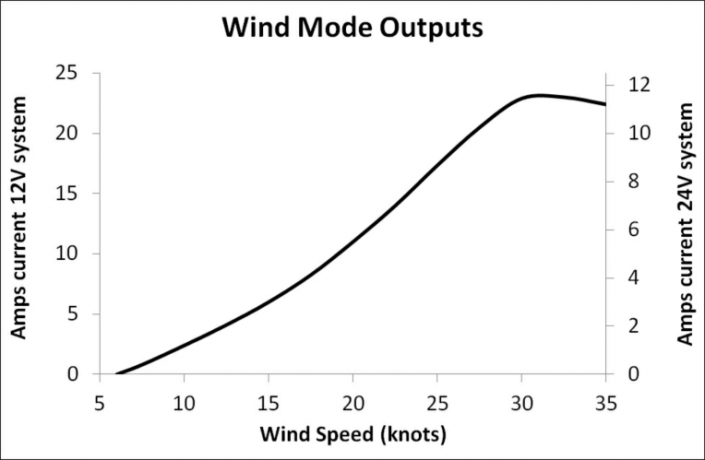
Duo Gen 3 suggests 5 amps at 15kn. Manual on the Duo Gen website with expected performance tables in the back.

I think that's for the 12 volt version !

Expect only about half of that for the 24 volt version

windmode-outputs-705x460.png


I have bought a boat which is fitted with a DUO GEN and I am surprised by the output. My boat is 24V so the amps are different to a 12V system. In 12knts of wind I am generating 1amp(2Amps at 16knts). Is this normal? I tried calling DUO GEN but could not get a sensible answer and they suggested a dealer visit. Obviously a dealer visit is fine if there is a fault but if this is as good as it gets then I don't see the point.

I have not tried the generator in water mode.

Are your batteries sufficiently discharged to accept more current . See the section in the manual regarding performance expectations

Performance and Expectations
The DuoGen was spsecifically designed to maximise zero carbon electricity generation on cruising yachts. The
DuoGen’s unique wind/water capability works best where cruising yachts are making frequent or long sea
passages, interspersed with periods at anchor or in harbour.
The DuoGen should perform in line with the values given in our published output graphs. However, when
monitoring the system, external factors can effect performance, and that may lead you to falsely conclude that
there is a problem. To assist in accurate evaluation, particularly in relation to wind mode, be aware of the
following:
● When monitoring the wind mode, wind speed measurement should be made at the height of the turbine
rotor. Where a mast head anemometer is used, there will be significant wind shear, and it is not unusual for
wind speed measurements at turbine level to be 30-50% lower than at the masthead. This is particularly true in
harbours and marinas.
● When measuring performance, battery state is also important. Fully charged batteries do not readily accept
current, and where a charge regulator is fitted, any dumped power will not be registered by the ship’s battery
monitor. In addition, where batteries are fully charged, or the regulator is ‘dumping’, the load seen by the
DuoGen’s alternator changes. This makes the alternator ‘stiffer’ to turn, which in turn increases the force which
furls the turbine. The increased furling angle reduces the intercept area of the DuoGen’s air rotor which in turn
lowers the electrical output.
When evaluating the DuoGen’s air mode, try to ensure batteries are 30 - 40% discharged, or alternatively
switch on numerous electrical loads in order to pull the battery voltage down.

● If wind mode outputs remain below expectations, first suspect turbulence in the wind stream. Turbulence at a
given site can be specific to a particular wind direction where it is caused by an obstruction either up or
downwind of the turbine. When the wind direction changes, and the obstruction is no longer in line with the
turbine, outputs may return to expected levels.
● If poor output cannot be attributed to site conditions, re-check the whole installation against the wiring
diagram and also look for poor or loose connections. Also, check fuses and fuse holders.
● Finally, ensure that the batteries are in good condition and of sufficient capacity. We recommend a minimum
of 300 Ah for use with the DuoGen.
If you still suspect a problem with the machine, consider the following:
● Do the air blades spin freely? The air rotor should spin without any undue noise or friction. If not, is there a
braking switch engaged or could there be another short circuit in the output cables? (Make sure you
disconnect the batteries before trying to find out!)
● Is the DuoGen free to move about its yaw axis? It should move easily with no undue noise or friction.
If in doubt, refer to your dealer or the manufacturer​
 
That's interesting, my batteries are about 90% charged. I now have a mid-river mooring and was hoping that the batteries would be fully charged on my return but in most instances the batteries are within 1-2 amps of where I left them.
 
Don’t own one of these myself but I did a bearing replacement for a mate. All the bearings needed replacement: working in the wind mode the output was well down on expectations, water mode less so. The job was relatively simple but I was struck by the relative mechanical complexity and inherent losses in turning the drive through 90 degrees.

The same alternator is used by their pure wind generator to much better effect. I’d have one of them if we ever take the boat back to UK.

Final thought. Masthead wind speed and direction instruments measure the wind in clear air. There’s likely to be a significant difference in wind speed at deck level plus the effects of any wind shadows in front of the kit.
 
Last edited:
There is about a 30% drop in wind speed from mast head to deck level. I have had my Duogen for 15 years. It does what the makers claim in both wind and water mode. In water mode on a long passage when we are doing circa 7kts we make over 200 amps per day at 12v. To do this in wind mode it needs to be howling! We lock the wind turbine in straight ahead mode at anchor and we get more output than by letting it oscillate about in the wind. I have striped it to replace bearings and seals and it's not a difficult job. There is not much to them.
 
We don't have a Duo Gen but the Aquawater gen and I would concur with geem, these devices work much better in water than wind mode.

In wind mode when the vessel is stationary, at anchor and on a mooring, the location is commonly specifically chosen to have shelter - so wind speed is low. When you are sailing it is almost impossible to have the fan in strong undisturbed wind as the only location is at the top of the mast. Any other location and the fan is commonly covered by the main. And as mentioned windspeed of 15 knots at the masthead means at deck level its only around 10 knots barely enough to turn the fan! At deck level the wind speed may be even lower if you have a furled main, bimini etc providing shelter (for the fan). You might find hauling the main/boom to the opposite side, away from the Duogen location, increases wind speed slightly, its worth doing, does no harm (that's what we do).

You will find on passage the DuoGen in water mode will earn its keep and should generate sufficient power to run the whole yacht (assuming you have normal power requirements). Don't give up yet!

Jonathan
 
Top