drying out pole fixing to steel hull

amazsteve

New Member
Joined
31 Oct 2013
Messages
3
Visit site
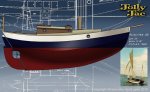
Am renovating a steel hull, long keel Tradewind 25. I wish to have the option of a pole either side to take the mud. Any readers have made something pretty that works?
Jolly Jac.jpg
 
There is a page on Legs on my website, under Cruising. In addition to advice on DIY installation of Yacht Legs there is a link to an owner who made his own. The only slightly tricky component is the socket on the hull, easy if you have machining capability but not impossible if you don't. YL's price for these sockets is outrageous, in recognition that if you have them the rest is fairly easy.
 
the legs on my FV are wood with a curved cheek to run under the bilge, one bolt between W/L and gunnel top, the bolt fixed in the leg, wing nut on the inside. Of course I can reach the nut while holding the leg which you cannot. However, could you drill the hole, weld a nut on the inside and cover with a cap inside? You would need a socket for the bolt outside, as it would need to be flush, maybe (in my situation other vessels raft to me while the leg is in place).

Come to think again, you could simply plug the hole....
 
not really suitable for soft mud or soft sand.

A common misconception. Yachts dry on legs on every imaginable type of seabed. If the bottom is soft the keel sinks in as much as the legs do. The compressive load on the legs on an upright boat is surprisingly little. Many years ago two Sigma 33s berthed permanently on legs in Ramsey, IOM, on soft mud.
 
So what should he make his legs out of? I would have a look at a stockholder of aluminium, such as Dore Metals in Sittingbourne, just to get a view of the amazing choice on the market.
Also look at patent aluminium scaffolding and handrail systems, there is a wide choice of innovative components.
Aluminium can be primed to make it corrosion resistant, then scumbled to resemble wood if you want to go that far..

What I would suggest he avoids is clunky great big chunks of wood, not suitable for such a very elegant boat in my humble opinion, and where would they stow on deck? whereas steel, although consistent with the vessel, would be heavy in suitable sections, and couldn't be used for any other purpose.

That's just where I would start personally.
How about some more details and photos of the yacht please!
 
Last edited:
A common misconception. Yachts dry on legs on every imaginable type of seabed. If the bottom is soft the keel sinks in as much as the legs do. The compressive load on the legs on an upright boat is surprisingly little. Many years ago two Sigma 33s berthed permanently on legs in Ramsey, IOM, on soft mud.

That's very interesting, using legs in sludge. Do they have some type of foot? If not, how could they help because surely they would just sink in to the mud anyway and offer no resistance to stop the yacht heeling?

Is it common to dry out boats like Siggies in mud, doesn't it knacker the keel bolts?

I'm not arguing at all, just trying to get my head round the concept really, cheers Jerry
 
My Yacht Legs have aluminium plates as feet, maybe 25 x 30 cm. Several photos of mine and others at http://coxengineering.sharepoint.com/Pages/Legs.aspx

I have no direct experience of Sigmas but I have dried out all three fin-keelers I have owned many times. No reason at all why it should damage the keel bolts, surely it is the same situation as a winter cradle? I have over-wintered my Sadler 34 on legs twice, only modification being that I tied the legs together in case somebody/something knocked one outwards.

On the materials question I would say aluminium is the best choice for weight reasons alone. Yacht Legs use two or three different sizes so they can be disassembled into shorter lengths for easy stowing.
 
Last edited:
In this same discussion a few weeks back I related the advice of my engineer friend that square section steel or ally is better than round, there flat faces resisting any bending moment. So, ally box with ply or wood cheeks might fit the bill.
 
In this same discussion a few weeks back I related the advice of my engineer friend that square section steel or ally is better than round, there flat faces resisting any bending moment. So, ally box with ply or wood cheeks might fit the bill.

I'm pretty sure that a round cross section has the highest minimum second moment of area for a given cross sectional area.
 
A common misconception. Yachts dry on legs on every imaginable type of seabed. If the bottom is soft the keel sinks in as much as the legs do. The compressive load on the legs on an upright boat is surprisingly little. Many years ago two Sigma 33s berthed permanently on legs in Ramsey, IOM, on soft mud.

That is spiffing, all the time there is no beam-on wind.

In 36 years on a drying soft mud mooring, I have noticed that the wind often swings to sideways on as the tide recedes, causing boats to leave wide semicircular tracks in the mud; I wouldn't want to have a boat relying on legs full time as the potential for damage if she ends up leaning on a leg is too horrible to contemplate.
 
I'm pretty sure that a round cross section has the highest minimum second moment of area for a given cross sectional area.

That would be my contention, but he points out it depends which way stress is applied, if it is in parallel to the flat faces there is much resistance, if across a diagonal less so. Also if the square is the same side dimension as the round diameter there is a bigger cross sectional area. In this case we are mostly concerned with compression I would think.
 
In the case of soft mud, a substantial 36ft fishing boat was sunk when the leg drove down on the ebb, then held the boat down on the flood. Bound to be one instance I suppose. If you fit big feet then the legs and fastenings may suffer over stress.
 
That would be my contention, but he points out it depends which way stress is applied, if it is in parallel to the flat faces there is much resistance, if across a diagonal less so. Also if the square is the same side dimension as the round diameter there is a bigger cross sectional area. In this case we are mostly concerned with compression I would think.

In general the forces on legs are compressive, as you say, so the main risk is buckling. That will happen about whichever axis has the lowest second moment of area, hence the minimax problem.
 
That is spiffing, all the time there is no beam-on wind.

In 36 years on a drying soft mud mooring, I have noticed that the wind often swings to sideways on as the tide recedes, causing boats to leave wide semicircular tracks in the mud; I wouldn't want to have a boat relying on legs full time as the potential for damage if she ends up leaning on a leg is too horrible to contemplate.

Well, I am certainly not going to say that they never fail but I have spoken to many users, several of whom berth full time on drying moorings on legs, and have yet to find one who has had a problem. The trick explained to me by a few of them is not to wind the legs down so far that both are at the same level as the keel. Leaving them a few inches up prevents the boat from tripping over them. When cruising in Brittany it was obvious that there are thousands of boats on them on drying moorings, many obviously home made.
 
Vyv,

the Anderson 26 ( designed by a committee rather than just Oliver Lee ) had integral grounding legs housed in tubes from bottom to deckhead- like scaffolding poles - let down from on deck.

They had small footpads which faired into the hull when raised.

This all must have seemed like a brilliant idea down at the pub in the 1980's, but all the A26 owners I know don't use the legs, as the potential damage given a cross tide or wind might be horrendous !

Drying legs might be fine on a chunky work boat, but not so good news for the average yacht...
 
Last edited:
Drying legs might be fine on a chunky work boat, but not so good news for the average yacht...

Again, a common misconception. I don't know why I am publicising the Yacht Legs company, since their website no longer answers this question when previously it did! Before I bought mine I did a good deal of research and discussed these problems with them. Not only did they refute suggestions that legs are not suitable for yachts, they gave me a list of manufacturers who will fit the sockets as standard, including Sadler. Mine is the shallow fin, which comes a little longer, but there are many deep fin 34s that have had legs since they were built (and use them). There are photos of three yachts, plus mine, with legs on my website, http://coxengineering.sharepoint.com/Pages/Legs.aspx admittedly all with longish keels but I have seen plenty with deep keels and legs.
 
Vyv,

no misconception and I'm surprised you as an engineer don't see the obvious problems of a yacht with legs either falling on one side through wind / tide pressure, or a leg foot sinking in due to uneven mud, and most mud I know is pretty uneven...

If on hard sand, the pounding just as the tide recedes or floods will be merciless on the boat.
 
Top
