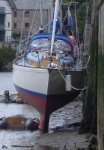
Drying out long keel against a wall advice?

Captain Crisp

Well-Known Member
Joined
1 Mar 2015
Messages
414
Visit site
Hi - any advice for drying out a 28ft long keel Twister against a wall? Considering doing this at Rowhedge and spending the night there... Never done this before...
Thanks,
Crisp
 
Hi - any advice for drying out a 28ft long keel Twister against a wall? Considering doing this at Rowhedge and spending the night there... Never done this before...
Thanks,
Crisp
The main thing is to make sure you are leaning against the wall as the tide ebbs. A halyard secured to something ashore and/or weight on the side deck is the usual technique.
A Twister will settle with her bow down due to the slope of the keel so you might end up having your head in a trotter- box!
 
I would think that at Rowhedge your keel would be in mud so it's anybody's guess how you'd end up, probably whatever your hull decides when it gets there.
 
Ideally check nature of bottom on previous tide. A few lines ashore, but make sure you can adjust them as she drops - or go for long bow and stern lines and pick shore side fixings a bit of a distance away, say 45 degrees to allow some flexibility. I take a line around the mast to the wall at head height to control lean, and to make sure she doesn't start going over the wrong way.

A bit of lean is good, but you don't need much. Near upright is my preference.

Mine also drops at the bow, but actually is reasonably well balanced so it is possible to have her more upright using the tension on all the lines, but I don't have a Twister so may not be so relevant.

Edit: if in mud all this is irrelevant! Just shut your seacocks off before she dries!
 
Fender plank... The wall is sheet piled with timber baulks, and as in the pic, the bottom falls away quite sharply. There's been a group of out of village kids being generally objectionable in the area between the pontoon and the Anchor pub (window in the rowing club bust, taking garden seats from the new houses, dive bombing off the wall, etc...)
 
If memory serves correct (not been there for several years) but there used to be rings embeded away from the wall for boats to tie to to help with the lean.
 
Top