dropping a mooring

ratbag

Well-Known Member
Joined
31 Dec 2010
Messages
408
Location
ireland
Visit site
i've recently moved to west kerry and im currently in dingle marina,
im thinking it would be handy to have a mooring in the cove that is close to where i live, just for convenience and not over winter, beneteau 43, specifications say about 9 ton, probably close to 11 ton with all my stuff on board,
bottom is sandy/mud, im thinking about using a train wheel i think they weigh about a ton, anyone have experience doing this, would i need a couple chained together, bay is quite well sheltered, ive walked the beach on very stormy days and it looks ok ,
i can get old wheels for €233
advice please
 
I don't know if you are contemplating DIY but I've laid smaller moorings and it's no fun. For a train wheel or two you need a workboat with a hoist which will mean engaging a local contractor who'll have access to the equipment needed.
 
Not a job for the unwary needs to be lowered to the bottom cos once the chain starts running if you are not very very carefull it will have you down there with it!
 
An old cast iron engine block with the chain passed down one cylinder and up another and shackled to itself used to be a popular solution. Probably easier to source than a train wheel.

As regards the danger with the chain running out, why not let the chain out first and then drop the weight?
 
A railway wheel and a few metres of very heavy chain is a popular solution.
Working with one ton weights afloat is a serious business, the sea may appear to be flat as a millpond but when even a tiny swell is just lifting the sinker, it can be violent.
If you've only got access to a modest workboat, a system of anchors is easier to lay safely.
I'd suggest getting a serious workboat or trawler to do it?

I know people who keep their boats part time on such 'summer moorings' the big thing is knowing when to move them for incoming weather. Sometimes it becomes unsafe to board the yacht and you end up having to trust the mooring.
 
thanks guys, ive been thinking about the logistics of dropping it, getting a local with a hoist is possible, the locals seem to have used tractor wheels filled with cement, i toyed with the idea of building a raft with plastic barrels and scaffold planks (which i have) but havent calculated the displacement needed yet, train wheel idea came from a friend who says its common in skerries harbour and he thinks one wheel is enough, but i think at least 2 would be needed, there is a decent slip close to where im thinking , not going to be cheap whatever way , chains, shackles etc
https://eoceanic.com/sailing/harbours/96/smerwick_harbour
interesting history in the area
 
Usual solution here is to lash the sinker under the boat at low water then, when it lifts, motor to mooring spot, chuck the chain and riser overboard, move a few feet further on then cut the lashing.

Don't do what one guy did a few few years ago, he floated his lump of concrete out lashed to drums, then cut the lashing - having forgotten to untie his dinghy:D
 
I suspect a 1 ton mooring weight is plenty for a 10 ton boat in any conditions I'd care to subject the boat to?
Once a ton sinker has been in the sand or mud for a few tides, it will take several tons of pull to shift it.

Presumably you will have plenty of swinging space so can go for a longish riser, which will give a better ride in breezy weather?

It's only cheap when you compare it to a marina.
 
You would be well advised to proceed with the upmost of caution ratbag. Smerbhic Harbour is exposed to the North and North West and you will find that most of your sailing activity will consist of shifting the boat back to Dingle every time the weather breaks. Chafe of your mooring lines will be a massive issue off the bow, (Trust me I know, having seen 2 2in lines chafe in a couple of days over there in a week.) due to the constant roll in off the Atlantic. Suggest you seek out the advice of Eddie Moore fisherman over there or Micheal Connor who has a mooring already there for his blasket ferry boat.
 
Any mooring sinker should be dug in or it will skate along the seabed in a gale - this can be DIY on half tide mud moorings like mine but is still a serious business requiring a gang of experienced members and a specialised moorings laying barge - in deep water it's a job for professionals.

A chap nearby trying it solo got killed last year.
 
I suspect a 1 ton mooring weight is plenty for a 10 ton boat in any conditions I'd care to subject the boat to?

My 4 ton boat lives moored to a standard railway wheel. The contractor who services the mooring considers it sufficient, bit only just. I am sure he would want a LOT more down there for ten tins.
 
thanks lonehort, it would only be for occasional use, i've been advised to talk to eddie and michael, im only at the 'thinking about it stage' there's a vast wealth of knowledge on this site but local knowledge is always the best route
 
My moopring is a railway wheel. ie I presume off a railway wagon. I am told it is 250kg. I believe it is from one of the heaviest freight railway systems in the world. One mooring contractor claims it is only just enough for my little 21ft sail boat.
As said using one mass and yews you would need 1 ton at least is no easy matter. If at all possible the best way to carry the mass is under your boat supported by ropes on the 2 jib sheet winches. Needs deep water next to a jetty where you can heave the weight in then park the boat over the top and raise the weight off the bottom take to location and drop.
All very difficult. The easiest way to create a decent mooring is to set it up in various parts which are individually manageable.
Start with a reasonable weight like a car engine block or railway wheel with riser chain attached. From there you attach more chain to anchors set at 4 points of the compass and say 6 metres out from centre mass. The anchors can be one fluke fisherman's style made out of scrap iron. (welded or bolted together). Now all this is easy if you can dive on the site but would take some cunning planing to get all the bits laid and joined from above. It is doable as chains to anchors do not have to be tight. They are there to stop the centre mass being dragged. You can have 2 anchors, 3 or 4.
Of course the heavier chain the better but most critical is the riser chain which will wear remarkably quickly and need inspection annually. Chains to anchors not so much because they will not often take a load or move. ol'will
 
I laid 36 moorings at the start of this season - the largest being 2.4 tonnes plus the tackle etc. ( although I would not like to do another that size) We have found that a 1.4 tonne concrete sinker 1.600 diameter will hold a 40 ft yacht Ok all summer season & it has done so for 4 summer seasons now.

They were all concrete & it is far cheaper to make concrete ones on the shore using some metal bent in a circle for formwork, Some heavy chain in the middle to form the eye(you need about 750mm of 38mm chain) through the chain you put some 12 mm rods set at various angles as reinforcement ( buy it from somewhere like travis perkins) hire a mixer for a day & if there is a beach as we have just use the stuff around you.You need about 6 bags of cement.

Concrete weights 145 lbs per ft3 so you can work out the weight.
You could, of course get a small load of readymixed concrete at about £ 100-00 per M3.
Your biggest problem is getting it down below high tide level & our club has a tractor so I built a crane on the back.

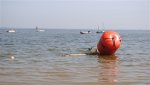
You then hire a 3 tonne airbag from Seatec on the isle of white. Delivery is about £40 & hire is about £40 per day. I bought 2 at £1000-00 each with a friend. We purchased a couple of cheap blower pumps for £ 20-00 ea as the pressure required is only 2 PSI

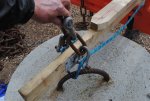
I designed a release mechanism with some timber & 14 mm dynema but for a 1 off you can do it very simple with rope that you just cut.
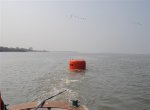
We place the sinker at low tide, attach release mechanism & air bag, wait for tide to come in & float it off & then tow to the drop point then release
My friend & I bought a 20 ft launch for the job & we do 4 moorings a day but one could tow the airbag and sinker with a yacht with a fairly powerful engine.

I wrote an article for PBO as I thought that sailing clubs could use the idea & save money but the editor would not publish it as he thought it was an advert for Seatec. I tried to explain otherwise but he would not listen

Airbag under tow (600 x 439).jpgLifting end (600 x 402).jpgDSC_0053 (2) (600 x 337).jpg
 

Attachments

  • Waiting for the tide to float off (320 x 240).jpg
    Waiting for the tide to float off (320 x 240).jpg
    17.7 KB · Views: 1
Last edited:
I laid 36 moorings at the start of this season - the largest being 2.4 tonnes plus the tackle etc. ( although I would not like to do another that size) We have found that a 1.4 tonne concrete sinker 1.600 diameter will hold a 40 ft yacht Ok all season & it has done so for 4 seasons now.

They were all concrete & it is far cheaper to make concrete ones on the shore using some metal bent in a circle for formwork, Some heavy chain in the middle to form the eye(you need about 750mm of 38mm chain) through the chain you put some 12 mm rods set at various angles as reinforcement ( buy it from somewhere like travis perkins) hire a mixer for a day & if there is a beach as we have just use the stuff around you.You need about 6 bags of cement.

Concrete weights 145 lbs per ft3 so you can work out the weight.
You could, of course get a small load of readymixed concrete at about £ 100-00 per M3.
Your biggest problem is getting it down below high tide level & our club has a tractor so I built a crane on the back.

You then hire a 3 tonne airbag from Seatec on the isle of white. Delivery is about £40 & hire is about £40 per day. I bought 2 at £1200-00 each with a friend. We purchased a couple of cheap blower pumps for £ 20-00 as the pressure required is only 2 PSI

I designed a release mechanism with some timber & 14 mm dynema but for a 1 off you can do it very simple with rope that you just cut.
We place the sinker at low tide, attach release mechanism & air bag, wait for tide to come in & float it off & then tow to the drop point then release
My friend & I bought a 20 ft launch for the job & we do 4 moorings a day but one could tow the airbag and sinker with a yacht with a fairly powerful engine.

I wrote an article for PBO as I thought that sailing clubs could use the idea & save money but the editor would not publish it as he thought it was an advert for Seatec. I tried to explain otherwise but he would not listen

View attachment 79376View attachment 79377View attachment 79378
Im told sinkers should have a concave bottom to assist "sucking" the muddy bottom of the river.
 
Im told sinkers should have a concave bottom to assist "sucking" the muddy bottom of the river.

We have laid hundreds over the last 40 years & never have we bothered with that. If the river bed is muddy the sinker will sink in anyway, Sinkers do perform better if wide & flat, rather than tall. Some of our sinkers come ashore with a foot of shingle & mud on top when recovered due to the movement of the sea bed.
That being said, Marconi YC is only a couple of miles up river from us & ditched the idea of concrete sinkers for anchors as sinkers did not work for them.
We tried anchors & they failed.
So 2 different solutions; only 2 miles apart. It all depends on what is on the bottom & how they are laid & conditions at the surface
 
Being involved in laying Marconi moorings it was interesting to read your account. I guess that it shows that there is more than one way of doing things and that local knowledge can be very local. I am also guessing that our conditions are very different to the OP’s.
 
Top