

zoidberg
Well-Known Member
Here's a comment from the Vendee Globe weather guru, which is relevant to our thinking...
And here's a pic of an 'unusual' wave a few miles north of St Ives, Cornwall.
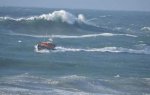
I wouldn't want to find myself 'beam-on' to one of them. And it wasn't the only one....
It is very clear that conditions which can capsize/invert a small or even 'Average White Boat' are to be found in many places other than the Deep Southern Ocean. Some of them are closer than many presume e.g. the Labadie Bank. What you are willing to do in preparation is a matter for you. The knowledge is out there....

"....these lows that form on the east coast of the USA or off Canada can be deep and can follow one another regularly with only 36 to 48 hours between two frontal passages," explains Christian Dumard, the Vendée Globe weather consultant. “And the key thing is this rapid succession of lows generates a residual swell in the North Atlantic. The wave heights now can be similar to those encountered in the Deep South".
And here's a pic of an 'unusual' wave a few miles north of St Ives, Cornwall.
I wouldn't want to find myself 'beam-on' to one of them. And it wasn't the only one....
"At the edge of the continental shelf, the sea depths rise from several thousand metres to a few hundred metres. This rise in the sea bed creates dangerous seas. We have the same thing in the South of New Zealand and at the approach to Cape Horn" continues Dumard. "The problem is that when the boats get into the Bay of Biscay, there is no way out. It is like a funnel
It is very clear that conditions which can capsize/invert a small or even 'Average White Boat' are to be found in many places other than the Deep Southern Ocean. Some of them are closer than many presume e.g. the Labadie Bank. What you are willing to do in preparation is a matter for you. The knowledge is out there....


