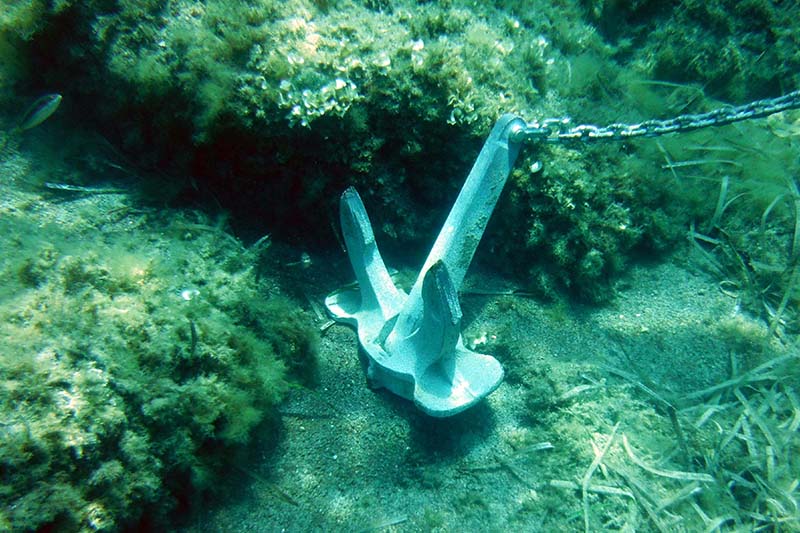
Dragging whilst on anchor

100m of 12mm chain weighs 325kg according to Google and as you say its going to need one hell of a pull to straighten that

I can't believe people are still banging on about the mythical use of catenary - 325kg pull is pretty small for a 35 foot sailing boat in a 20 knot breeze and a 40 knot gust is 4 x the force. If people can't understand the maths and don't trust people who do then a bit of snorkelling at 20 plus knots wind will show you how little curve there is left.

The angle at the anchor in any breeze or current that might drag you is set pretty much only by the scope. Looking at chain behaviour in light winds is of course a lesson in the lovely curve of catenary but pointless when it disappears at the moment you most need it.

The use of chain is for strength and anti-chafe so there is a point to chain but most experienced people are now investing in better and sometimes bigger anchors and in reducing their chain size and therefore weight so the strength is only perhaps twice the maximum they need not 4 or 6 times. Adding in a decent elastic bridle of any kind reduces the snatch loads leavingthe anchor with (hopefully light small diameter) chain to have to cope only with the forces averaged over a couple of seconds.

But if people are still in love with big heavy chain then all the previous anchor threads have shown they won't be convinced.
 
I'm not surprised at all to hear that.
And I also see your point that it doesn't take a bar tight chain to leave only the anchor holding, though I always experienced the same as Deleted User - i.e., a relevant chunk of chain never lifted from the seabed.
OTOH, also the pulling angle is bound to make a big difference on the anchor holding power, and in this respect a heavy chain can only mean a more horizontal pull, aotbe.

Firstly it's always only the anchor holding even in 2-3 knots of wind. Easiest way to find out if that's tosh or not is just to try anchoring somewhere with lots of room and almost dead calm with the boat end of the chain and no anchor attached. Try 5 or 10 to 1 if you really want to. Nobody has ever done that and ever said the chain holds the boat again.

But bar taut isn't what happens and would take a theoretically infinite amount of force to do - but it only needs to have so little curve that angle at the anchor is almost bar taut - say 5 degrees out from a straight line and the catenary force needed is very very much less than the force required for 1 degree from bar taut. And less than 5 degrees difference isn't really going to do anything for snatch loads or anchor/chain angle.
 
I’m in the jfm camp, I fitted a 40kg delta when I bought Eos over 10 years ago. 25 tons of boat has never dragged after anchoring for weeks on end each year, many occasions in full gales. I see no reason to change the delta.
 
I can't believe people are still banging on about the mythical use of catenary - 325kg pull is pretty small for a 35 foot sailing boat in a 20 knot breeze and a 40 knot gust is 4 x the force. If people can't understand the maths and don't trust people who do then a bit of snorkelling at 20 plus knots wind will show you how little curve there is left.

The angle at the anchor in any breeze or current that might drag you is set pretty much only by the scope. Looking at chain behaviour in light winds is of course a lesson in the lovely curve of catenary but pointless when it disappears at the moment you most need it.

The use of chain is for strength and anti-chafe so there is a point to chain but most experienced people are now investing in better and sometimes bigger anchors and in reducing their chain size and therefore weight so the strength is only perhaps twice the maximum they need not 4 or 6 times. Adding in a decent elastic bridle of any kind reduces the snatch loads leavingthe anchor with (hopefully light small diameter) chain to have to cope only with the forces averaged over a couple of seconds.

But if people are still in love with big heavy chain then all the previous anchor threads have shown they won't be convinced.

There is indeed a saying that the anchor holds the chain and the chain holds the boat.

This of course is a simplification of a dynamic situation. No different from you climb an aircraft with power and adjust speed with pitch. It is right, yes. Does it explain the whole dynamic - no.

The chain is there to keep the anchor perpendicular to the bottom of the sea. If it is perpendicular it stands a decent chance of digging in. if the anchor rises to a critical anchor it will come unstuck and depending on the wind / tide off you go.

The more chain and or the heavier that chain is the stronger the wind / tide has to be to lift the anchor to the critical angle and this is both the taught theory and bourne out in practice.

You are rather critical "If people can't understand the maths and don't trust people who do" without stating your own expertise - which may or may not be extensive. There are many experts on here of things from batteries to engines and infinite knowledge of things we never knew there was much to know of - however they all explain their position as opposed to simply dismissing others.
 
When I looked at this once I found that the chain would snap before it got straight. That said I have observed that the chain is to all intents and purposes straight in a good blow. That’s when your anchor holding will be tested, so I can’t see a lot of point in catenary and therefore in a heavy chain. It will help a lot when the wind is not strong of course, but who needs help then?


Well, the catenary pulls your boat towards the anchor in quiet weather and chain on the seabed also helps to prevent ranging about which can be very tiresome. So that's all good.

Ideas ebb and flow like the tide. Some pencil squeezer noticed that the traditional view of catenary might have been a bit overstated, or maybe choose to portray it as overstated in order to add an edge of drama.

We now have the opposite extreme and folk as saying stuff like:
"The weight of the chain is utterly irrelevant"
So it goes.
 
If people can't understand the maths and don't trust people who do
You'll forgive me if, as an exponent of those who don't understand the maths, I can't see why I should trust you, but nothing you wrote so far made me think that you do.
I'll happily bow to your superior knowledge as soon as you will actually demonstrate the (ir)relevance of chain weight.
Dismissing it as "utterly irrelevant" doesn't cut the mustard as a mathematical proof, as I hope you'll agree.

Firstly it's always only the anchor holding even in 2-3 knots of wind. Easiest way to find out if that's tosh or not is just to try anchoring somewhere with lots of room and almost dead calm with the boat end of the chain and no anchor attached.
I must admit that my curiosity on this matter has never been enough to bother making such experiment.
Otoh, I cruised for almost two decades with a boat whose anchors were as close to bricks as anchors can be.
The following pic shows one of them, and it was taken in the very same anchorage shown in the video below.
That was made in one of the cases I mentioned in my post #28, i.e. when I wanted the boat to stay close to the shore with a very low wind of variable direction.

Obviously, I would never trust the anchoring below for overnighting, but that ground tackle is the very same which was still holding (with some 80m of chain down, and less than 10m depth) when in the middle of the night, due to an unpredicted and radical change in wind strength and direction, we found ourselves pitching like hell in 4/5 feet waves and 25+kts gusts.
Now, remind me why I should have invested in better anchors, rather than sticking to bricks which clearly rely on sheer weight more than anything else? :rolleyes:
2K6kxeDO_o.jpg


I can't believe people are still banging on about the mythical use of catenary - 325kg pull.

I can't believe people are incapable of grasping the GCSE level fact that kg is a unit of mass not force (or 'pull'), such a basic error certainly doesn't incline one to give much credence to other technical assertions that you might make.
 
A 20kg fits like a glove. Go to the Rocna website and download the paper template, stick it to thick cardboard and cut it out. This will reassure you if you have any doubt

I did that, but my wife reckoned that we needed a metal version to hold properly - that one wouldn't even sink.
 
I did that, but my wife reckoned that we needed a metal version to hold properly - that one wouldn't even sink.
I fitted the metal Rocna but kept the cardboard Rocna as a backup anchor. I figured it would still be better than my Delta;)
 
I can't believe people are still banging on about the mythical use of catenary - 325kg pull is pretty small for a 35 foot sailing boat in a 20 knot breeze and a 40 knot gust is 4 x the force. If people can't understand the maths and don't trust people who do then a bit of snorkelling at 20 plus knots wind will show you how little curve there is left.

The angle at the anchor in any breeze or current that might drag you is set pretty much only by the scope. Looking at chain behaviour in light winds is of course a lesson in the lovely curve of catenary but pointless when it disappears at the moment you most need it.

The use of chain is for strength and anti-chafe so there is a point to chain but most experienced people are now investing in better and sometimes bigger anchors and in reducing their chain size and therefore weight so the strength is only perhaps twice the maximum they need not 4 or 6 times. Adding in a decent elastic bridle of any kind reduces the snatch loads leavingthe anchor with (hopefully light small diameter) chain to have to cope only with the forces averaged over a couple of seconds.

But if people are still in love with big heavy chain then all the previous anchor threads have shown they won't be convinced.

I'd love to see the math. Not that I doubt you, just that the mind boggles. I remember as a kid setting up a zip line across a small river. About the same length of 100m. To straighten the cable enough to carry a 45kilo child took some pulling on a 5T block and tackle. The leverage to hold up 325 kg over 100m must be quite something indeed. As said previously, such force would surely snap a chain.
 
My books on another site .How ever basically from memory

Anchors and FAST PLANNING hulls - 3 points

Lifted from my favourite book “ Navel architecture of planing hulls “ by Lindsay Lord :encouragement:

1-
Calculating suitable weights for planing boat anchors is more one that is largely related to windage than displacement.
Hence 5 or 7 ton breaking strain or whatever fitted to a typical 45 ton Fly bridge 20 M boat .
The greatest wind resistance of a boat occurs off full beam.
The heaviest pull on an anchor is a function of mainly topside windage of Sq M of boat profile - not the displacement.

Imagine a sail for a 5 ton yacht I can carry that wrapped up in its bag over my shoulder, but I can’t carry the boat and the sail moves the boat .

2- chain size
Naval architects use the formula for anchors 10x the pull of the anchors own weight ,a notional break free figure , then add a safety factor of x4
Strength / size / weight beyond this point becomes clumsy to handle - requires unnecessary larger and basically useless gear .
Which I think is why the OEM stuff is what it is .
So in old units ( you may need to convert metric back )
A 50lb anchor ,should hold a 500 lb pull, with a safety factor of 4 = 2000 lbs .

So you need to do any maths based on windage and anchor pull strength of the chain .Not the displacement.
Mentally think of a sail .
The added safety margins cope with any snatch forces from sudden waves .

So what stops us going mad and fitting the most badassarey ground gear we can get our hands on ?
Keep wearing your planning mobo hat , no s sneaking a D speed or sail boat hat on :)

3- Adding weight to the bow

The centre of net lift (CL ) - when planing is just behind where the point where the boat lifts out ,ideally as near the centre of gravity as possible to maintain the most stable ride interms of maintaining the ideal angle attack or planing angle .
How ever in reality with variable weights like fuel / water / stores etc this is not always possible .
The further divergent the CL and CoG the more likely or the boat to increase its pitching motion when planing through waves .
If you put too much weight on the bow - you can end up with a higher longitudinal moment of inertia , resulting in decreasing the ability to climb over waves , increasing the method of travel to go through rather than over .
This may flatten out the ride in rough seas and be seen to be beneficial , but at the expense of increased wetted area and more drag , slower speed or increased fuel burn if you set your speed for the cruise .
More likely to get wet from spray forming earlier Fwds and higher .
Depending on how fine the bow sections are in front of the centre of lift you may find in bigger seas the boat gets knocked off the plane sooner , ie at say 20 knots as opposed to 18 knots when pressing on in a big head sea , with more weight on the bow from the proposed new heavier gear

How ever if you have also (unwittingly)done the reverse by adding weight on the stern bathing platform say in the common huge tender example then adding weight to the bow could be beneficial in terms of rebalancing the CL , but increased overall wetted area so a slower boat than a stock OEM without the extra weights at each end .
Excess weight aft in a planing boat in a following sea is a cause of broaching so adding or rebalancing weight Fwds .The more plastic underwater that presents to the following waves running downwind the greater the potential yawing forces .
 
Last edited:
I can't believe people are still banging on about the mythical use of catenary - 325kg pull is pretty small for a 35 foot sailing boat in a 20 knot breeze and a 40 knot gust is 4 x the force. If people can't understand the maths and don't trust people who do then a bit of snorkelling at 20 plus knots wind will show you how little curve there is left.
Blimey why is it that any thread on any forum about anchors always has to get nasty. If you and Elecglitch bother to read what I actually wrote, I never said or suggested that because a chain weighs 325kg it requires a force of 325kgf to pull it. As I said, I have on many occasions over nearly 30yrs of boating snorkelled out in high winds to observe how my anchor and chain is behaving and as I said I have yet to witness the final part of the chan lifting off the seabed such that the pull on the anchor is anything but horizontal. You can take it or leave it but I believe that because of that and because there is a certain coefficient of friction between the chain and the seabed, that part of the chain on the sea bed provides resistance to being pulled which is in addition to the resistance provided by the anchor

If you take your argument to its logical extension, why do you guys bother with chain at all? Why not connect your anchor to your windlass with wire rope which has a similar breaking strain but which is much lighter and can be stored more easily?
 
So you need to do any maths based on windage and anchor pull strength of the chain .Not the displacement.
I disagree - again, based on empirical evidence, rather than any theoretical reasoning and/or any kind of maths.
Each and every time I've been anchored in strong wind, I noticed that the boat keeps swinging along a rather wide arc, up to 90 degrees or so, if not even more.
I suppose that the "normal" chain load along this arc depends mostly on windage, but the problem is that the snatch load is by far (I mean, to the point of being clearly perceivable onboard) the highest/worse, every time the boat reaches the limits of this arc.
Strong and sudden gusts can further emphasize this effect, but let's forget that, in this context.
My point is that this snatch load is mostly driven by the boat momentum, which obviously depends much more on her mass (displacement), rather than windage.
 
I disagree - again, based on empirical evidence, rather than any theoretical reasoning and/or any kind of maths.
Each and every time I've been anchored in strong wind, I noticed that the boat keeps swinging along a rather wide arc, up to 90 degrees or so, if not even more.
I suppose that the "normal" chain load along this arc depends mostly on windage, but the problem is that the snatch load is by far (I mean, to the point of being clearly perceivable onboard) the highest/worse, every time the boat reaches the limits of this arc.
Strong and sudden gusts can further emphasize this effect, but let's forget that, in this context.
My point is that this snatch load is mostly driven by the boat momentum, which obviously depends much more on her mass (displacement), rather than windage.

From memory I can’t remember any mass in the equation.
Are talking the same end ?
I,am at the anchor end ( suspect Mike is too ? ) the chain if you in that camp is either horizontal or just coiled up in pile if you have let enough out .
So while granted the bow roller and windlass part may do as you describe- boat veering about and I,ll add a few waves for vertical occilation ot the bow roller for realism .

Anchor shackle feels nothing .

Chain disturbs the sea bed near the boat as it’s dragged sideways ( which actually helps it resist ) and does it catenerary thing as it’s lifted .

Buts as said directly under the bit you quoted I did say .......
“ added safety margins to cope with snatch “

Depends if you are believer in the chain or not ?
I can’t see any chain lifting if the anchor is in Sydney and boat in the E Channel - Ok exaggeration but on the L side part of the scope but they can’t all lift to 5 degrees warp / curveature accepting there’s no such thing as bar tight .
In that example in say 30 M deep as the wind moves the boat it will lift some chain but not all of it back to Sydney .
Therefore the theoretical breaking force of the weight of the 10,000 miles working against itself ( Mikes 325 Kg or what ever ) never comes into effect .The boat Ony lifts say 100 m .

So for me if put 70 M of 10 mm out in 4 m , there’s nit a snow balls chance in hell the anchor shackle will feel a thing in a blow , snatching and all .

I have seen the chain lift if the L on the bottom is insufficient, like if put 6 m out in 4m deep and the wind risers - sure , but like mike I tend not to do that after years of observation.
In fact if anything put far too much chain down as others have inferred making the anchor just a weight doing nothing .
 
Last edited:
If you take your argument to its logical extension, why do you guys bother with chain at all? Why not connect your anchor to your windlass with wire rope which has a similar breaking strain but which is much lighter and can be stored more easily?
M, that's actually an alternative which I have seen on some hardcore trawlers, and which can make sense for whoever wants to explore also very deep anchorages, since you can arrange the ground tackle with extreme cable lengths (I mean, up to 300m if not more!) that would be impossible or very impractical to store, using chain alone.
Otoh, I've only seen that in boats built with drum winches by yards of commercial/fishing boat heritage, like the rather well known Wanderbird, and also some Northern Marine vessels.
Anyhow, also in these cases, there is ALWAYS a pretty substantial length of chain attached to the anchor(s), for the very same reasons that you are mentioning, I reckon.
Or maybe, it's just because none of those boater are familiar with maths… :rolleyes:
 
Blimey why is it that any thread on any forum about anchors always has to get nasty. If you and Elecglitch bother to read what I actually wrote, I never said or suggested that because a chain weighs 325kg it requires a force of 325kgf to pull it. As I said, I have on many occasions over nearly 30yrs of boating snorkelled out in high winds to observe how my anchor and chain is behaving and as I said I have yet to witness the final part of the chan lifting off the seabed such that the pull on the anchor is anything but horizontal. You can take it or leave it but I believe that because of that and because there is a certain coefficient of friction between the chain and the seabed, that part of the chain on the sea bed provides resistance to being pulled which is in addition to the resistance provided by the anchor

If you take your argument to its logical extension, why do you guys bother with chain at all? Why not connect your anchor to your windlass with wire rope which has a similar breaking strain but which is much lighter and can be stored more easily?

You are right of course - I wasn't being polite the way I try to be on most threads - but I find the nonsense spoken on faith based threads difficult so must learn to be more of a reasonable human being.

On your other point, there is no discernible friction of chain on a seabed unless it is caught round something. Again simple to find it if that is tosh by trying it with the other end of a chain with no anchor attached.

The other myth that a heavy chain changes the angle that the anchor is pulled at is absolutely true until the wind gets up to 15 knots, 20 knots, 25 knots - whatever the chain and boat combination is then becomes so small (never bar taut but close) that just when you need the best angle it is gone. Scope is the only guarantee of getting a good angle that remains just as important in a strong wind as a light wind. And most modern anchors are better at retaining almost perfect holding at higher angles, so an old fashioned anchor might need 8:1 before it's maxed out the advantage of scope but 5 or 6 to 1 will do it for some modern ones.

But as anchoring is either a matter of understanding, observing learning and experimenting for some, and faith in phrases for others I don't expect to convince anybody who prefers to believe in experience alone. It's like the debate last year on why snorkelling over your anchor was a bad habit to have.

Yes, you are right that the most common way of describing the non-faith based rode is "an infinitely strong length of piano wire". The reason we don't actually go for that is that the other characteristic of chain is anti-chafe and that is invaluable.
 
Top