
Downwind Using Second Jib

Slowboat35

Well-Known Member
Joined
4 Apr 2020
Messages
2,655
Visit site
I've just turned up an old jib (High-cut Yabkee actually) and wonder if it could be used as the other half of a twin-headsail downwind rig. Most times you see this it is using a twin groove headstay which I don't have - but how would it go hoisted on the spinny halyard? Clearly there would be a gap between the sails , maybe quite a big one, but would the sail take the strain without a supporting foil?
 
I've just turned up an old jib (High-cut Yabkee actually) and wonder if it could be used as the other half of a twin-headsail downwind rig. Most times you see this it is using a twin groove headstay which I don't have - but how would it go hoisted on the spinny halyard? Clearly there would be a gap between the sails , maybe quite a big one, but would the sail take the strain without a supporting foil?
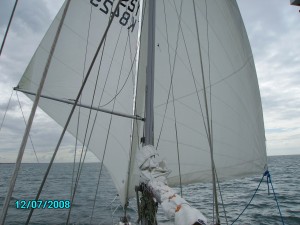
No problem at all. The supporting foil holds the luff straight which is good for pointing (it manages the draft of the sail by keeping it flat), but irrelevant deep downwind. The luff tension is held longitudinally between halyard and bow fitting.

Your biggest challenge likely to be managing the loose-luffed sail on the hoist and drop, especially if short handed. Much easier if the halyard is at the mast.

An excellent tip we used with our spinnaker last year is to keep one or two turns on the winch and chuck the halyard tail overboard when dropping. Gives just the right amount of friction.
 
Down wind I use the Genoa and a High-cut Yankee on an inner fore-stay.
The gap between the sails reduces rolling (allows the air to spill in the middle), that's why they put a hole in the top of a parachute.

PICT0597-300x225.jpg
 
It will, but with two sails of unequal size you might find the action of the boat interesting.

I kept my old foresail, but still need to experiment with both raised.
 
We’ve just had our old genoa recut and had a bolt rope and hanks added so we can fly it downwind from a detachable inner forestay. Picking it up on Monday so I’ll be very interested to see what Pete Sanders has done with it. I’m interested to hear that the slot between the sails is supposed to reduce rolling. I’ll report back if I get a chance.
 
It will, but with two sails of unequal size you might find the action of the boat interesting.
Not at all. Done this many times over 1000s of miles.
The ultimate set up is twin furlers with twin poles. Working jib on inner furler, genoa on outer furler. Easy for on watch crew to adjust sail area for Tradewind sailing at night. All done from the cockpit with ease
 
Once set should work OK. Setting and dousing though in any breeze can result in biggish shock loads on the halyard. Keep it under semi-control though and you should be OK.
 
Not at all. Done this many times over 1000s of miles.
The ultimate set up is twin furlers with twin poles. Working jib on inner furler, genoa on outer furler. Easy for on watch crew to adjust sail area for Tradewind sailing at night. All done from the cockpit with ease
Lacking twin poles, have used one pole for one headrail and a braced boom for the other. Cheap and easy.
 
Lacking twin poles, have used one pole for one headrail and a braced boom for the other. Cheap and easy.
It's not an option for us. Reasonably high cut headsails are too high for an effective stay with our main boom. With the poles we can get the headsails tight and flat. This stops the sails filling and emptying as the boat rolls. For one things it's very wearing on sails to have them doing this and noisy as well. Downwind sail shape is not that important but sail wear and tear is IMHO. My second spinnaker pole cost me $50 in the Bahamas. We already had two mast tracks for poles so happy bunny ?
 
Top