Domestic freshwater pump problem...

Iain C

Well-Known Member
Joined
20 Oct 2009
Messages
2,366
Visit site
Happy New Year all...

I was on my boat (2004 Bav32) between Christmas and New Year and it's developed a fault. All was fine until I refilled the water tank from about 50% full to 100% full (although I stopped refilling when it sounded like it was nearly full rather than letting it overflow as per usual).

Normally, when I turn the water pump on at the panel, the pump slows as the pressure builds and then obviously stops until a tap is opened and pressure is lost. Now what is does is slow down as normal, but then gets really slow and then a noisy "hammering" occurs, exactly the same as you sometimes get when you get hammering/an airlock in a domestic house system when you close a tap too quickly. When I looked at the tank, the LP pipes going to the water pump were indeed moving in time with the hammering noise. The pump still works, but obviously I was having to turn the pump on at the switch panel for the exact time I was using the tap.

It does seem weird that this happened after filling the tank. Any ideas please people?
 
do you have any accumulator vessels in the outlet plumbing. if so i would suspect they or it might have lost its capacity, partly due to the colder weather.
 
Filling the tank has stirred up debris that has been drawn into the pump. A small particle is now lodged on one of the valve seats. There should be a strainer upstream of the pump that stops stuff like this. You will need to strip the water side of the pump and clean the valves and seats.
 
Thanks guys, much appreciated. It certainly makes sense that there's dirt in there, the odd thing is that the tank was the fullest it's ever been before I re-filled it, and the pressure of the mains hose in question was the feeblest!

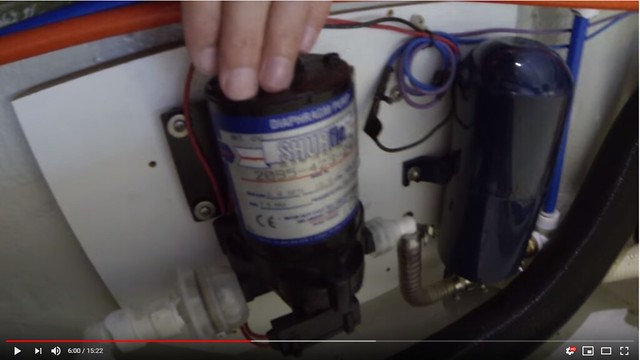
My setup is identical to this...not my boat but screen grabbed from a YouTube video of an identical one. I was pleasantly surprised that the complete pump is only £50 but if I can fix it for free that would be great.

Incidentally, if the pump fails there's effectively no way to get water out of the tank as there's no hand pump on the boat. Plus with the pump right under the head of whoever is sleeping in the stern cabin, using the pump is a bit antisocial at night. If I wanted to install a hand pump, is it simply a case of taking a T piece feed from the LP side of the tank and running it up to the galley sink?

31632695487_0847d66a24_z.jpg
 
Thanks guys, much appreciated. It certainly makes sense that there's dirt in there, the odd thing is that the tank was the fullest it's ever been before I re-filled it, and the pressure of the mains hose in question was the feeblest!

My setup is identical to this...not my boat but screen grabbed from a YouTube video of an identical one. I was pleasantly surprised that the complete pump is only £50 but if I can fix it for free that would be great.

Incidentally, if the pump fails there's effectively no way to get water out of the tank as there's no hand pump on the boat. Plus with the pump right under the head of whoever is sleeping in the stern cabin, using the pump is a bit antisocial at night. If I wanted to install a hand pump, is it simply a case of taking a T piece feed from the LP side of the tank and running it up to the galley sink?

There should be a strainer on the inlet side of the pump; clean this.

I'd also open all the taps and let most of the tank get pumped out, this might dislodge any small bits in the pump valves.

As for a hand pump, you can plumb this in to the tank side of the electric pump. If you're seriously thinking of doing this, I'd suggest you consider a foot pump, as this leaves both hands free.
 
Even with the tap closed? Only if the accumulator is leaking water, surely. My boat did not have an accumulator until I fitted one. Pump ran all the time a tap was open.

Exactly - Our accumulator failed by rusting through at the bottom then the edges ripping the membrane so it just pressured into the bilges.
 
Diaphragm pumps are quite simple to strip and clean, but first run a bowl full of freshwater to clean the parts in, preferably warm with some fairy liquid. A very light coating of silicon grease or Vaseline refreshes the various rubber seals. If any seals are perishing or cracked / splitting then perhaps time for a new one.

My last two boats I've installed the Seaflo 17lt/min ones from EBay, and have had no issues at all, even after the current one was running dry for ~a week after a calorifier leak allowed the tank to run dry.

https://www.ebay.co.uk/itm/SEAFLO-H...600323&hash=item3d52f6930e:g:gVcAAOSwjyhaMEBI

Don't forget to check the pressure switch is also clean.

If your tank has an access port it might be worth draining it out then use a wet and dry Hoover to remove any loose crud. It is surprising how much limescale can accumulate in a cold water tank.
 
Last edited:
Top