
PaulRainbow
Well-Known Member
A question please - why would you want five batteries? Most have one unless they are deep cycle, such as Trojan, and have two.
Be some pretty basic electrical systems if you can manage on a single battery.

A question please - why would you want five batteries? Most have one unless they are deep cycle, such as Trojan, and have two.
A question please - why would you want five batteries? Most have one unless they are deep cycle, such as Trojan, and have two.

I'm going to look at resistance values of wires of different diameters -anyone have a good source for this?
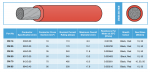


You can also do that, possible more conveniently, by varying the lengths of the cables between the batteries.I'm going to look at resistance values of wires of different diameters -anyone have a good source for this?
Assume you want to achieve 400 Ah at 12v
Now, please ignore size, cost, installation factors and weight.
I have it in my head thats from a charge and discharge perspective its best to have for example; 2 x 12v 200Ah rather than 5x 12v 80Ah batteries. Am I correct and why?
Apart from having few total cells in the 200 set up are there any other reasons for it being better to have larger batteries.
Thanks
Dave
Depending on how you intend to use it, it might pay to consider splitting into two smaller banks?
Why? A large bank works more efficiently.
According to my calculation, based on 0.7mm wall thickness, that gives you a 22mm2 connection. Less than half the 50mm2 cables on my installation and probably less than your "heavy duty lead".... ...
My made to measure connectors are lengths of flattened 10 mm copper pipe.
And then fails as a single unit.
It might be worth looking at failure modes and so forth over the whole lifecycle of the batteries.
This seems to be a big bank, where maybe the advantages of it being a single bank are wearing thin.
One duff cell will bring the whole system down.
If you don't treat each battery in a bank identically, they will fail prematurely.
If you do treat them identically, they will tend to fail together.
Plus if you have two banks for different loads, what constitutes acceptable performance might be significantly different.
According to my calculation, based on 0.7mm wall thickness, that gives you a 22mm2 connection. Less than half the 50mm2 cables on my installation and probably less than your "heavy duty lead".

Regardless of the theoretical Smartgauge calculations, just taking the positive and negative connections from opposite ends of the bank is simpler and works fine. On my last boat, I had 6 x 110Ah batteries in parallel wired in this way, with no problems. You're never going to run the batteries completely flat, so the theoretical niceties are largely irrelevant.

I quite agree. This issue came up a few months ago on another forum and an electrical engineer who also designs and manufactures marine electrical equipment, mostly used in battery charging and related. She said the concern with wiring batteries in a multi-battery bank to give all batteries the same charge path, resistance, cable lengths, etc is completely unnecessary in a real work setting. Yes in theory it looks good but when you actually calculate the differences in charging current, cumulative resistance of cables and connections, and all the issues claimed to be a problem the numbers show that the charging problem is less than negligible. I ran the calculations myself and had to agree with her conclusions, even though I had already wired my battery bank to comply with the other theory.
Note that this applies to a typical marine battery setup and usage. If one has frequent needs for very high current from and/or deep discharge of the battery bank then it starts making sense to wire for equal charge/discharge paths.
If you can get them at a reasonable 6 volt golf cart batteries are the way to go 4 of them will give you a 450 ah bank. They cope with deep discharges better than thin plate cells.
I have 6 and get away with leaving them all connected as I charge daily using solar.
That's what I said in #16.
Brian

That's a rather pessimistic view. In 40+ years of boating, I've only experienced one cell failure, in an 8 year old battery which was part of a 6-battery bank.
A single large bank has many advantages - it accepts charge more readily, it experiences less depth-of-discharge for a given load, the currents in each battery are lower.
Quite right. No intention to correct or demean your post. I started mine earlier but had to leave for a bit and did not see your post when I sent mine.
It does however prove that we are both very smart and erudite boaters.
Not meant that way, just that I agreed with you, I've spent the last 45 years working on battery charging, today to much is controlled by the marketing people.
Brian
Similar experience in my 40 years boating re bad cells. Also I use my batteries as one large bank for the reasons stated.
Also, if there is a bad battery or cell in my bank, it's just a matter of a couple minutes to remove a cable or two to isolate the one bad battery.