Does this olive need removing before fitting gas pipe?

steve yates

Well-Known Member
Joined
16 Oct 2014
Messages
4,104
Location
Benfleet, Essex/Keswick, Cumbria
Visit site
Getting ready to put the galley back in bethfran, ive got 3m of 8mm copperpipe with fittings at each end attached with compression joints, attaching the spigots for flexi gas hose, one to the regulator, the other will attach to a spigot fitted to the gas inlet on the gimballed cooker.
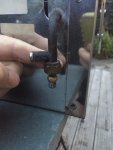
The cooker is secondhand, and looking at it, I dont think that olive or nut should be there? I want my own nut and olive on that tailpie to make the compression joint with the matching spigot. Am I right? and how do I remove the olive?
Thanks.
 

Attachments

  • bethfran-gasinlet1.jpg
    bethfran-gasinlet1.jpg
    88.6 KB · Views: 154
I would have thought that you could reuse the olive and nut provided its not damaged or been over tightened. You will presumably be attaching something with a compression union.

If not then an "olive puller" should get it off safely without damaging the pipe or the cooker

Joint sealer should not normally be used on compression joints but maybe a very very light smear over and around the olive if you reuse it would not be too great a sin
 
Last edited:
I would have thought that you could reuse the olive and nut provided its not damaged or been over tightened. You will presumably be attaching something with a compression union.

If not then an "olive puller" should get it off safely without damaging the pipe or the cooker

Joint sealer should not normally be used on compression joints but maybe a very very light smear over and around the olive if you reuse it would not be too great a sin
As VicS says. If you do use a joint sealer I would use a non hardening one or possibly hawk white which I think is a brand.
 
No such thing as an olive puller. As has been said, if you must, cut it off. Calortite , just a smear will seal it when you tighten up. Copper olives only, not brass. Good luck.
 
Not sure what these are then?

The olive removing tools for 8mm are I have discovered cutters , not pullers after all, and are rather more expensive . This one from BES is about £47
8-mm-olive-removing-tool_min_19247_P_1.jpg

Cutting most of the way through with a fine toothed hacksaw then splitting with a flat bladed screwdriver is probably the way to go if its necessary to remove it. Maybe use a Dremel if there is room ( perhaps cut the nut off first)
 
mebbe it's just me - but is that cooker pipe mild steel, and fairly rusted? could you change the pipe from inside the cooker? gas and all that ;-)
 
If you cut a little deep while removing the olive, you've wrecked the pipe. I'd be inclined to try it as is. If there's any leakage, a bit of gas rated PTFE tape (yellow reel, IIRC) should sort it.
No,,,,,,, PTFE tape is for sealing threaded joints of size 1/2" bsp and larger, never for trying to seal olives which should be sealed with Plasticon or another approved non setting gas compound if required.
 
Just to add to the blend - as per VicS I would certainly re-use if possible, trying to remove the old olive risks further hassle. A key comment that has not been added is that, whatever you do, you should test to ensure the fitting is gas tight once you have assembled the pipe run, use propriety liquid such as Snoop or Teepol for best bubbling effect, Dilute washing up liquid is best avoided due to its salt content (or wash down well with tap water afterwards). Apply with a paintbrush if space is tight.
 
Just to add to the blend - as per VicS I would certainly re-use if possible, trying to remove the old olive risks further hassle. A key comment that has not been added is that, whatever you do, you should test to ensure the fitting is gas tight once you have assembled the pipe run, use propriety liquid such as Snoop or Teepol for best bubbling effect, Dilute washing up liquid is best avoided due to its salt content (or wash down well with tap water afterwards). Apply with a paintbrush if space is tight.


You should be doing a manometer test before opening the gas pipe to establish that there is no pre work leak, and again after all connections are finished.
This is the only certified 100% test for gas tightness.
 
You should be doing a manometer test before opening the gas pipe to establish that there is no pre work leak, and again after all connections are finished.
This is the only certified 100% test for gas tightness.
As I understand it there are two pressure tests which should be carried out

One on the pipework and appliances, before the regulator is fitted and the gas cylinder connected, using air at 70mb. This obviously requires a pump .

The other on the complete system, after fitting the regulator and connecting the gas cylinder using the gas at 20mb for butane or 30 mb for propane.

In both cases there should be no detectable loss in pressure over 5 minutes after allowing an initial 5 minutes for the temperature to stabilize

(The above is 14 year old info from the old Corgi handbook which may have been updated by Gas Safe)
 
Top