Does my propeller need priming again this year?

TheBomber

Active Member
Joined
13 Jul 2016
Messages
48
Visit site
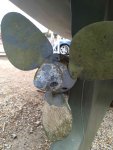
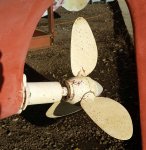
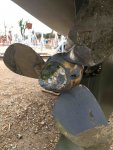
Last year I took the propeller off and brought it home so that I could precisely follow the Seajet Triple Pack instructions for priming and antifouling (particularly the requirements re temperature for the epoxy primer). When the boat was lifted, and after a jet wash, the propeller looked like this:
IMG_1373 small.jpg
IMG_1375 small.jpg
The antifoul is/was grey but I can't remember if the primer had a colour and hence whether there are any parts which will need new primer. Unfortunately I expect the answer to my thread title is 'yes'. Why does the paint/primer come away like that?
 
A propellor is a harsh environment for a surface coating - for many obvious reasons. If you do not follow the instructions for applying the primer it can be removed very quickly. Usually the instructions mention use an abrasive of a certain size, don't touch the abraded surface with fingers, don't clean with X use Y etc etc. Get it wrong and it all peels off - I learn the hard way, twice - different coatings (I'm a slow learner).

I would recommend that you re-coat with primer. Abrade down but not so harsh as to remove any primer left but hard enough to rough up exposed metal. Then re- coat with the appropriate AF. Primer may be expensive - but losing the top coat is more expensive - don't try to cut corners. Getting it wrong is factorially more expensive than another coat of primer.

I'd do as you did last time - take it home and do it in the comfort of your kitchen :)

Jonathan
 
Thanks Jonathan. I was coming round to the same view after initially hoping that the primer would last a number of seasons. I’ll give the Seajet another go this year and maybe try some alternatives in the future.
 
If you already have the Seajet - then use it. Velox has had the highest number of votes for effectiveness over the last few years but at the back of my mind is the idea its more difficult (maybe impossible) to source now in the UK. All AF work on the basis you use your yacht, leave it sitting for a period of time and AF will foul - including a prop. Simply running the prop every time you are at the boat would help (as movement keeps fouling at bay). So even if you are just there to check something - run the engine for a few minutes - in gear - this will help keep the prop clear but will do nothing for the hull - you need to take it out and move the yacht to keep the hull clear.

I find Velox over priced in Australia and does not justify the costs and have been using Trilux. But we can beach easily, its a catamaran, and I am quite happy to wipe down the hulls and attack the props with a kitchen sink nylon scrubber. I've tried PropSpeed and PropGold (the latter aka PropOne, both silicone coatings, and have not found the positive results justifying its costs and popularity.

Good Luck

Take care, stay safe

Jonathan

edit

My conclusion is that there is no really effective AF for props. Hull AF can last a couple of years - if you do not eke it out when you apply it, buy something decent and move (ie use) your yacht - we are still all looking for the perfect answer for props. If you do not follow the intsructions for prop treatment - it will fail :(
 
Your experience is very much in line with mine. I have used the Seajet product for several years and each year have found myself taking the prop back to bare metal and starting over again. Each year I hope that next year will be different (definition of stupidity?). On lifting out, the prop is usually fairly clean so the stuff has worked but cleaning the prop before anti-fouling has always left the primer looking sad so I end up removing it all. I have enough left for one more year and will then try a different material. The prop is a Brunton Autoprop so needs annual servicing anyway. Seajet is better than nothing but not the solution I had hoped for. Thanks for asking this question - had intended to ask exactly the same!
David Morgan
 
I tried using Velox on my saildrive folding propeller and despite careful cleaning, sanding and priming it started to come off the first time I used the engine. It left a visible stream of white flecks in the water. Two others in the club who shared the tin with me had much more success so maybe it was me or residual grease on the blades. I reverted back to Trilux which had given good results for many years. I cleaned the Velox and primer off and applied the Trilux directly with no primer. As usual, it performed almost perfectly even in those years where I hardly used the boat. She's only in the water for 6½ months so I don't know how it would fare over a full year.
 
Sounds like I should be reasonably pleased with the Seajet - it seemed to do the job through the season and anytime I went swimming it looked in reasonable condition. I shall, however, take note of Jonathan's recommendation to run the prop even when moored sometimes, to help prevent any buildup.

I have enough left for one more year and will then try a different material.

David - does this mean you don't mix up all the 2-part primer in one go? That seemed to be the instruction so I did, which is why I only have a part tin of antifoul left now.
 
I use Hammerite special metals primer on a Featherstream with a Velox top coat. The Hammerite is excellent, far better than the Velox primer I used before (once!). Prep is easy and 95%+ of the primer and antifoul is still attached at the end of the year, it just requires touching up over winter, even a gap of two years between maintenance visits is not problematic.
This is the prop at the end of the year, white is the Velox, red the underlying Hammerite
1646474244945.jpeg
 
Last edited:
I tried to buy some Velox Plus earlier this week but it's in short supply as it's being withdrawn in small tins and will be only available in 5L tins in the future for 'professional use only'. Trilux 33 is also going the same way I was told, but will be replaced with International Cruiser 200. Apparently it is all to do with the EU Biocidal Directive Registration fee. The UK importer does not have enough sales to warrant it.
 
Sounds like I should be reasonably pleased with the Seajet - it seemed to do the job through the season and anytime I went swimming it looked in reasonable condition. I shall, however, take note of Jonathan's recommendation to run the prop even when moored sometimes, to help prevent any buildup.


David - does this mean you don't mix up all the 2-part primer in one go? That seemed to be the instruction so I did, which is why I only have a part tin of antifoul left now.
No - I did not mix all the two part primer in one go. I used a syringe and measured the proportions like that. This is the third year I have done this and could probably stretch it for one more year.
David M
 
No - I did not mix all the two part primer in one go. I used a syringe and measured the proportions like that.

If I buy a new pack this year I shall try that too - thanks. However, as I still have the antifoul and a tin of Hammerite Special Metals primer, I’m tempted to try that this year now that it has been suggested.
 
Many folks on here swear by hammerite special metals primer but it was a disaster on my prop with the (water based) that I bought last spring. I wonder if people with food adhesion are using old tins with a more potent (eg non water based) formula?

Or should I use more coats of primer?

I’m certainly methodical in using the right grade sandpaper and keeping the blades grease free
 
Many folks on here swear by hammerite special metals primer but it was a disaster on my prop with the (water based) that I bought last spring. I wonder if people with food adhesion are using old tins with a more potent (eg non water based) formula?

Or should I use more coats of primer?

I’m certainly methodical in using the right grade sandpaper and keeping the blades grease free
Same here, it came off the leading 1/4 of the prop blades after about 3 hours running on mine.
Strange, as it was well abraded and degreased. And paint from the same tin has stuck well on other projects, including brass and even (admittedly very poor) chrome
 
Many folks on here swear by hammerite special metals primer but it was a disaster on my prop with the (water based) that I bought last spring. I wonder if people with food adhesion are using old tins with a more potent (eg non water based) formula?

Or should I use more coats of primer?

I’m certainly methodical in using the right grade sandpaper and keeping the blades grease free
My tin is the water based formulation. As I recall I just lightly sanded the prop and wiped it with acetone before application. Then followed the instructions on the tin re drying and overcoating
 
Last edited:
Many folks on here swear by hammerite special metals primer but it was a disaster on my prop with the (water based) that I bought last spring.


Two years ago I painted the aluminium duo-props with Hammerite Special Metals Primer after first removing the remains of old paint. A few coats of the special metals primer were applied . It's water based paint applied by brush. Finally I applied a spray top coat of car body paint.

This week - Two years later - the boat was lifted ashore .
The primer is very much intact with only the blade tips bare metal in places .
There is one small blister probably where my preparation was not quite good enough.
The top coat is faded but substantially intact and worn off only on the forward facing faces of some of the blades.

This is a very good result with negligible bare metal showing and the remaining paint well adhered to the props.

Previous painting attempts have resulted in little remaining paint. The only exception being new props were the original factory paint is fairly durable.

I think this success must be substantially down to the Hammerite Special Metals Primer
 
Top