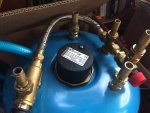
Does anyone have a picture of their calorifier set up?

Sooshark

Active Member
Joined
20 Apr 2016
Messages
50
Location
London
Visit site
I am removing an ancient calorifier this weekend. Got the instructions for the new one, but would quite like to see the finished thing first, just have a clear idea set out in my mind.

I've bought an ASAP Calorifier with an Accumulator...
 
Just follow the instructions. They're easy to fit. It's worth experimenting with the thermostatic mixer valve, until you get the optimum hot water temperature. This will allow you to just turn your shower on at the hot setting without scalding yourself!
 
It's worth experimenting with the thermostatic mixer valve, until you get the optimum hot water temperature. This will allow you to just turn your shower on at the hot setting without scalding yourself!

Trouble is that you then have less heat stored.

Being restricted in space compared to a house hot-water tank, I always understood that boat calorifiers were deliberately kept much hotter so that you mix in more cold water and thus get the same amount of warm water from a smaller tank.

A thermostatic valve at the shower is not a bad idea if you're worried about scalding, but the tank should be allowed to get as hot as it and its plumbing can cope with.

Pete
 
I think pvb is referring to the mixer valve on the outlet from the tank which will blend the 'hot' water from the tank with cold water to 'make it go further'. Certainly the thermostat on the tank itself should be set higher to maximise stored energy and also minimise risk of bacteria growth. However, when being heated by engine coolant you don't have much control over the temperature as it is pretty much governed by the coolant temperature.
 
Yes exactly - the calorifier is kept at a higher temperature and the thermostatic valve after the calorifier (but before entry into the hot water system) mixes the hot and cold to provide a steady temperature of hot water into the hot water system.

EDIT: beaten to it by Keith-i
 
Trouble is that you then have less heat stored.

Being restricted in space compared to a house hot-water tank, I always understood that boat calorifiers were deliberately kept much hotter so that you mix in more cold water and thus get the same amount of warm water from a smaller tank.

A thermostatic valve at the shower is not a bad idea if you're worried about scalding, but the tank should be allowed to get as hot as it and its plumbing can cope with.

Pete
Thats what I deduced from my Bene setup. The thermal switch, non adjustable, was set too high for my taste. Scalding water if not careful. Plus the PRV was stupid to cope with it, 6 bar IIRC. It led to the hot water hose blowing off the calorifier twice whilst underway motoring and the dumping of the water tank in to the bilges in a force nine! Did my heart rate good that one! I first of all tried an accumulator, that didnt help that much. Then I put a 2 bar PRV in. It stopped the hose blow off but dribbled all the time in the marina when the calorifier was on the mains. Then I put an external thermostat in circuit. Set it at about 60 deg C. Stopped the dribbling BUT as you say, the realisation hit me, Bene designed it to have really hot water so that a smaller calorifier produced more acceptable showers per cycle. I let the Admiral go first now and if it gets a bit cold, we are in Gib, so not to bad.
Stu
PS the temp in the calorifier is set by the thermostat, the mixing and outlet temp is done by the outlet at the sinks or heads.
 
Last edited:
PS the temp in the calorifier is set by the thermostat, the mixing and outlet temp is done by the outlet at the sinks or heads.

These days, most calorifiers have are supplied as standard with a thermostatic mixer mounted on the calorifier itself, to minimise wasting of hot water.
 
These days, most calorifiers have are supplied as standard with a thermostatic mixer mounted on the calorifier itself, to minimise wasting of hot water.
No doubt they are but you will note that I qualified my advice with ref to my Beneteau. I must say that all the other AWBs of that era that I have been involved with are the same.
Stu
 
Thanks for the replies! All useful info.

My main thing is the fact it said it came with all the fittings, but in the instructions it talks about push fit, hep20 or speed fit - there aren’t these fittings with it and the guy at ASAP said I didn’t need them - so am I supposed to jubilee clip them?

Also where the optional second coil is, those fittings you can blow straight through - they don’t need to be blocked off?

Cheers!

0F593B6A-E589-4B23-BEFC-CCB358ACC7A0.jpg
 
Last edited:
Thanks for the replies! All useful info.

My main thing is the fact it said it came with all the fittings, but in the instructions it talks about push fit, hep20 or speed fit - there aren’t these fittings with it and the guy at ASAP said I didn’t need them - so am I supposed to jubilee clip them?

Also where the optional second coil is, those fittings you can blow straight through - they don’t need to be blocked off?

Cheers!

View attachment 68350

Those spigots can just be used with rubber hoses and jubilee-type clips. Double clipping if you prefer.

If the second coil is self-contained and air just blows in one connection and out of the other then you can just leave it uncapped.

Richard
 
Just been looking at the Surecal website here http://www.surejust.co.uk/surecal-horizontal-calorifier-connection-instructions. The posted picture shows a single coil calorifier. The hose barb with the red knob is the hot water outlet, the adjacent slightly smaller barb is the PRV outlet, the barb with the black knob is the cold water inlet.

The barb fitted directly into the calorifier body nearest the red knob is the inlet from the engine, the other is the outlet returning coolant to the engine.

All the barbs are designed to have hoses pushed on to them and secured with jubilee clips.

Make sure that the hot water outlet uppermost when fitting the calorifier.
 
I had assumed that the blue pipe was something to do with the second coil .... but if it's a single coil then I don't know what that is? :confused:

Richard
No idea either but the layout on the Surcal website shows a square array of four barbs for the twin coil layout, which is missing on the posted photo. Only two barbs, so only one coil.
 
Thanks for the replies! All useful info.

My main thing is the fact it said it came with all the fittings, but in the instructions it talks about push fit, hep20 or speed fit - there aren’t these fittings with it and the guy at ASAP said I didn’t need them - so am I supposed to jubilee clip them?

Also where the optional second coil is, those fittings you can blow straight through - they don’t need to be blocked off?

Cheers!

The choice is yours.
Youd use Hep 20 fittings if you are plumbing with Hep20 pipe I guess but it you are plumbing with hoses they can be pushed on and secured with worm drive clips


You mention an accumulator in #1 but have you also bought an expansion tank, or is that what you meant ?


Hotpot_Connection_Instructions.
 
Last edited:
Just been looking at the Surecal website here http://www.surejust.co.uk/surecal-horizontal-calorifier-connection-instructions. The posted picture shows a single coil calorifier. The hose barb with the red knob is the hot water outlet, the adjacent slightly smaller barb is the PRV outlet, the barb with the black knob is the cold water inlet.

The barb fitted directly into the calorifier body nearest the red knob is the inlet from the engine, the other is the outlet returning coolant to the engine.

I'm afraid that advice is wrong.

* The hose barb with the red knob is the overflow from the pressure reducing valve to the bilge.

* The next barb on that fitting is the cold water inlet from the pressure pump.

* The barb with the black knob is the hot water outlet from the thermostatic mixer valve, to go to the taps.

* The 2 barbs connected directly to the calorifier body are the inlet and outlet for the water from the engine cooling circuit; it doesn't matter which way round these are plumbed.
 
Thanks for the replies! All useful info.

My main thing is the fact it said it came with all the fittings, but in the instructions it talks about push fit, hep20 or speed fit - there aren’t these fittings with it and the guy at ASAP said I didn’t need them - so am I supposed to jubilee clip them?

Also where the optional second coil is, those fittings you can blow straight through - they don’t need to be blocked off?

Cheers!

View attachment 68350

See my comments in post 16 regarding the correct way to plumb it.

The calorifier in your photo is a single coil calorifier.

Here's a (rather poor) photo of the Surecal calorifier I fitted in my old Hallberg-Rassy.

View attachment 68356
 
Last edited:
I'm afraid that advice is wrong.

* The hose barb with the red knob is the overflow from the pressure reducing valve to the bilge.

* The next barb on that fitting is the cold water inlet from the pressure pump.

* The barb with the black knob is the hot water outlet from the thermostatic mixer valve, to go to the taps.

* The 2 barbs connected directly to the calorifier body are the inlet and outlet for the water from the engine cooling circuit; it doesn't matter which way round these are plumbed.

PRV = pressure reducing valve or pressure relief valve. I would guess that you mean the latter?

I would, indeed, expect the relief valve to have the red cover and the output thermostat to have the black cover but I don't think there's any rules about that.

Richard
 
PRV = pressure reducing valve or pressure relief valve. I would guess that you mean the latter?

I would, indeed, expect the relief valve to have the red cover and the output thermostat to have the black cover but I don't think there's any rules about that.

Richard

If you want to be pedantic, Surecal call it a "pressure release valve".
 
I fitted a 22l horizontal single coil Surecal (are they exactly the same as the ASAP Hotpots – they look to be so and I note the name on the immersion heater?) and I recall being initially confused by the very lightly ‘barbed’ (actually just slightly indented ) fittings on it which, although I thought they were for hoses, actually directly accepted (in my case Speedfit) plastic plumbing fittings.

The OP’s, however, appear from the photograph to be true barbs – but I suspect that the end barbed section from the compression fitting can be replaced by a smoother brass fitting for direct connection to plastic, as mine were. Might that explain the following?

... My main thing is the fact it said it came with all the fittings, but in the instructions it talks about push fit, hep20 or speed fit - there aren’t these fittings with it and the guy at ASAP said I didn’t need them - so am I supposed to jubilee clip them? ...

BTW, I found Surejust very helpful by telephone when planning installation.
 
Top