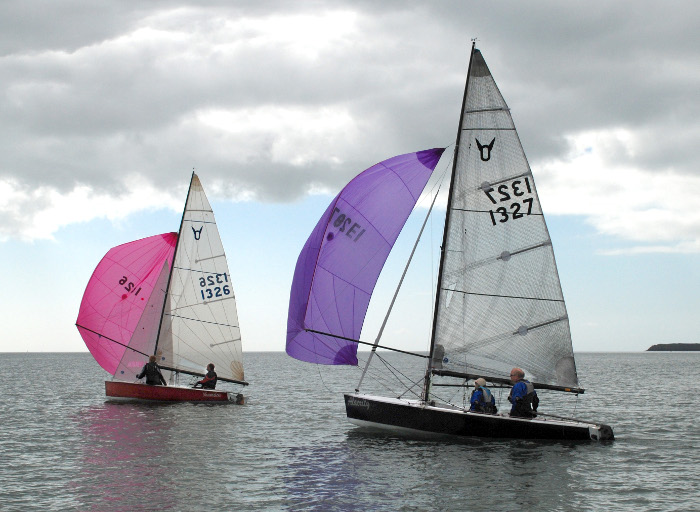
Do you use a spinnaker when you're single/shorthanded?

I can see that an asymmetric is small (if any) use at such times (feel free to correct me if you know a technique that allows an asymm to fly beneficially, DDW)...

The whole point of light wind sailing (especially in a light boat like yours) is NOT to sail DDW, but make better progress by sailing the angles and going downwind in a series of gybes. An Assy is a better tool for this as it can firstly normally be bigger and secondly when doing this the apparent wind is normally on the beam, so no need to pole back, so might as well have a nice stick out the front. Plus the shape is much more efficient.

I'd appreciate any tips on coping with the balloon as easily as possible...hoisting, controlling and rapidly snuffing.

Snuffing.... On a Dinghy.....?
 
you haven't really got a lot of responses from dinghy sailors because this is more a big boat forum.

I've sailed my RS400 singlehanded with kite up in a gentle breeze and it's fine - the hassle is the launch and recovery because you generally need 2 hands to do this quickly and with minimum fuss - the simplest way to achieve this is a bungee to hold the tiller central (ish) - and then don't rock the boat too much!

I'm not sure if your osprey has a chute or not - I'm not overly familiar with the class - if it does then launch and recovery is much easier - if not then it's just a bit more involved. Once up life is simpler - cleat off the guy at the right point then play the sheet - or you may want to cleat the sheet if you want to open that beer ... ;)
 
The whole point of light wind sailing (especially in a light boat like yours) is NOT to sail DDW, but make better progress by sailing the angles and going downwind in a series of gybes. An Assy is a better tool for this as it can firstly normally be bigger and secondly when doing this the apparent wind is normally on the beam, so no need to pole back, so might as well have a nice stick out the front. Plus the shape is much more efficient.
Depends if Dan has done the modifications required to shuv a fixed pole out the front for it - and tbh if he's using it for cruising then whilst the Asy is fun it's a lot of modification for not that much gain.


Snuffing.... On a Dinghy.....?
Yer ... for some reason they put socks along the deck ... strange ... ;)
 
Depends if Dan has done the modifications required to shuv a fixed pole out the front for it - and tbh if he's using it for cruising then whilst the Asy is fun it's a lot of modification for not that much gain.
Yeah, not sure I'd reccomend it on the "£ per fun" scale, but he asked!


Yer ... for some reason they put socks along the deck ... strange ... ;)
Much more sensible...
 
K

No. The bag is visible hanging on the guard wires in my second photo. When dropping the spinnaker I attach the inner corners of the turtle to the hand rails on the coachroof. This holds the top of the bag open. I never release the sheet from the winch until the spinnaker is in the bag. It is easy to bunch the whole foot together behind the mainsail, then stuff it into the turtle. I never fly the genoa and kite together, always furl first.

We're saying the same thing about bag positioning. No one that I know of flies the kite and genoa together for any length of time but most do unfurl the genoa to lower the kite. Dop you lower the kite without the genny unfurled?
 
You haven't got a lot of responses from dinghy sailors because this is more a big boat forum.

Snuffing...on a dinghy...?

I don't see why not...I have lazyjacks already. I'm not quite the typical dinghy-sailor, much more interested in yachtsmen's replies than dinghy-racers' class-bound logic. Presumably the benefit of a snuffer is quickly and safely to reduce a large, hard-to-control sail into something small, inert and manageable...to a singlehander, it sounds good!

I'll only know whether I gain more from one type, by trying both...and since avoiding the slow, straight route DDW is the idea and benefit of the asymmetric, I'm very tempted.

Assuming I'll only want either type on calm days when my white sails aren't nearly enough, I'm tempted to believe that the fittings and fixture-points needn't be Harken's finest...

...so is there a reason why I couldn't cobble-together a sprit, using my symmetric's pole? It wouldn't be neat, but I don't want to cut launchers in my hull if I can do it without.

...the hassle is the launch and recovery because you generally need 2 hands to do this...the simplest way is a bungee to hold the tiller central...once up, life is simpler - cleat the sheet if you want to open that beer... ;)

That sounds like my kind of sailing! Which won’t make sense to most folk, who’ll be thinking, why bother with the spinnaker at all?, or possibly, why not have a less demanding dinghy?…the answer is, I’m no racer, but nor am I so damned sedentary that I want a sailing couch.

I slightly dread the kind warnings this question will elicit...but since I really am only talking about using the kite in up to six knots of breeze, wouldn't it be fair to choose an enormous masthead one, such as Int14s and Cherubs fly?

The 'breath in, pull string, breath out' instructions will vary with what chute and pole arrangements you have.

Not sure I understand that!
 
Just a wee question, Dan: do you have a bungee across the tiller so that you can let go? Single biggest aid to singlehanding a dinghy!
 
We're saying the same thing about bag positioning. No one that I know of flies the kite and genoa together for any length of time but most do unfurl the genoa to lower the kite. Dop you lower the kite without the genny unfurled?

Leave it furled. I have been using exactly the same method as described earlier for well over 20 years now, never yet had any problems at all with it.
 
All boats seem too slow dead downwind and the asymetric only really pays downwind when it can seriously increase your speed and bring the apparent wind forewards.

Many ospreys seem to have been fitted with a spinnaker shute? if that's the case then hoisting and dropping should be easy, the tricky bit will be setting the pole. I used to be able to set the pole and run with the kite on my own in a Merlin Rocket but that's a bit shorter so easy to reach the front of the mast and still hold the helm (just)

Even if your boat dosn't have a shute you can still attach a downhaul to the middle of the kite, pull on this when you let the halyard/guy/sheet go and it will collapse into the boat. Bungy for helm is a good idea as it might steer you straight for long enough to set the pole...

The good thing with the Osprey is the kite doesn't hoist that far up the mast so you don't have miles of rope or a long sail! I've single handed an older 14 and had the kite up, dropping it steering with the helm between my knees was tricky. It will be possible and the drop is always easier than the hoist as you can leave the pole up until you're sorted, best to have a play on a light wind day.
 
The last time I flew my spinnaker when I was single handing was from Rhu to Broddick. I got the chute up just off Kip in the gentlest of breezes; lovely. The wind must have been 'squeezed' between Small Cumbrae and Bute as the wind had piped up a bit as Ladybird had a bone in her teeth doing all of 6.5 knots (max theoretical hull speed plus a bit!).

I had just started to douse the sail when it blew out . . . . So that was the last time I flew my spinnaker solo.
 
Yes - a symmetrical in light airs, two handed. Dead downwind, it's more peaceful than trying to sail goose winged.

It takes a while for me to set it up, and the boat is quite quick, so I would normally only bother with it if we had at least 10 miles to run. Which is funny, because I learned to sail on a lake that was about 350m across, and we used one there.
 
Dan

Yachts and dinghies are very diffierent beasts. To fly a symmetric kite on a yacht is relatively easy; first you press the "auto" button and let George steer, then you have a stable platform and all the time in the world to wander around the foredeck putting the pole up, sorting the lines out, etc.

On a dinghy you don't have "auto". This means that you can't go up the front and put the pole out for a start. Also a snuffer won't work for you for the same reason.

You need a system that works by simply pulling one or two lines from the steering position (pole out, and kite up / kite down, pole in). This you can do with an asymmetric but not a symmetric kite.

Also, as previously stated, in light winds you would typically sail the angles rather than DDW, especially in a dinghy as the VMG difference is greater than on a heavy displacement yacht.

So, I would suggest that if you want to improve your downwind performance in light airs, fit a chute (hole in the foredeck with nice smooth edges, you don't even need a sock), add a bowsprit (you need to build a tranverse bulkhead about 18" back from the bow, make a pole liner out of woven rovings wrapped around the pole, and then cut a hole in the bow and a hole in the bulkhead and glue it in). Get a secondhand asymmetric kite off something like an RS400 or an old ISO or something, and give it a go.

Gentlemen, I thank you for so many spinnaker-accounts.

I've kept quiet since starting the thread because I'm such a spinnaker-novice, I can't even remember what boat I was aboard when last I had control of a spinnaker...

...so I've been content to read and learn, here. Iain C has previously, kindly explained in detail, much about my own boat's conventional spinnaker gear which I didn't know, and about the advantages and downsides of asymmetrics.

Reading descriptions here with a singlehander's point of view, there still seems to be a good deal to be apprehensive about in the complexity of the symmetric spinnaker, yet the asymmetric doesn't necessarily answer my requirement.

Many will already be bored to hear, my boat's a moderately-modified Osprey dinghy which I sail alone. I never race but I like getting the best out of her. The accounts of cruising yachtsmen may seem irrelevant to my purposes, but they're really quite in line with my needs because I can't count on any of the advantages of enthusiastic racing teamwork, and I won't be carrying a kite in anything except light winds, ever. This photo is misleading...newer boats, more fully/ably crewed, and better kit...but it gives an idea...

Osprey-Paul-Evenden2.jpg


I'm irritated by the boat's serious sluggishness dead-downwind under white sails, in very gentle breezes...I doubt anyone isn't. I can see that an asymmetric is small (if any) use at such times (feel free to correct me if you know a technique that allows an asymm to fly beneficially, DDW)...

...but will my symmetric (on the antiquated kit I already possess) be rewarding enough on such days, to justify the bother and clutter of all those extra control-lines and blocks?

On a day when there's any probability of strong gusts, I'm very unlikely to try hoisting a third sail...

...but for a boost when my generous upwind rig isn't enough, I'd appreciate any tips on coping with the balloon as easily as possible...hoisting, controlling and rapidly snuffing. :encouragement:
 
All boats seem too slow dead downwind...the asymmetric only really pays downwind when it can seriously increase your speed and bring the apparent wind forwards.

I suspected that...hence my appetite for the biggest possible supplement to my sail-plan when I want to go DDW on calm days...

...but I see that the bigger the sail dragging me dead-downwind, the more likely it is to collapse if I approach the wind speed. Which further leads me to favour an asymmetric...

...except, in winds as light as I'm thinking of (no more than force two, ever), is it hard or impossible to benefit from enough apparent wind to cover the extra distance, more quickly than I would have done by simply drifting, steering DDW?

I'm not thinking of the spinnaker as a tool to make the boat blast along when there's a decent breeze...just as a possibility to gain useful headway when she's hardly moving.

Neil, Kelpie, thanks...even without a spinnaker, I've had many occasions when something to hold the tiller would have helped a great deal. I should have fitted it already. :encouragement:

I've attached four tough cloth bags to the forward cockpit bulkhead, mostly to tidy-up trailing lines, so another long halyard from a masthead asymmetric wouldn't be a problem.

Umm...a dumb question to illustrate how new to me spinnaker-handling is...are chutes in the deck only used for symmetric spinnakers, or equally suitable for asymmetrics?
 
On a dinghy you don't have "auto". This means that you can't go up the front and put the pole out for a start. Also a snuffer won't work for you for the same reason...you need a system that works by simply pulling lines from the steering position (pole out, kite up/down, pole in). This you can do with an asymmetric but not a symmetric kite.

Thanks Bob, you seem to have answered most of the questions my last post (and this thread-starter in general) asked. :encouragement:

...if you want to improve your downwind performance in light airs, fit a chute (hole in the foredeck with nice smooth edges, you don't even need a sock), add a bowsprit (you need to build a tranverse bulkhead about 18" back from the bow, make a pole liner out of woven rovings wrapped around the pole, and then cut a hole in the bow and a hole in the bulkhead and glue it in). Get a secondhand asymmetric kite off something like an RS400 or an old ISO or something, and give it a go.

Gulp! Holes in bow and deck...are these absolutely vital? I was hoping that in the very calm conditions this sail would be used, a deck-mounted sprit would have enough support, and that when there's so little wind, the sail itself could be hauled out of its bag, the halyard & sheet already tied on...I want to make the point that I'm more than satisfied with the main and genoa when there's any wind to speak of - so, is a race-spec asymmetric set-up really necessary, for very light winds?
 
Last edited:
On a dinghy you don't have "auto". This means that you can't go up the front and put the pole out for a start. Also a snuffer won't work for you for the same reason.
Hence use of a bungee - also you can use special one way cleats that allow you to pump a halyard up or downhaul down with one arm - I know the International Canoe crowd did this.

You need a system that works by simply pulling one or two lines from the steering position (pole out, and kite up / kite down, pole in). This you can do with an asymmetric but not a symmetric kite.
Er - not entirely correct - I know the Wayfarers, Merlins and 505s (to name just three classes) used a system of dual poles alongside the boom with the sheet/guy permanently attached via a ring - launching the pole was a matter of pulling a line then you could hoist the symmetrical kite. There's three lines involved in this which is why I said not entirely correct as you mentioned one or two lines.
The RS400 uses a twin line launch method - pole outhaul and halyard - the RS800, ISO, 2000 and others use one line where the tension in the halyard also launches the pole.
 
I'd imagine deck-mounted could work, depending on the camber of your foredeck. You'd want it to be fairly flush to avoid snagging the genoa sheets during a tack.

On bungees, do fit one, do it now! Costs about two quid. Use something decent, say 8mm or more. I set it up so that the bungee is fixed either side of the boat about a foot back from the forward end of the tiller. When not in use, it has just enough slack to lie under the tiller safely out of the way of the extension etc. To 'engage the autohelm' you lift and pull it forward so that it is above the tiller, then it sits against the bracket for the tiller extension. Not a secure connection by any means, but something you can do in half a second with one hand and your eyes elsewhere. Usually find you need to slightly fiddle with it to find the mid-point, but again that is a one handed job. Get the boat steering on a reasonably straight course, if in doubt tending to head up a bit for safety, then run forward and do what you have to do.

It's much simpler than it sounds, now that. I've written it down!
 
Gulp! Holes in bow and deck...are these absolutely vital? I was hoping that in the very calm conditions this sail would be used, a deck-mounted sprit would have enough support, and that when there's so little wind, the sail itself could be hauled out of its bag, the halyard & sheet already tied on...I want to make the point that I'm more than satisfied with the main and genoa when there's any wind to speak of - so, is a race-spec asymmetric set-up really necessary, for very light winds?

Absolutely not - I have proved that it can be faster to go DDW in very light airs than trying to tack downwind - to the point where I have goosewinged an asymmetric.
The waters where you sail (Chi Harbour) are tidal - so the current is a huge consideration - even more so in light winds - trying to run against the tide is a big challenge and it's not unusual to see boats going backwards whilst trying to fill their kites - I've got to the point of taking down a kite in such weather to allow me to creep up in the shallows.

You can launch an asymmetric or symmetric from a bag or a chute - a chute is usually easier, especially if singlehanded - if I were you I'd take a look at some other ospreys and see how they do it.
 
Thanks Bob, you seem to have answered most of the questions my last post (and this thread-starter in general) asked. :encouragement:


Gulp! Holes in bow and deck...are these absolutely vital? I was hoping that in the very calm conditions this sail would be used, a deck-mounted sprit would have enough support, and that when there's so little wind, the sail itself could be hauled out of its bag, the halyard & sheet already tied on...I want to make the point that I'm more than satisfied with the main and genoa when there's any wind to speak of - so, is a race-spec asymmetric set-up really necessary, for very light winds?

You could certainly deck-mount a bowsprit. Frankly, you don't even need to bother about it being retractable (just have it fixed out the front). You could launch the kite from a bag, but retrieval will be your big problem because you'll need both hands to pull it back down, whilst at the same time not letting the haliyard go completely (because you don't want it going in the water), whist at the same time trying not to fall out of the boat. A chute makes it much easier. Look at any single-handed dinghy with a kite, and you'll notice that they are all asymmetric, they all have a chute, and they all have simple "pull with one hand" launch and retrieve systems, all for a very good reason. An option to look at would be to have a kite sock with a deck-mounted mouth, but frankly were it me, I'd just cut a hole in the deck.

Also, you mentioned masthead kites. Don't do it without putting a second set of speaders and cap shrouds on, or you'll lose the mast tip. You want the hoist to be no more than 18" about the hounds.
 
Last edited:
Hence use of a bungee - also you can use special one way cleats that allow you to pump a halyard up or downhaul down with one arm - I know the International Canoe crowd did this.

Yes, and those cleats are over £50 each, and you also need an elaborate bungee take-up system to make them work.

Er - not entirely correct - I know the Wayfarers, Merlins and 505s (to name just three classes) used a system of dual poles alongside the boom with the sheet/guy permanently attached via a ring - launching the pole was a matter of pulling a line then you could hoist the symmetrical kite. There's three lines involved in this which is why I said not entirely correct as you mentioned one or two lines.
The RS400 uses a twin line launch method - pole outhaul and halyard - the RS800, ISO, 2000 and others use one line where the tension in the halyard also launches the pole.

And how many of them are single-handers?
 
On bungees, do fit one, do it now!

I'm entirely persuaded...I might even have got there on my own, eventually! Cheers.

Thanks to all, for your helpful advice; although I'm still left wondering what to do, possibly because there is no clear straightforward solution.

On the one hand I'd like to be able to say I can handle a symmetric spinnaker, and I've every opportunity to learn since I already have the equipment...

...on the other hand, it sure as heck isn't a neat, modern, slick-functioning twin-pole set-up, and I reckon it will have kept the crew busy when the boat was raced, two-up...

...so the apparent simplicity of an asymmetric remains seriously tempting for singlehanding. I'm even beginning to think of making those holes in the bow and deck.

...it can be faster to go DDW in very light airs than trying to tack downwind...I have goosewinged an asymmetric.

With a second sprit or pole? If that's a serious option, an asymmetric must be smart answer for my purposes - because it'd be a boon on reaches, and can pull DDW.

You mentioned masthead kites. Don't do it without putting a 2nd set of spreaders and cap shrouds on, or you'll lose the mast tip. You want the hoist to be no more than 18" above the hounds.

The temptation of a masthead kite comes from the extremely light conditions in which I'd use it...so I was thinking the top of the mast wouldn't be in much danger of damage.

If I added further shrouds/stiffening to the top of the mast, wouldn't I be changing its intended bend-characteristics, which as they are, prevent gusts from overpowering the rig?
 
Last edited:
Top