Do you use a spinnaker when you're single/shorthanded?

On my 34 footer I’ve got the full kit for a symmetric and an asymmetric but for cruising purposes I no longer carry the symmetric. Its not flying it single handed that is difficult its getting it back down reliably that causes problems – plus the hassle of packing it again.

I would suggest that the cause of your difficulty is that you are using the method that racing crews use, which is the only one the magazines seem to know. The method I have used for years avoids both of your problems.
Firstly, instead of releasing the snap shackle at the tack, release the guy from the winch. This allows the pole to swing forward and the spinnaker is blanketed behind the mainsail. Leaving the guy attached quietens the sail, gives you something to catch hold of and, most importantly, keeps the tack of the sail out of the turtle so you know where it is. If singlehanded at this stage throw all of the halyard overboard and let it trail behind. Now release the halyard clutch. The drag of the rope in the water just about balances the weight of the sail but you might need to take one turn around its winch to increase the friction.
Secondly, forget all this nonsense about feeding the spinnaker under the boom and down the hatch. That might work if there are half a dozen of you on board but not on your own. Instead, leave the turtle attached to the guard wires and with a couple of bungees to the hand rail, giving a nice big mouth to stuff the sail into. Bunch the foot of the sail together and haul the halyard down, feeding the sail into the turtle. There is no wind in it because it is behind the mainsail. When it is all in you have the sheet, guy and halyard all in the right places and the sail is ready to go next time, no repacking involved at all. Then tidy up the pole uphaul, sheets and guys.
 
Yep, fly them whenever the wind is aft of the beam and less than about 20 knots. That's on my Dad's boat and delivering the race boat, normally 2 or sometimes 3 up in both cases. Both boats have a good autopilot which makes the whole process barely harder than fully crewed. I just get a bit bored on long sails going downwind, only time recently I have voted against hoisting was when I was reading an especially good book and didn't want to be disturbed.

The only comment I would have on Vyv's method above is that it will work pretty well in light winds - I've used it sucessfully a few times - but when the breeze pipes up it's a sure fire way of dropping the kite in the water, as you cannot stuff the kite into the bag anything like as fast as you can pull it down the hatch. Then down a hatch (either hatch) is the only way to go. Agree entirely about not spiking the shackle though, just let the guy run.
 
On my Fulmar I have only tried the spinnaker once and that was singlehanded in light airs. If you plan ahead and know what could go wrong and take your time, it is very possible. The biggest problem was when it came to dropping it as I found the sprayhood got in the way. On the boat is a snuffer that the previous owner never used, so for next year I will try that.

My own experience says the hoist is never much of a problem, it is always the retrieval. Once up and set the sail is no more difficult to handle than a white sail. The bonus of boat speed is well worth the little extra work, plus it is something else to tweek whilst sailing.

In the past I have tried a cruising chute and never found it any where near as effective as a spinnaker. I would never entertain one for my boat as they have more setting problems than a spinnaker.
 
The only comment I would have on Vyv's method above is that it will work pretty well in light winds - I've used it sucessfully a few times - but when the breeze pipes up it's a sure fire way of dropping the kite in the water, as you cannot stuff the kite into the bag anything like as fast as you can pull it down the hatch. Then down a hatch (either hatch) is the only way to go. Agree entirely about not spiking the shackle though, just let the guy run.

Probably true if totally singlehanded. In the vast majority of our cases Jill provides friction for the halyard, which works in any wind speed. We have dropped our spinnaker using this method many times in over 20 knots of wind.
 
Yes - single-handed in a motorsailer with a triradial, takes time and forethought with reasonably light winds, but it can be done if the autohelm is good.
Actually we're looking for a spinny 'cos ours was on loan and has been returned. Height 34 ft J 17 -anyone got one they don't use?
Colours like these would be nice...
DSCF0359_zpsfeeaa665.jpg
 
The only comment I would have on Vyv's method above is that it will work pretty well in light winds - I've used it sucessfully a few times - but when the breeze pipes up it's a sure fire way of dropping the kite in the water, as you cannot stuff the kite into the bag anything like as fast as you can pull it down the hatch. Then down a hatch (either hatch) is the only way to go. Agree entirely about not spiking the shackle though, just let the guy run.

Sure, Vyv's technique works in light airs but gives a high chance of trawling in heavier winds. Anyway I was referring to being singlehanded. With 2 on board and an autohelm a symetric is no problem.

However, just letting the guy run is one of those things you can get away with for years but when it goes wrong it goes wrong big time.

I was racing in someone else's boat from Harwich to Lowestoft in about 25-30 knots. As we came to the final approach to Lowestoft we entered the channel between the offlying sandbanks. We thought we could carry the spinnaker to the finish line but the channel turned progressively towards the wind and it beacame apparent that we would have to drop. The skipper - against my advice - asked for the guy to be let run. It was, but somehow with the sail beginning to flog the guy wrapped itself around the end of the pole and would go no further. The shackle on the guy was then way out of reach from the foredeck but the sail was still filling. I let the sheet go but that jammed in the turning block. By that stage we were being dragged sideways towards the sands and knee deep in water. Someone tried letting the halyard run but it wasn't long enough to depower the sail before the knot in the halyard met the clutch. The spinnaker was still up and pulling well but flying abeam about 30 feet away. The sands were approaching fast and the only way out was to cut the sheet and in the resultant flogging the guy freed itself and ran out.

We crossed the finishing line with the spinnaker streaming horizontally from the masthead about 30 feet out with the guy and sheet trailing vertically into the water about 60 feet away. We were sitting there pondering how to get the thing back on board when a jetskier came past and seeing our problem headed for the guy and sheet. He was about to retrieve both of them and we had to scream at him to just get one of them before we ended up flying him from the mast head as well. He succeeded and its the only time I have ever been pleased to see a jetskier. He was actually on a charity trip around the UK so we sent him a donation when we got back home. No one will ever convince me it is a good idea to just let the guy run in anything but a zephyr.
 
Sure, Vyv's technique works in light airs but gives a high chance of trawling in heavier winds. Anyway I was referring to being singlehanded. With 2 on board and an autohelm a symetric is no problem.

However, just letting the guy run is one of those things you can get away with for years but when it goes wrong it goes wrong big time.

I was racing in someone else's boat from Harwich to Lowestoft in about 25-30 knots. As we came to the final approach to Lowestoft we entered the channel between the offlying sandbanks. We thought we could carry the spinnaker to the finish line but the channel turned progressively towards the wind and it beacame apparent that we would have to drop. The skipper - against my advice - asked for the guy to be let run. It was, but somehow with the sail beginning to flog the guy wrapped itself around the end of the pole and would go no further. The shackle on the guy was then way out of reach from the foredeck but the sail was still filling. I let the sheet go but that jammed in the turning block. By that stage we were being dragged sideways towards the sands and knee deep in water. Someone tried letting the halyard run but it wasn't long enough to depower the sail before the knot in the halyard met the clutch. The spinnaker was still up and pulling well but flying abeam about 30 feet away. The sands were approaching fast and the only way out was to cut the sheet and in the resultant flogging the guy freed itself and ran out.

We crossed the finishing line with the spinnaker streaming horizontally from the masthead about 30 feet out with the guy and sheet trailing vertically into the water about 60 feet away. We were sitting there pondering how to get the thing back on board when a jetskier came past and seeing our problem headed for the guy and sheet. He was about to retrieve both of them and we had to scream at him to just get one of them before we ended up flying him from the mast head as well. He succeeded and its the only time I have ever been pleased to see a jetskier. He was actually on a charity trip around the UK so we sent him a donation when we got back home. No one will ever convince me it is a good idea to just let the guy run in anything but a zephyr.

This sounds like the classic mistake of confusing "let it run" with "let go of it". It is usually possible to control the release of the rope for a sufficiently long time to ensure it clears any obstructions, just don't let go of it completely. Ropes will often tangle if you just release them without any kind of feeding or control
 
We thought we could carry the spinnaker to the finish line but...

Yes, from time to time God occasionally reminds us that whilst we may put spinnis up, he reserves an absolute right to take them down.

You have nevertheless admitted to a serious mistake ....where was your camera? :)

Here's how it should be done (scroll a third of the way down): http://www.cupinfo.com/en/ac32-main.php
 
Last edited:
No one will ever convince me it is a good idea to just let the guy run in anything but a zephyr.

A technique i have used successfully shorthanded and in rising wind strengths. Only time it was a problem was when inexperienced crew let guy and sheet run simultaneously in rising winds. Spinnaker flying from masthead like a huge flag with sheets /guys trailing down wind and me wondering "Now what do I do?"
The spinny was flying free so not really dragging us over or down and the boat was under good control, the problem was retrieval without damage. Had to kind of run down on it and release the halyard simultaneously so that it collapsed into the water then round up to avoid wrapping it around the keel and rudder while we dragged it in.
Apart from that, I think that letting the guy run and pulling the spinnaker down behind the main and into the hatch is a good option when short handed and the wind is livening things up.
 
Someone tried letting the halyard run but it wasn't long enough to depower the sail before the knot in the halyard met the clutch. The spinnaker was still up and pulling well but flying abeam about 30 feet away. The sands were approaching fast and the only way out was to cut the sheet and in the resultant flogging the guy freed itself and ran out.

Easy to be wise after the event (especially when you weren't there) but I think you knifed the wrong thing, I would have knifed the halyard. We've done that once in a similar situation when we were luffed by another boat whilst we were dropping and the kite got ripped out of the bowman's hand. Halyards then got replaced with ones that were much longer and we don't have knots in the end so we can just dump it out the mast if we have to, which we last did last season after this... You can see me gesturing to blow the halyard.


But on the original point, I have to admit to never having had a hangup with a guy when dropping. Which probably means I'm due one...

I think that for the very rare occasion where it goes wrong, the advantages of being able to keep all your crew in the cockpit when shorthanded means I'll stick to it.
 
Halyards then got replaced with ones that were much longer and we don't have knots in the end so we can just dump it out the mast if we have to, which we last did last season after this...

Good video, and you did well not to get waltzed around by the trailing spinnaker into another crash gybe around 2:15.
 
Fly my 'chicken' symmetric (80m^2 versus 100m^2 standard size) solo up to 15 knts and 115 off true wind. Never raced with symmetric kite, only asymmetrics on dinghies. Mostly used to maintain passage speed off wind, rather than for added excitement.

 
Last edited:
Good video, and you did well not to get waltzed around by the trailing spinnaker into another crash gybe around 2:15.

Yep, that was the point the Halyard got blown completely and pulled out of the mast.

Quick trip up the rig to re-thread it when we got in seemed like an acceptable price to pay!
 
Gentlemen, I thank you for so many spinnaker-accounts.

I've kept quiet since starting the thread because I'm such a spinnaker-novice, I can't even remember what boat I was aboard when last I had control of a spinnaker...

...so I've been content to read and learn, here. Iain C has previously, kindly explained in detail, much about my own boat's conventional spinnaker gear which I didn't know, and about the advantages and downsides of asymmetrics.

Reading descriptions here with a singlehander's point of view, there still seems to be a good deal to be apprehensive about in the complexity of the symmetric spinnaker, yet the asymmetric doesn't necessarily answer my requirement.

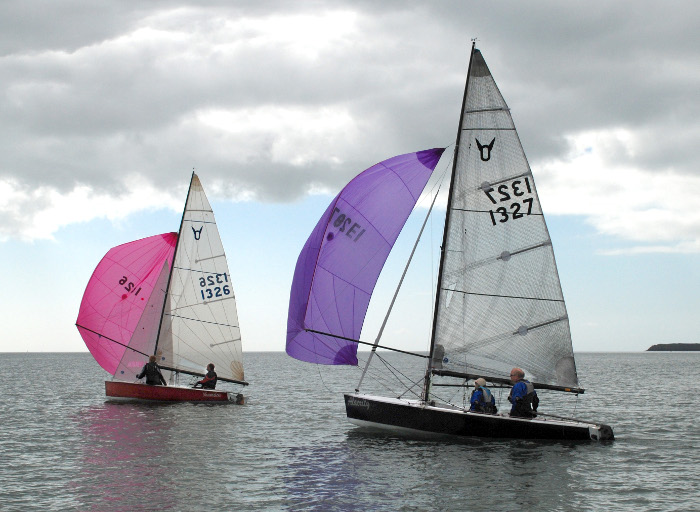
Many will already be bored to hear, my boat's a moderately-modified Osprey dinghy which I sail alone. I never race but I like getting the best out of her. The accounts of cruising yachtsmen may seem irrelevant to my purposes, but they're really quite in line with my needs because I can't count on any of the advantages of enthusiastic racing teamwork, and I won't be carrying a kite in anything except light winds, ever. This photo is misleading...newer boats, more fully/ably crewed, and better kit...but it gives an idea...

Osprey-Paul-Evenden2.jpg


I'm irritated by the boat's serious sluggishness dead-downwind under white sails, in very gentle breezes...I doubt anyone isn't. I can see that an asymmetric is small (if any) use at such times (feel free to correct me if you know a technique that allows an asymm to fly beneficially, DDW)...

...but will my symmetric (on the antiquated kit I already possess) be rewarding enough on such days, to justify the bother and clutter of all those extra control-lines and blocks?

On a day when there's any probability of strong gusts, I'm very unlikely to try hoisting a third sail...

...but for a boost when my generous upwind rig isn't enough, I'd appreciate any tips on coping with the balloon as easily as possible...hoisting, controlling and rapidly snuffing. :encouragement:
 
Last edited:
Yep, that was the point the Halyard got blown completely and pulled out of the mast.

Quick trip up the rig to re-thread it when we got in seemed like an acceptable price to pay!

Ahh got it, explains why you suddenly had to whirl the wheel in the other direction ...and yes, if you didn't as much as nick your spinnaker a spot of halyard re-threading was certainly a result! One tiny point; isn't your lower spreader patch a smidge too far away from the luff?
 
Instead, leave the turtle attached to the guard wires and with a couple of bungees to the hand rail, giving a nice big mouth to stuff the sail into. .

not sure I understand you. Presumably you are using a side launch bag attached to the guard rails and far enough astern to be able to attach one side to the hand rails on the cabin top? Then you are pulling the kite by the sheet in between guard rails and genoa, packing as you go. Correct?


P.S. If this post seems a bit out of sequence its because all the posts from 23 onwards loaded up after I had written and posted the above. And no I had only just opened the browser, so why would that happen?

P.P.S Flaming - commendable lack of yelling and screaming in that video.:encouragement:
 
Last edited:
Ahh got it, explains why you suddenly had to whirl the wheel in the other direction ...and yes, if you didn't as much as nick your spinnaker a spot of halyard re-threading was certainly a result! One tiny point; isn't your lower spreader patch a smidge too far away from the luff?

Yep, not a nick! I was surprised.

In that breeze we wouldn't have eased the outhaul, sits a bit better in more normal breeze. North certainly aren't generous with them though... Last main we added some pretty big ones ourselves. But this main seems tougher anyway.
 
K
not sure I understand you. Presumably you are using a side launch bag attached to the guard rails and far enough astern to be able to attach one side to the hand rails on the cabin top? Then you are pulling the kite by the sheet in between guard rails and genoa, packing as you go. Correct?

No. The bag is visible hanging on the guard wires in my second photo. When dropping the spinnaker I attach the inner corners of the turtle to the hand rails on the coachroof. This holds the top of the bag open. I never release the sheet from the winch until the spinnaker is in the bag. It is easy to bunch the whole foot together behind the mainsail, then stuff it into the turtle. I never fly the genoa and kite together, always furl first.
 
....
...but will my symmetric (on the antiquated kit I already possess) be rewarding enough on such days, to justify the bother and clutter of all those extra control-lines and blocks?

....:

That's something only you can decide, how rewarding will you find it?
A bit more speed and a lot more involvement with actively sailing the boat downwind.

The 'breath in, pull string, breath out' instructions will vary with what chute and pole arrangements you have.
 
Top