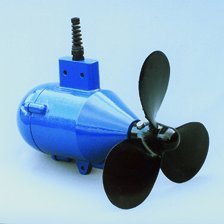
DIY Towed Generator

MASH

N/A
Joined
8 Mar 2004
Messages
2,188
Visit site
I think we're all familiar with the type of generator that uses a towed impellor turning a short length of flexible "driveshaft", ie rope, that in turn drives an on board alternator. (like the Aquair)
It seems to be limited (correct me if I'm wrong, I've not used one) by the difficulty of obtaining efficient rotational speed because of both flexibility of the drive rope and it's lack of torsional stiffness, and by the impellor skipping at high boat speed, ie shortcomings in materials and geometry.

The design of an outboard motor leg would seem to offer solutions to the geometry as it can be mounted deep enough to work reliably and should offer reasonably low drag. If a suitable impellor were made to fit the propshaft and a small motorcycle alternator fitted where the engine used to be we'd have something light, demountable, robust and able to put out a decent amperage wouldn't we? Like an outboard it can be mounted/lifted/moved easily

Does anyone know how to get an impellor designed - are there hydrodynamic students out there who need a project? Before scoffing, look at a British Seagull prop. If something that simple can transfer 2hp into the water it cannot be hard to make something to rob half that back, and that's nigh on a Kilowatt (should be plenty after losses)...The impellor & its design is the key, fitting an alternator isn't going to be too hard.

What sort of speed do outboard props turn at? I'm thinking of the bearings and seals here.

Lubrication of the top bearing, water? Where is the impellor usually for that - on the bottom of the leg?

Would it be worth the trouble - you Aquair owners please advise?

Impellors optimised for 4 Kt and a 7Kt would cover the speed range of most boats and keep the alternator at a sensible output.

Go on! Tell me why not, suggest tame design engineers or suggest improvements.
 
seagull prop

Would not an inexpensive recycled British Seagull propeller attached to its own truncated shaft and swung 180 degrees provide 1/2 the gear?
 
Impeelor for generator

I think you would end up with too much mechanical drag (bearings etc trying to use an o/b leg.
The impellor /propellor would I think look more like a walker log screw or an old VDO mechanical log type screw. ie long pitch. hence lots of torque. The larger the diameter (to get power) the lower the speed overall hence you would I think need a gear up to an alternator or wind an alternator especially to produce volts at low revs. ie lots of turns on stators. Permanent magnet alternators are best so doesn't waste power in the field coil however a powered field coil gives more control over output and load imposed on the prop.

Actual pitch of the prop is determined from water speed, angle of attack of the water on the blade at design speed and of course the radius of the point you are measuring pitch. Then I imagine from experiment you find the load you can put on the prop before it starts to cavitate.
actually come to thinkl about it there is a lot I don't know about the design of the prop but instinctively I don't think the seagull prop would be any good. go back to sleep or think of other things olewill
 
my thoughts too, why not use the outboard / an old one to generate the power.

Unacceptably high losses in the gearbox I suspect. The Aquair 100 is cited at 1A per kt - if you only have 100W to play with then squishing gearbox oil around is a lot more significant than when you're putting several kilowatts the other way.
 
cut out the middleman, i.e. any drive shaft, gear box, etc. to reduce transmission losses.

Make up a shrouded prop attached to a torsionally stiff rope thence into a low-speed alternator. It has to be a low-speed one otherwise
a car type alternator will produce zilch at say 60 rpm (a guess at the rotational speed of a shrouded impellor).

A decent impellor design could produce low rpm but lots of torque.


This sounds like an ideal committee job to get the spec and operating conditions well and truly understood before anyone takes a spanner to a Seagull.


Sign up here !


EDIT

Current micro-hydro terrestrial genny design favours a form of the Archimedes screw. If that works well on medium volume, low head water supply onshore, it might be a good start for a towed array.

http://www.youtube.com/watch?v=MYrIN5KEuIk
 
Last edited:
my thoughts too, why not use the outboard / an old one to generate the power.

who's brave enough to take the motor out of an old small outboard and fit an alternator ?

can't cost that much to see what happens.

not efficient, so what if it only generates 2 -3 Ah, that's still a usefull amount.
My concern there would be that 2-3Ah is a small energy input against the downside drag.... anyone who has rowed a tender with the outboard down vs up will have a good appreciation of its impact!

I think the towed impellor is probably the main commercial solution available for a good reason.
 
I'm thinking that the rake of a standard propeller blade is wrong.

An analogy - think of driving a normal woodscrew into a chunk of wood with a hammer. Doesn't turn (just graunches the wood).

Screws designed to be hammered-in have a gradual helical twist - maybe not more than half a turn an inch. Those turn very easily when hammered. I'd suggest that this is the type of propeller to be aiming for.

I could see a rigid pipe extending backwards working - something like those crazy long-tailed Thai outboards ...
Maybe with a supporting line from above - and retractable for when encountering lumpy seas.
 
Thanks for the replies guys.
Melandnick, that's exactly what I'd rather have but at well over two grand you can see why I'm going down this road...and as I'd envisaged it uses an impellor that looks much like an aircraft prop rather than a Walker spinner which would not develop useful power unless it was huge. Remember the point of a Walker log is to provide rotation without drag (ie also without the possibility of absorbing power) so is the opposite design philosophy to what we need. The big generator under Carlingford Lock uses a turbine that is a stumpier version of a wind turbine as one might expect, (higher Reynolds number in water, but let's not get into that) so that style seems to be established in practice, as shown by Duogen's prop like device. I wonder how Duogen's bearings stand up long-term to the tortion caused by the inflow angle - the 20 degree off-square angle that it has to the waterflow causes big differences in the load between the top and bottom halves of the impellor disc. The impellor will also be trying to rise against the hydrovane which will add to the stress. Bending loads along the shaft axis aren't generally well liked by bearings.

Propellors are useless as impellors - as stated in my first post.

Towed Archimedes screw. Hmmm...now there's a thought.

Regarding the drag thing, certainly a small boat - mine is 32ft, needs little power (from wind or engine) to make 3-4 kts - the 2hp outboard gives 3 in flat calm - and would feel the drag of a genny at that speed. At higher speeds, certainly as it approaches hull speed the power availale from the sails becomes quite large, if the 30hp engine can drive it at no more than 6kts then there is power to spare at 6.5 or 7 which in smooth water it often attains. The power reserves are related to windspeed and point of sailing rather than boat speed though so even when slowed to 4.5 or 5kts in a sea that power is still available.

If we assumed only a 15% overall efficiency at 6kts and getting 7 amps as per the Duogen which seems reasonable - 120Watts output against 900W drag - much as I suggested earlier, is useful power from a horsepower's worth of drag, Kw and Hp being roughly equivalent. And with the sails producing in excess of 30Hp that isn't going to be noticed.
It ghosting conditions it isn't a goer, but above 5 Kts in smooth water I reckon it might do.

Clearly the mechanical losses become more significant at lower speeds and are substantial in the system I've proposed, but for a saving of £2000 I think it might be worth a look.

The utterly critical thing though is the impellor and its design. The more efficient that is, the lower the speed where the drag and output curves intersect.
 
Last edited:
Have a look at the impeller of a Walker log. The blades are almost parallel to the direction of travel.
So put an adjustable spanner on you seagull propeller and twist through 90 degrees! ;)
 
Archimedes screw drive...

(1) Screwdrive as in the video's above

(2) a fairly rigid shaft ( 1/2 dia? aluminium ) or unlaying type 1/2 inch dia rope

(3) coupled to a generator/ efficient alternator such as used in wind generators, permanent magnet type perhaps 200 watts

(4) mounted in a gimbal on the stern?
 
Are we going to end up with shaft generators again? Existing gear, annoying spinning noise, (
I can't stop mine due to hydraulic gearbox) And the prop can transmit 20 - 30 HP, so should be able to 'receive'/generate a few... The trick in any case would be a regulator designed to sense when it caused the rotor to slow (power drop) and ease back on the field current, rather than sensing the battery and trying to fill it.(permanent magnet units don't have the control to go from 'no-torque' to 'all-the-amps-the-sea-can-give' smoothly.)
BTW, I used an Aquair at speeds >4kn (no use below that) and was disappointed with the output - 100W is not a lot - 8amps max and that's it running hot!
The rope does transmit the torque OK once it's locked up its strands, but it can be an interesting exercise to retrieve, even when the prop is stalled with a bucket/funnel.
 
Last edited:
Top