MASH
N/A
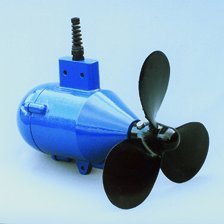
I think we're all familiar with the type of generator that uses a towed impellor turning a short length of flexible "driveshaft", ie rope, that in turn drives an on board alternator. (like the Aquair)
It seems to be limited (correct me if I'm wrong, I've not used one) by the difficulty of obtaining efficient rotational speed because of both flexibility of the drive rope and it's lack of torsional stiffness, and by the impellor skipping at high boat speed, ie shortcomings in materials and geometry.
The design of an outboard motor leg would seem to offer solutions to the geometry as it can be mounted deep enough to work reliably and should offer reasonably low drag. If a suitable impellor were made to fit the propshaft and a small motorcycle alternator fitted where the engine used to be we'd have something light, demountable, robust and able to put out a decent amperage wouldn't we? Like an outboard it can be mounted/lifted/moved easily
Does anyone know how to get an impellor designed - are there hydrodynamic students out there who need a project? Before scoffing, look at a British Seagull prop. If something that simple can transfer 2hp into the water it cannot be hard to make something to rob half that back, and that's nigh on a Kilowatt (should be plenty after losses)...The impellor & its design is the key, fitting an alternator isn't going to be too hard.
What sort of speed do outboard props turn at? I'm thinking of the bearings and seals here.
Lubrication of the top bearing, water? Where is the impellor usually for that - on the bottom of the leg?
Would it be worth the trouble - you Aquair owners please advise?
Impellors optimised for 4 Kt and a 7Kt would cover the speed range of most boats and keep the alternator at a sensible output.
Go on! Tell me why not, suggest tame design engineers or suggest improvements.
It seems to be limited (correct me if I'm wrong, I've not used one) by the difficulty of obtaining efficient rotational speed because of both flexibility of the drive rope and it's lack of torsional stiffness, and by the impellor skipping at high boat speed, ie shortcomings in materials and geometry.
The design of an outboard motor leg would seem to offer solutions to the geometry as it can be mounted deep enough to work reliably and should offer reasonably low drag. If a suitable impellor were made to fit the propshaft and a small motorcycle alternator fitted where the engine used to be we'd have something light, demountable, robust and able to put out a decent amperage wouldn't we? Like an outboard it can be mounted/lifted/moved easily
Does anyone know how to get an impellor designed - are there hydrodynamic students out there who need a project? Before scoffing, look at a British Seagull prop. If something that simple can transfer 2hp into the water it cannot be hard to make something to rob half that back, and that's nigh on a Kilowatt (should be plenty after losses)...The impellor & its design is the key, fitting an alternator isn't going to be too hard.
What sort of speed do outboard props turn at? I'm thinking of the bearings and seals here.
Lubrication of the top bearing, water? Where is the impellor usually for that - on the bottom of the leg?
Would it be worth the trouble - you Aquair owners please advise?
Impellors optimised for 4 Kt and a 7Kt would cover the speed range of most boats and keep the alternator at a sensible output.
Go on! Tell me why not, suggest tame design engineers or suggest improvements.