DIY Synthetic Teak

I disagree with Hurricane on fitting the cleats on top of the decking. But only from an appearances point of view. This shows how much flexibilty is available just from freedom of choice when designing your own deck. I would not fit anything on top of the decking but that is my choice as I think it looks better. I am sure Hurricane would agree with me that care is the main requirement when doing your own deck.
Yep, I agree that the appearance is also important. During my research, I came across another P67 that had undergone the synthetic teak upgrade and I didn't like the fussiness of that design - here's a pic of that design:-

super-yacht-2.resized.jpg

Cutting and caulking round the cleat, I think, would look strange - the above approach tries to mitigate that with a border. I didn't like the border and, actually, just bolting through is MUCH easier. Looks less fiddly. In fact, I didn't like that whole design - the way the curves continue over the hatches etc. It all looked wrong.

This is my finished foredeck - I think this is far less fiddly:-
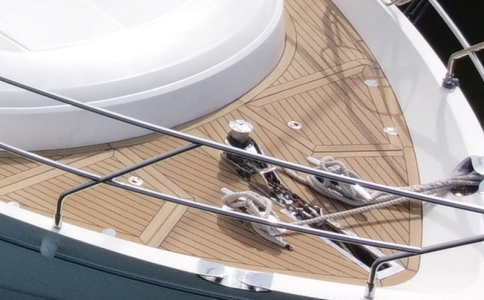
Screenshot_2025-11-01_14-39-47.resized.png
 
Last edited:
Everyone thinks I'm crazy looking to do it myself, but I'm hoping it will be very satisfying if I get it right! As you say time and care, in reality whatever solution I go for, I'll be taking the old deck up and prepping myself (no way I could afford to pay someone to do that and I have a son in-law who's a carpenter and pretty handy/has all the tools), the incremental vs that to manufacture the panels/fit vs the money saved seems well worthwhile.
Yep - everyone thought I was crazy as well.
I "kind of" fixed that in my last session when I made the deck myself and got a local contractor to fit it.
However, if you have a youngster who is keen to help - that would make the whole job easier.
There is also a steep learning curve working with Trakmark.
But VERY rewarding.
My advice though is "Go for it".
 
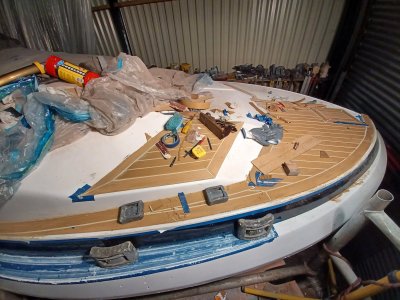
Totally agree. Good example of different layouts of decking on the same boat model. Here's one I was doing recently. Old school Dek-King that doesn't need welding. What a messy bugger I am!8UrP2j_ST_6a70j7d4_wcA.jpg
 
Last edited:
Totally agree. Good example of different layouts of decking on the same boat model. Here's one I was doing recently. Old school Dek-King that doesn't need welding. What a messy bugger I am!View attachment 201509
Love the weights but not heavy enough IMO

One of the best things I did for my DIY Teak project was to make some (about 25) weights.
I keep most of them in my garage/workshop and they are about the most useful tool I have.
I even have some that I keep with my sewing equipment.
They can be used for anything that needs to be temporally held in place.
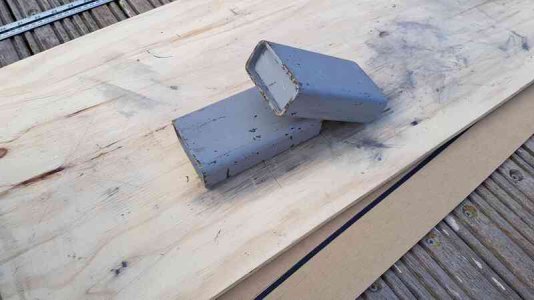
This is a pic of the weights from earlier in this thread.
Just some 4 x 2 steel tube/section cut into 6" long sections and filled with lead.

serve.resized.jpg
 
My weights are lead dive belt weights so I just add more if necessary. Never had a problem so far. However, as I always warm the lengths as I lay them they relax and the grip of the Sabatak 750 generally makes the weights unnecessary. I recently bought nine 7lb scale weights from the local junk shop for £4 each which I am sure will be useful.
 
Hi Hurricane,

This is remarkable work, and I admire your perseverance and the fact that you have mastered the challenging task of working with synthetic teak.

I work professionally with synthetic teak and understand how many nuances need to be considered, so your result is truly commendable!


Allow me to share my experience. Perhaps someone will find this information useful.
We also started using TeckDeck (Trackmark) in our projects, but we also studied other systems, including Flexiteek, Permateek, Isiteek, and Nuteak. The first three systems are very similar and are exactly what you are doing. Back welding, a lot of weight and crutches to ensure high-quality back welding.

For DIY craftsmen, I can share an alternative method if you don't want to create a whole fleet of weights and crutches. You can buy instant cyanoacrylate glue and glue all the profiles together before welding, and then, after turning the panel over, weld it calmly without fear of gaps appearing. However, for a good result, you first need to flatten the profiles by letting them rest under weight in a warm place or in the sun. This may take a little longer, but you definitely won't need a huge number of weights and crutches, and a perfect white table.

After working with these systems and not being entirely satisfied with them, our company ultimately decided to create our own profile design, and now we have a profile developed by me called Isoteak Pro Deck. I designed it to be versatile so that it could be used in both DIY projects and professional work. I incorporated a double lock into the profile design, which is first glued and then welded from the back. In some projects, we even used it without welding, laying it on the deck profile by profile, simply gluing them together. And this gave a good result. We recently filmed a video of the process of manufacturing panels and welding PVC teak. I can't post links here, but you can find this video on our Isoteak channel or on our website.

In addition to the profile system, to make work easier for DIY craftsmen, we have ready-made welded sheets of various sizes into our range, from which panels can be cut according to a template.

As for bubbles after installation, yes, this problem exists, but it can be solved even more easily than you described. My advice, based on extensive experience: take a 5 ml syringe with a medium-thick needle, fill it with cyanoacrylate glue, pierce the bubble through the material and squeeze the glue into it. Then press down on the bubble for 40-60 seconds to release the air. This method is simpler, more reliable and cleaner.

I would also like to share some information about adhesive sealants. We have tested many options. And the main conclusion is this: Sikaflex is not suitable for PVC teak coverings. As well as it works with natural teak, it works just as badly with PVC. The fact is that it is quite liquid and has a long polymerisation time, so it does not fix PVC panels and then they need to be loaded very carefully to avoid bubbles. The same story applies to Bostik sealant, which is recommended by Flexitec. Its characteristics are better, but not ideal. As a result, we use two options:
1. Merbenit sealant from Switzerland. It has a polymerisation start time of about 20-30 minutes (depending on temperature and humidity), and it is thick enough to immediately glue the material to the deck. You can see how it works on our website or YouTube channel.
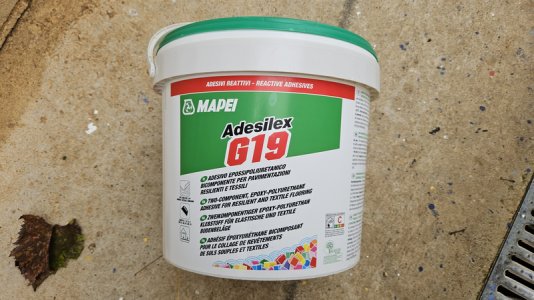
2. For large surfaces, we use 2K adhesive from Bostik. This adhesive is very easy to apply and gives you about 1.5 hours to stick the panels, but it is also quite liquid and requires weights to press the panels down. On the other hand, with this adhesive, you get a completely flat surface without bumps and unevenness, which inevitably occur when using pressure rollers and sealant adhesives.

I'm sure I've forgotten to mention something, so don't hesitate to ask, I'll share my experience and maybe I can give you some useful advice.

Good luck with your projects,
Maxim
 
Top