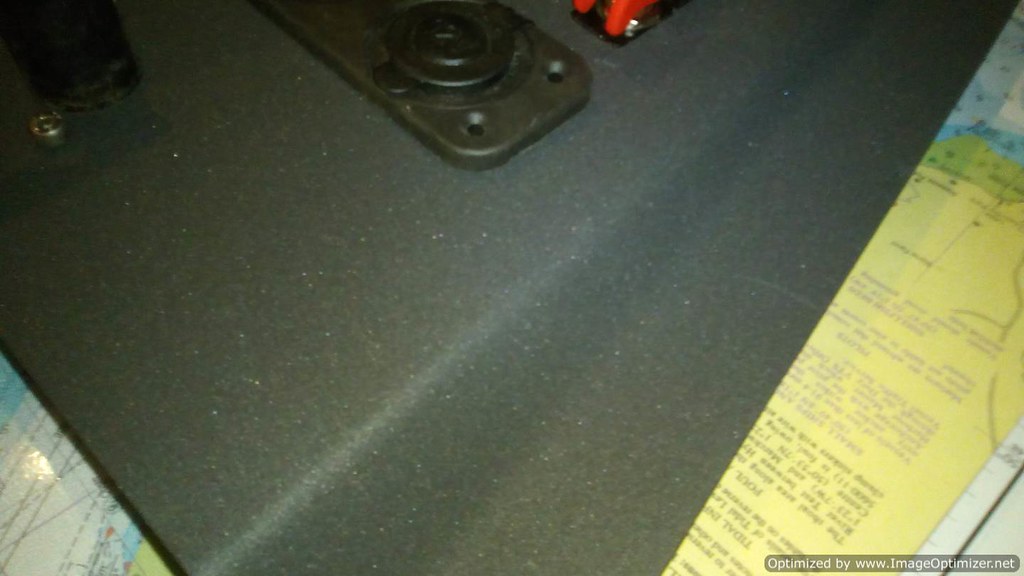
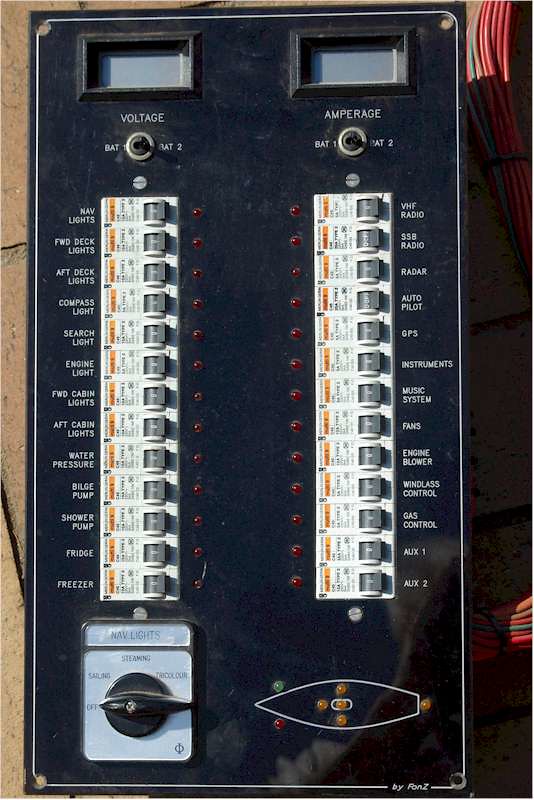
DIY Switch / Breaker Panel

No shore power just 12v, I thought it would be ok to run the fridge whilst motoring to get it cool and house batteries to tick it over for a few hours. It's wouldn't be used a lot, more for the beer on mates weekends away and even then it doesn't have to be on 24/7.

Have I got it wrong? If you can't use a 12v fridge away from a marina or are boats fitted with 240v ones just for shorepower? I've never had one before as I'm sure you can tell.

That's fine - motoring with the fridge on is a good way to get it chilled. Ours is 12v and works very well. We find shore power so useful - perhaps simplifying some of what you are proposing might free up funds to consider a shore power unit? We use an electric kettle and toaster when connected which saves a bit of gas and also we can run the eberspacher on chilly evenings which again, we could only do with the engine on. I bought 'Replacing your boat's electrical system' which is an Adlard Coles manual. Well written, clear and simple which suits me and it's available in Kindle format.
 
Last edited:
Tom, I recently replaced a switch panel and initially used Carling C1005B circuit breaker switches, I got them from Mouser electronics. The main issue I had was mounting them in a diy panel, the rectangular holes are small and need to be exact, it was beyond my diy skills!
I eventually found a BEP marine breaker panel and it has been great, not cheap though. Any appliances without an on/off switch go through the breaker panel, all the others are wired via a blade fuse set up as posted on page 1.
I still have all the Carling breakers if you need them.
 
I still think it's more complicated than it needs to be. Pete provided details of someone who will make a new panel, in post #1, so i'd design one to use whatever switches you want, not fuses or breakers, just the switches.

Cable from the isolator (fused) to a positive busbar. Cables from the busbar to a blade fuse box, one cable per fuse, one fuse per circuit. Stuff like VHF, GPS, MFD etc wired straight to its fuse. Everything else has a cable from the fuse to its switch. You could have a single switch for wind/log/depth etc, which would supply another small fuse box, with separate fuses for each device. You can group fuses in a fuse panel, so you could have fuse 1 for the Fridge, fuse 2 for the heating, fuses 3,4,5 and 6 for the wind etc, link at their input from the switch or you can fit more than one fuse box.

IMO this is much simpler, still gives you what you need and you can make a nice custom panel that won't cost a fortune using some nice Carling rocker switches.
 
There seems to be some strange, base level conceptual thinking behind all this, a lot of hardware for limited functionality.
I can't quite square the 'that won't matter in normal circumstances' mantra with the perceived need for an eff-off bilge pump.

"True, to an extent, or in my case vice versa. The starter solenoid shorted so that the motor was running all the time, and I had to kill the power to the engine. Having a single switch, this also killed the autopilot, nav lights, plotter, depth sounder, everything right down to the compass light. My crew had to steer for a while by a mobile phone running Navionics propped in the binnacle cup-holder. Only for a few minutes, though, till I lifted a saloon seat and disconnected the engine battery, then I was able to turn the main switch back on without blowing up the starter motor.

I'm still happy with my single switch; situations like the above are rare and fairly easily fixed. But there is probably value in two separate switches if you have space to conveniently mount them, which I don't. An alternative solution would be a single switch but an isolator in the engine supply downstream of it. You shouldn't need to turn off the whole domestic side, just the troublesome circuit at the panel. If we consider the engine as just another circuit, an isolator on it makes sense - don't think of turning batteries on and off, think of isolating troublesome circuits. "

And how would that have played out single handed?
Designing for normal use is fine, but personally I feel that seagoing yachts need a bit of 'what if?'
Stuff does go wrong on boats. Things get wet or broken.

I think the OP would do well think about the physical layout of his wiring (including the panel), considering the cable sizes implied.
If all those heavy cables are loomed to a single panel in the kind of space typically available in a relatively modest yacht, I suspect it will be a pig to work with.
When you've wrestled with a few of these amateur creations, you start to think the CANBus fans are maybe not so potty after all.
 
An option worth considering are the Din rail industrial circuit breakers.

One of the nice advantages is they can be very easily replaced if a fault develops in the future.

This is the solar panel installation for our new yacht using standard mounting boxes. The circuit breakers can be mounted in a nicer enclosure if they are in a part of the boat that will be seen.

QVhAYva.jpg
 
I also use MCB mounted on DIN rails but I had a custom engraved panel over the top with indicating LED's for each circuit.

I have separate MCB for each main device so that in case of I need emergency shut off.

35277427923_fc27c91b82_b.jpg


This is the panel off my previous boat.
 
That's the way to do it. We use good quality DIN breakers or the Blue Sea circuit breakers - not cheap but nearly indestructible!

Sometimes I use blade fuses, I've actually done blades on my boat, although they total over 60 blade fuses and various relays and contactors, etc. Little more complex than needed but fairly resilient against failure.


I also use MCB mounted on DIN rails but I had a custom engraved panel over the top with indicating LED's for each circuit.

I have separate MCB for each main device so that in case of I need emergency shut off.

35277427923_fc27c91b82_b.jpg


This is the panel off my previous boat.
 
Last edited:
YB, I like your wiring diagram, did you draw it using software, if so, what? I've used Tinycad to try and work my way through my spaghetti, but yours looks cleaner.
 
That's certainly better than fore-and-aft - but I'm curious whether "loss of one circuit" has ever actually happened to you?

Pete

No, but then I’ve never had a fire on board, but I still have fire extinguishers. I have had a lighting circuit failure when I only had a single circuit on a previous boat..
 
What's with all the negativity about wanting to isolate circuits, I thought it would be a PBOers wet dream (have I just given away too much personal information). Maybe my brain is wired in a different/wrong way, things like the fridge would need to be fused anyway, if it was fed from the battery switch-fuse box-fridge then if Jr decides to play with the thermostat/control switch without me noticing I'll run the batteries down. Same goes with the sailing instruments, I get to the boat turn the master switch turn on the instruments and bingo, when I get to wherever I can turn them off but turn on the cabin lights/anchor light. I haven't got to go through a dozen items to turn them off.

I don't see a boat as if it's a car where you're sitting in one place possibly needing all the electrical items at once. The car is generating it's own power. I see it as a "backwards" house where you have different "ring mains" you want to turn off and on as and when you need them but your not connected to the grid so the emphasis is on conserving power and turning circuits on when you need them rather then off when you want to work on them.

I'm not saying I'm right and your wrong, I can see the conventional way of doing things is fine, I don't see this any more involved then running an extra dozen fuses and a switches for individual items. Like I say I'm probably wired up wrong.

This is just the way I think would work best for me but I wanted to know if there were alternative options to the Blue Sea/Carling breakers.

Thanks for the input, I've picked up some good ideas.

YB, I like your wiring diagram, did you draw it using software, if so, what? I've used Tinycad to try and work my way through my spaghetti, but yours looks cleaner.

I used this website to design my diagram, found it pretty easy but you have to use their symbols for what you want them to mean (as in they might mean something to a electrician to what you see them as). I can share my diagram with you to modify if that helps or you can start from scratch.

https://www.digikey.com/schemeit/project/
 
Last edited:
What's with all the negativity about wanting to isolate circuits, I thought it would be a PBOers wet dream (have I just given away too much personal information). Maybe my brain is wired in a different/wrong way, things like the fridge would need to be fused anyway, if it was fed from the battery switch-fuse box-fridge then if Jr decides to play with the thermostat/control switch without me noticing I'll run the batteries down. Same goes with the sailing instruments, I get to the boat turn the master switch turn on the instruments and bingo, when I get to wherever I can turn them off but turn on the cabin lights/anchor light. I haven't got to go through a dozen items to turn them off.

I don't see a boat as if it's a car where you're sitting in one place possibly needing all the electrical items at once. The car is generating it's own power. I see it as a "backwards" house where you have different "ring mains" you want to turn off and on as and when you need them but your not connected to the grid so the emphasis is on conserving power and turning circuits on when you need them rather then off when you want to work on them.

I'm not saying I'm right and your wrong, I can see the conventional way of doing things is fine, I don't see this any more involved then running an extra dozen fuses and a switches for individual items. Like I say I'm probably wired up wrong.

This is just the way I think would work best for me but I wanted to know if there were alternative options to the Blue Sea/Carling breakers.

Thanks for the input, I've picked up some good ideas.


I used this website to design my diagram, found it pretty easy but you have to use their symbols for what you want them to mean (as in they might mean something to a electrician to what you see them as). I can share my diagram with you to modify if that helps or you can start from scratch.

https://www.digikey.com/schemeit/project/

There isn't a golden rule - I think what you are taking on is very good and you will at least understand it all once you have completed it. I also think that to keep things as simple as possible is a decent strategy - good luck and do take a peep at the book I recommended.
 
What's with all the negativity about wanting to isolate circuits, I thought it would be a PBOers wet dream (have I just given away too much personal information). Maybe my brain is wired in a different/wrong way, things like the fridge would need to be fused anyway, if it was fed from the battery switch-fuse box-fridge then if Jr decides to play with the thermostat/control switch without me noticing I'll run the batteries down. Same goes with the sailing instruments, I get to the boat turn the master switch turn on the instruments and bingo, when I get to wherever I can turn them off but turn on the cabin lights/anchor light. I haven't got to go through a dozen items to turn them off.

I don't see a boat as if it's a car where you're sitting in one place possibly needing all the electrical items at once. The car is generating it's own power. I see it as a "backwards" house where you have different "ring mains" you want to turn off and on as and when you need them but your not connected to the grid so the emphasis is on conserving power and turning circuits on when you need them rather then off when you want to work on them.
......
But in your house, you don't sit in your study to turn on the washing machine?

Switch panels are indeed some sort of wet dream for owners of certain sorts of boats.
I think it's something to do with small boys seeing all those knobs and dials on Concorde or Battersea Power Station? Or maybe 70s Japanese HiFi?

In every other walk of life people are happy to have a few switches wherever they are needed, but on our boats, we have this strange herding instinct to gather all the switches into one place (and then lament that we need our glasses to read the little labels).
I think it was OK when we were talking about a few lights, an echo sounder, a VHF and a Decca set.
But these days we are talking about more toys, many of which take a lot of power.
The boat I'm just looking at has a pretty modest 12V system in 21st century terms, but there's a fridge, autopilot, eberbasto,( theres a fairly modest inverter but that's not via the panel).... and all the minor stuff.
Cabling that little lot so the eberbasto doesn't go into a low voltage sulk if the fridge is on and the autohelm is active, means quite a few metres of pretty hefty cable route there and back, when the loads are in fact quite near the house batteries.
The panel is out at the moment, to sort the VHF aerial. Typically, everything is a very tight fit.
Typically again, there are a few additions it would be nice to make....
 
Cabling that little lot so the eberbasto doesn't go into a low voltage sulk if the fridge is on and the autohelm is active, means quite a few metres of pretty hefty cable route there and back, when the loads are in fact quite near the house batteries.

I quite consciously avoided that kind of thing when I wired my boat.

By default, most loads do go via the chart table - they don't all have switches there, but they go through the fusebox so that that function is all in one place. However, the fridge compressor is a couple of feet away from the batteries, on the port side, while the chart table is on starboard. The fridge has its own control panel in the galley which includes an on/off switch so there's no switch for it on the main panel. It would be silly to run power there and back just in order to put the fuse in the same box as the others. Likewise the bilge pump, which is on the centreline but the logical wiring run is straight from the batteries down the same conduit as the engine supply. So both of these are supplied from a small four-way box in the battery compartment. Since that's there, I also wired the gas alarm to it - no issues of load in that case, but it's another item with no need for a panel switch and happens to be mounted near the batteries. The bilge pump manual switch is near the pump, both for convenience and a shorter wiring run. That's another item it would make no sense to switch from the chart table.

Pete
 
The thing i really hate about fuses is how so many boats have 50,000 different types/styles/ratings of fuses, dotted about and hidden behind panels and equipment. OK, so your VHF came with a tiny, inline, glass fuse, doesn't mean you have to leave it there and have to remove the VHF to check/change the fuse. One type of sue should be used and blade fuses are most suitable. Breakers are fine, but cost more money. They can, don't have to be on the switch panel, but they do need to be in an easily accessible place.

As i've already said, anything with it's own switch does not necessarily need it's own switch. Certainly no point in having one for the VHF, this should be wired as simply as possible, a fused cable straight from the main busbar. MFDs don't generally want their own switch, but if they have radar overlaid it's a good idea to have a switch for the radar, rather than having it in standby. Some items that do have their own switch can still be clustered to a switch at the panel, as YB has put in his drawing. For instance, i have a N2K network with a GPS receiver, Depth/speed/water temp, AIS via the VHF, wifi data router and 2 x Garmin GMi 10s. I can switch the Garmin displays off via there own power buttons, but i need a switch to turn the other things off and the displays take their power from the N2K network, so i have a switch that supplies two blade fuses in a 8 way fuse holder beneath the saloon sofa that houses the batteries, the VHF/AIS, data router and the power cable for the N2K network. One fuse is for the N2K network and the other is for the data router. So, not only does the switch kill the power to everything on the N2K network, there are very short cables to the network, the router and also the VHF, is that is also connected to a fuse in the 8 way holder.

The N2K network is split into three areas, part of it is under the sofa, the next part is a metre aft, with cables going up the the cockpit displays, and the final part is in the panel above one of the aft cabin wardrobes.

Within the same sofa base are the battery isolators, to which a pair of cables are connected to a 6 way fuse holder that houses fuses for the equipment that is "always on".

A sizable cable goes from the isolator to the engine housing, where the main switch panel is located. That's nicely situated so nothing has unnecessarily long cable runs. This is populated by toggle switches and thermal breakers, it was fitted to the boat when i bought it. I made some modifications as the cable going from the isolator to the panel was well under rated and a single cable fed all 22 switches, which meant that the light dimmed when anything heavy load was used. I fitted heavier cable, but connected it to a busbar, very close to the panel. Single cables go from the busbar to heavy load switches, such as the fridge, bilge pump, water pump etc. Some switches are connected in groups, for instance the two light switches are supplied by a single cable. No more dim lights.

So, you don't need everything at the chart table, or indeed any one place. Careful planning keeps wiring looms to minimum sizes and individual cable runs as short as possible.
 
....
So, you don't need everything at the chart table, or indeed any one place. Careful planning keeps wiring looms to minimum sizes and individual cable runs as short as possible.
One boat I really like has very little of the electrics at the chart table. The space it might normally occupy is given over to a white board for noting nav info, a funny little lectern-shelf that holds the almaniac open at the right page, and holders for the stuff you actually use at a chart table.
 
YB, have a look at caravan panels. Not only are they cheaper new, but there are a few caravan recyclers who sell the parts.

e.g.

http://caravansparesnorthdevon.co.uk/interior-spares/

They can supply fused switch panels, or rocker ones from newer vans. Load ratings are all suitable for boats.


This is a good move! Some of the caravan units even have Volts and Tank gauges...way ahead of boats units for the cash!
 
One boat I really like has very little of the electrics at the chart table. The space it might normally occupy is given over to a white board for noting nav info, a funny little lectern-shelf that holds the almaniac open at the right page, and holders for the stuff you actually use at a chart table.

All i have at the chart table is a handset for the black box VHF. The wifi router sends everything to a laptop, which displays all of the onboard data and OpenCPN on a 24" LED screen on the forward bulkhead, as well as a 12" tablet.

Still undecided whether to keep using the tablet or to fit a chart plotter at the helm.
 
Top