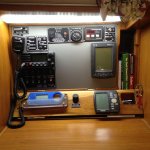
DIY Switch / Breaker Panel

Yellow Ballad

Well-Known Member
Joined
10 Oct 2013
Messages
1,487
Location
Sundance, Bristol Channel
Visit site
On my never ending list of bits to sort is the electrics and that involves sorting a new panel.

I would love a custom Bluesea 360 panel with "Flat Rockers" so they can't be turned on by mistake however I'm not sure I could stretch to that sort of cash when there's other stuff on the list. I know a few have made up their own panels so I'm asking what switches and breakers do you use or recommend? I see a lot of smaller push button breakers upto 10a and switches rated upto 10a as well but I would need 10a, 15a, 20a, 25a and one at 50a.

I would have thought a combined breaker/switch would be the way to go but which ones and from where?

Thanks in advance.

Tom
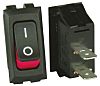
 
I know a few have made up their own panels so I'm asking what switches and breakers do you use

For what it's worth, my home-made main switch-panel uses these:

R4406957-01.jpg

https://uk.rs-online.com/web/p/rocker-switches/4406957

They're just switches, as I have a separate fusebox mounted behind the panel:

5029.png

https://www.bluesea.com/products/5029/ST_Blade_Fuse_Block_-_12_Circuits_with_Cover

I'm happy with blade fuses, the only time one has blown has been the Seatalk fuse when I stupidly tried to work on the wiring with the system turned on, and shorted it out. The fuse blowing was precisely what should have happened, and replacing it from the small bag of spares kept nearby was no trouble.

Unfortunately I don't seem to have a good shot of just the panel, but you can see it in the bottom left of this general chart-table shot:
IMG_0773.jpg

The panel itself (along with all the others) was done by Andrews and Arnold, who are mostly a telco but do an odd sideline in laser engraving.

Pete
 
Jissel's panel uses similar components to PRV's. You can get blade circuit breakers that can be reset, but the only time fuses have ever blown on me have been when I'm only having a little fiddle, so I don't need to turn the power off, so I decided the money was better spent towards a bottle of wine. A bag of fuses on Ebay is so cheap, it's easy to carry lots of spares.

Use lots of switches, each with their own fuse so you have proper control and protection of everything. If you run short of space you can use two way switches for things like steaming light and anchor light that you'll never use together. You could do the same for deck level nav lights and masthead tricolour but, for that, put a separate fuse for each, so a fault in one doesn't take out both
 
Designing a panel or wiring system for a boat, the key thing that most seem to get wrong is allowing for the bulk of the wiring loom and being able to articulate it so you can get the panel in place without stressing any of the joins. This seems to get 50% worse for 10% more wires.
Personally I'm not really in favour of the traditional 'one big panel does everything' approach. I think typical small yacht wiring has grown out of it.
At work, we used to make front panels with a printed plastic overlay with clear windows over LEDs.
 
Designing a panel or wiring system for a boat, the key thing that most seem to get wrong is allowing for the bulk of the wiring loom

As someone who's got it wrong on one boat, and better but still not great on another, I can agree with that :). Wiring really does take up a lot of space, hence the need on larger modern yachts for distributed switching via CAN etc, as discussed on another thread.

I know of a small survey workboat with a lot of electrical gear, where the design included an allowance for the weight of wiring but not its location, making the not-unreasonable assumption that it would be spread roughly evenly around the boat. In fact the yard found it easier to run all the wiring on one side rather than cross the interior, and the boat as launched had a noticeable list as a result. They had to move a couple of bits of heavy gear to the other side to even it out.

Personally I'm not really in favour of the traditional 'one big panel does everything' approach. I think typical small yacht wiring has grown out of it.

I think you might be right.

Most of my electrics go through one fusebox at the chart table, with the majority of those circuits switched by a panel in front of it. But some circuits from that fusebox are not switched at the panel, where they supply equipment that either has its own switch or a separate switch close by and there's no need to switch it on or off as part of a wider group. And then some other circuits don't go through that fusebox at all, but one of two lesser boxes in other locations.

Pete
 
I'm in agreement with the small panel, and I'm quite happy with blade fuses as well but really I would like to be able to switch off key circuits in one place but those circuits require some decent power, hence bigger switches (I would rather four big switches then two dozen smaller ones). I feel though I might have to stump up for the Carling breakers to do it this way. Most things have their own switch or draw very little, wind, log etc I could pull individual fuses if needs be but I wouldn't want to leave the fridge on by mistake. I wouldn't really want to leave circuits live when they're not being used.

This is what I want but I can't help but feel there's a more "Practical Boat Owner" way of doing it. I want to future proof the panel for things I haven't got yet (Fridge, Heater, Bilge pump (see other thread)). There's also instruments I've shown that are yet to be bought/fitted.

PANEL3-e1518809743352.png


I've worked out the ratings by going off the highest figures I can find (VHF transmitting, normal bulbs rather then LED, Tiller pilot working hard rather then idle). In reality all of this stuff wouldn't be used together but I assume it should be accounted for.

Screenshot_20180216-190541-e1518810007241.jpg


And the wiring diagram which I've posted before

Sundance-New.png
 
Last edited:
I would suggest a small fuse in the 'always on' bilge pump wiring.
I don't like a lot of other features, e.g. all the interior lights being on the same breaker, the dual battery switch so you can't run the engine with the domestics switched off, the GPS and VHF being muddled in with domestic stuff.
The heater will probably want a high current permanent live too.
If you're going to have Navtex, maybe you want it on the permanent live?
At the very least, I'd add a voltmeter or two. There may be one in the solar controller, but I'd want that fused, not least as a means of taking it out of circuit.
Boat electrics do go wrong, and IMHO, it's best to think about what should be the last things to keep working when bits start dropping off.
Or you may simply want to switch off certain things for maintenance while still using others.
 
I would suggest a small fuse in the 'always on' bilge pump wiring.

A "small" fuse is no good since a decent bilge pump draws quite a bit of power when it's working. He's got it on a 20a breaker which seems reasonable.

I guess you mean a fuse rated for the cable, at the point where it branches off the input side of the main switch? Seems sensible.

I don't like a lot of other features, e.g. all the interior lights being on the same breaker

I'm fairly relaxed about this one. I believe the reason for the traditional split is just that a boat full of incandescents adds up to quite a high draw, and you end up with a single fuse larger than the rating of the cable size actually appropriate for the individual runs. That reason went away with LEDs. Fuses don't just pop regularly for no reason on a seaworthy boat so "being suddenly plunged into darkness" is not something that's actually likely, and the fact that the forepeak lights are still on while you're stumbling about in a darkened aft cabin wouldn't be very helpful if it did.

the dual battery switch so you can't run the engine with the domestics switched off

True, to an extent, or in my case vice versa. The starter solenoid shorted so that the motor was running all the time, and I had to kill the power to the engine. Having a single switch, this also killed the autopilot, nav lights, plotter, depth sounder, everything right down to the compass light. My crew had to steer for a while by a mobile phone running Navionics propped in the binnacle cup-holder. Only for a few minutes, though, till I lifted a saloon seat and disconnected the engine battery, then I was able to turn the main switch back on without blowing up the starter motor.

I'm still happy with my single switch; situations like the above are rare and fairly easily fixed. But there is probably value in two separate switches if you have space to conveniently mount them, which I don't. An alternative solution would be a single switch but an isolator in the engine supply downstream of it. You shouldn't need to turn off the whole domestic side, just the troublesome circuit at the panel. If we consider the engine as just another circuit, an isolator on it makes sense - don't think of turning batteries on and off, think of isolating troublesome circuits.

the GPS and VHF being muddled in with domestic stuff.

The only "domestic stuff" I see it sharing with is the FM radio. But I agree there should probably be a distinction between instruments you want on when under way, and electronic items that you may want at any time. Presumably with this setup he will leave the "Electronics" breaker on 24/7, and switch the individual items at the sub panel, which I guess has the same effect from a usability point of view. But the main "Electronics" switch then becomes pointless, and a 50 amp breaker for electronics is pretty questionable too. That's been done because of the autopilot.

I would definitely put the autopilot on its own breaker. Putting it on the "Electronics" breaker is an example of what I call "filing-cabinet mentality", putting items together based on categorising them by the wrong thing. Yes, an autopilot has some electronics in it, but the salient fact from an electrical point of view is that it's a powerful electric motor, that could potentially draw even higher currents if it jams or stalls for some reason (hopefully its control system would prevent this, but still...).

That lets you knock the rating of the "Electronics" breaker down a fair bit, but I'm still not sure what it's really for. Any one of the individual electronics fuses will blow long before the big breaker does. Maybe the answer (especially if using purchased panels with a specific number of ways) is to use this breaker for the pilot and power the electronics panel directly without a shared breaker?

The heater will probably want a high current permanent live too.

I don't think I would power a heater from upstream of the main isolator. It's a big circuit to leave on all the time, and heaters tend to be tucked away in nooks and crannies around the cockpit with potentially vulnerable wiring runs through lockers etc. I know you need to let it finish shutting down before removing power, but on a personal boat (as opposed to a charter one) I'm happy to leave this to the operator. My main switch has a warning placard next to it to this effect. It's rare that I have the heater running when I'm about to leave the boat anyway.

If you're going to have Navtex, maybe you want it on the permanent live?

I tend to say not. Of course you don't want to switch it off with the under-way instruments during a trip, but I don't see any need for it to run when the boat's not in use. When I come down to the boat I'll already know what the weather's doing, and after being powered up on arrival the Navtex will have received several broadcasts before we get out of Internet range.

At the very least, I'd add a voltmeter or two.

Agree - or I would prefer a more intelligent battery monitor, which will also include a voltage display.

Pete
 
I have my interior lights on two separate circuits. All are LED, but the circuits are split port/starboard. Loss of one circuit still provides light in every part of the boat.

Edit: Except the heads. For that you need to leave the door open....
 
I have my interior lights on two separate circuits. All are LED, but the circuits are split port/starboard. Loss of one circuit still provides light in every part of the boat.

That's certainly better than fore-and-aft - but I'm curious whether "loss of one circuit" has ever actually happened to you?

Pete
 
I'm interested in the OP's opening post where he talks about needing some fairly high capacity breakers.
Just been replacing my panels and the breakers on the old one are all 5, 8 or 10 amp. The 10 is for the fridge. There is one 20 amp one for the anchor winch.
wondering what he will connect to a 25 amp breaker and a 50 amp breaker?
 
As mentioned in my previous reply I want to be able to turn key circuits off in one place hence the bigger breakers left and center of the panel, I'm looking at them like switches rather then breakers. Although for things like the fridge, heater, bilge pump and cabin power which will just be a cigatette and USB socket at the chart table will be protected by the breaker side of the "switch". That's why I have a main "switch" (breaker) for the Nav lights leading to four smaller breakers and switches for each light. I could wire it so the nav lights are live all the time but if they get knocked on, with the main breaker off it won't matter. The same with the instruments "switch" everything I need to use whilst sailing is on that "switch". I get to the boat, turn the battery switch on, turn the instruments on and bingo off we go stripped back simple "filing-cabinet mentality" is exactly what it is.

Hence my OP about high amp switches.

I'll answer the questions and suggestions as best as I can below.

Quote Originally Posted by lw395

I would suggest a small fuse in the 'always on' bilge pump wiring.

A "small" fuse is no good since a decent bilge pump draws quite a bit of power when it's working. He's got it on a 20a breaker which seems reasonable.

I guess you mean a fuse rated for the cable, at the point where it branches off the input side of the main switch? Seems sensible.

Breaker is just rated at what Rule listed in their manual, seems pointless to me run a small fuse then rated as it will blow prematurely. I think I've shown the wiring slightly wrong on my diagram, but the manual breaker is fed by the auto breaker so is again more of a switch, if the auto breaker pops the manual breaker can't turn the pump on.

Basically a single version of this with a "flat rocker breaker" acting as a switch (the small rocker switches are only rated upto 10)

https://www.bluesea.com/products/1522/360_Panel_Dual_Bilge_Pump_Control

I don't like a lot of other features, e.g. all the interior lights being on the same breaker

As with Pete, I don't see it as a massive issue. Sailing at night I pretty much wear a head torch at all times, and if not it's in my pocket. The boat is only 30ft, if the breaker popped because a bulb went it's not going to be to hard to find again to reset, even if I was in the V-berth.

the dual battery switch so you can't run the engine with the domestics switched off

True, to an extent, or in my case vice versa. The starter solenoid shorted so that the motor was running all the time, and I had to kill the power to the engine. Having a single switch, this also killed the autopilot, nav lights, plotter, depth sounder, everything right down to the compass light. My crew had to steer for a while by a mobile phone running Navionics propped in the binnacle cup-holder. Only for a few minutes, though, till I lifted a saloon seat and disconnected the engine battery, then I was able to turn the main switch back on without blowing up the starter motor.

I'm still happy with my single switch; situations like the above are rare and fairly easily fixed. But there is probably value in two separate switches if you have space to conveniently mount them, which I don't. An alternative solution would be a single switch but an isolator in the engine supply downstream of it. You shouldn't need to turn off the whole domestic side, just the troublesome circuit at the panel. If we consider the engine as just another circuit, an isolator on it makes sense - don't think of turning batteries on and off, think of isolating troublesome circuits.

With the panel I've shown I should be able to run the engine with all the "switches" off, and isolate everthing running from the house bank however as Pete has pointed out I wouldn't be able to isolate the engine but keep the "instruments" or "Nav lights". That would be an emergency situation and if all the electrics gets killed for a few minutes whilst a battery lead gets disconnected I can't imagine it'll be a problem, not ideal especially at night but it's a rare occurrence. However an isolator on the starter motor feed does make sense and something I'll consider.

I should point out the battery switch I have is a Dual Plus so I can combine the batteries if needs be.

the GPS and VHF being muddled in with domestic stuff.
The only "domestic stuff" I see it sharing with is the FM radio. But I agree there should probably be a distinction between instruments you want on when under way, and electronic items that you may want at any time. Presumably with this setup he will leave the "Electronics" breaker on 24/7, and switch the individual items at the sub panel, which I guess has the same effect from a usability point of view. But the main "Electronics" switch then becomes pointless, and a 50 amp breaker for electronics is pretty questionable too. That's been done because of the autopilot.

I would definitely put the autopilot on its own breaker. Putting it on the "Electronics" breaker is an example of what I call "filing-cabinet mentality", putting items together based on categorising them by the wrong thing. Yes, an autopilot has some electronics in it, but the salient fact from an electrical point of view is that it's a powerful electric motor, that could potentially draw even higher currents if it jams or stalls for some reason (hopefully its control system would prevent this, but still...).

That lets you knock the rating of the "Electronics" breaker down a fair bit, but I'm still not sure what it's really for. Any one of the individual electronics fuses will blow long before the big breaker does. Maybe the answer (especially if using purchased panels with a specific number of ways) is to use this breaker for the pilot and power the electronics panel directly without a shared breaker?

Everything on the "Electronics switch" is stuff for sailing yes the radio maybe not but I'm thinking it's more for weather reports (SSB reciever). Pretty much everything will have a switch on the unit itself so can be switch on or off if it's not needed but the breaker (switch) is rated for everything on and running at full consumption but each individual things are fused to their requrements.

Pete I've sort of answered your points at the start of this post (breaker actually being a highly rated "switch" and keeping all the "sailing" things together). I want to try and keep the panel as simple as possible. If the tillerpilot jams it pops the fuse but the breaker is rated high enough not to trip so everything else is ok. The tiller pilot is on a deck plug so my though was this would be live whilst sailing so I can always plug in a search light, external charge socket for in th cockpit etc.

The heater will probably want a high current permanent live too.
If you're going to have Navtex, maybe you want it on the permanent live?

Heater has been rated to spec.
I don't really want to leave anything switched on when I leave the boat, possibly not even the bilge pump if I'm honest (see other thread). Navtex to be fair it died so I might not replace it but on a passage I would check the following days forecasts giving me it plenty of time for it to to pick up future ones.

At the very least, I'd add a voltmeter or two.

I plan on using the the solar controller to moniter the house bank as you say, noted on the fuse.

Gosh that was a long one, I hope it makes sense to you as it does to me. Going back to the OP, I take it no one has any ideas for some decent high amp switches rather then these carling breakers?
 
I'm interested in the OP's opening post where he talks about needing some fairly high capacity breakers.
Just been replacing my panels and the breakers on the old one are all 5, 8 or 10 amp. The 10 is for the fridge. There is one 20 amp one for the anchor winch.
wondering what he will connect to a 25 amp breaker and a 50 amp breaker?

The 25a breaker will feed the bilge pump as speced in the Rule manual for the 3700gph pump, one for the pump the other fed by the first breaker as an override switch. I could use a switch for the override but again it's finding one to take the current.

50a breaker feeds the 12 circuit fuse box that's rated upto 100a (I don't plan on loading it above 50a at most though), as mentioned above the breaker is acting as a switch to turn that circuit on and off as required. I know I could feed the fuse box directly off the main switch but then I can't turn the lot off without turning everything else off. This way in a marina/anchorage I can turn all the instruments off but be able to have the fridge on and the cabin lights on etc.

It's all on the pictures on page 1.
 
From my very non-technical perspective - it seems a bit complicated. If in a marina and on shore power then there is no problem with using the fridge as the batteries are being charged anyway and I wouldn't think of using the fridge at anchor or moored if the engine isn't running. Perhaps I've got it wrong?
 
No shore power just 12v, I thought it would be ok to run the fridge whilst motoring to get it cool and house batteries to tick it over for a few hours. It's wouldn't be used a lot, more for the beer on mates weekends away and even then it doesn't have to be on 24/7.

Have I got it wrong? If you can't use a 12v fridge away from a marina or are boats fitted with 240v ones just for shorepower? I've never had one before as I'm sure you can tell.
 
No shore power just 12v, I thought it would be ok to run the fridge whilst motoring to get it cool and house batteries to tick it over for a few hours. It's wouldn't be used a lot, more for the beer on mates weekends away and even then it doesn't have to be on 24/7.

Have I got it wrong? If you can't use a 12v fridge away from a marina or are boats fitted with 240v ones just for shorepower? I've never had one before as I'm sure you can tell.

My fridge is 12v and never gets turned off, but i have 390ah of batteries and 260w solar power.

I think you're making your new system unnecessarily complicated. Basically, all you need is a fuse/breaker for each circuit and a switch for any that doesn't have it's own switch. For instance, the VHF doesn't need a switch, it has it's own and there is no reason not to leave the circuit to the VHF live when the set is turned off. The water pump doesn't have a switch, so needs one at the panel.

The switch you have has a few areas where it could be better, but all relate to something going wrong, in normal use it's fine. If you were to fit suitable breakers at each battery you'd be covered for it's possible deficiencies in an emergency. The breakers would offer protection for the battery cabling and the switch, whilst allowing a reasonably quick way of isolating a faulty battery (assuming the breaker didn't trip due to the fault).
 
Last edited:
My fridge is 12v and never gets turned off, but i have 390ah of batteries and 26w solar power.

I think you're making your new system unnecessarily complicated. Basically, all you need is a fuse/breaker for each circuit and a switch for any that doesn't have it's own switch. For instance, the VHF doesn't need a switch, it has it's own and there is no reason not to leave the circuit to the VHF live when the set is turned off. The water pump doesn't have a switch, so needs one at the panel.

The switch you have has a few areas where it could be better, but all relate to something going wrong, in normal use it's fine. If you were to fit suitable breakers at each battery you'd be covered for it's possible deficiencies in an emergency. The breakers would offer protection for the battery cabling and the switch, whilst allowing a reasonably quick way of isolating a faulty battery (assuming the breaker didn't trip due to the fault).

That's good to know, I was surprised when looking at the specs at what power they used, thought it was pretty reasonable.
Guessing you meant 260w?

I should have mention the switches shows after the fuse box indicate the switches on the items themselves rather then another switch panel feeding the items. I only posted the diagram to give a better picture of what I wanted to achieve.

I was planning on using cube fuses on the battery but as you suggested breakers would be a better idea to isolate each battery, good shout.
 
Last edited:
Top