DIY Mast lowering/lifting.

jmp

Well-Known Member
Joined
6 Feb 2003
Messages
128
Location
Notts--England
Visit site
Anyone know where to trace this device?

I saw fairly recently a simple gantry device for raising /lowering yacht masts.It was not the well known A frame system,but consisted of two telescopic type poles,port and starboard sitting on the deck against the toe rail ,joined at the top.The structure was then guyed fore and aft with the top just above and close to where the spreaders are positioned when stepped.There was a simple pulley hanging from the top,which would then lift the mast with a strop around the mast under the spreader roots in the same way as a crane job!

I can't for the life of me remember where I saw it!. /forums/images/graemlins/frown.gif
 
I'm in the middle of making such a device. My last boat had a pivot bolt in the tabernacle so I just made a crane to pivot on the same bolt and attach to the forestay allowing me to lower the mast on the pivot.

12mast%20being%20lowered.jpg


The newboat has a mast step shoe on deck so as soon as the mast is free of that it can suit itself. The arrangement you describe is the way to go in this instance.
I'll take a pic of the succesful arrangement, or the broken and twisted mast.
 
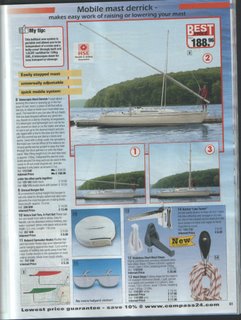
It was advertised in Compass 24 catalogue for about £200.I thought at the time that a syndicate of 5 or 6 owners could get one between them to spread the cost and assist each other using it.
Mast%20Derrick.jpg
 
So it was. £189.95. Max lifting ht 6.5m and max load 120kg.
But I cant log onto the website.
 
I presume you are hoping to raise and lower a mast that is either keel stepped or not made to pivot on cabin top.
Shear legs could be used which are guyed both fore and aft and sideways.
However the mast must be lifted from a point well above the centre of gravity. ie the shear legs need to be much more than half the length of the mast plus enough room for a tackle + 2metres if it is a keel stepped mast.

Providing the mast is not too heavy then it can be tilted to horozontal and lowered to the deck. The shear legs would be mounted just in front of the mast if you wanted to lay the mast base to the stern or just aft of the mast if you wanted base to the bow. However laying it on centreline would be the only choice.
I would suggest that the fore and aft guying of the shear legs be in the form of wire or rope guys about 3/4 of the way up each pole, a rope fore another aft on each pole. This would leave the centre of the boat clear for the mast to be lowered to the deck.
The poles for the shear legs obviously have to be strong enough to take the entire weight of the mast ( or a t least half) in column compression and the base points for the shear legs on the gunwhale needs to be strong enough. as does the lifting tackle. A chain block might be best.

Note that except in the case of very light masts/small boats you could only get the mast down to lying on the cabin top/ bow rail and stern rail. To get it to the ground would require a lot of strong people, possibly on ladders.

I would suggest that if you want to be able to do DIY mast lowering then you modify the base for a hinge or swing tabernacle then use spinnacker poles or similar to lower the mast aft with the base secured in the tabernacle. This is a whole lot more manageable and can be done easily while under way for bridges etc. However again it is even more difficult to get the mast from lowered to off the boat.

Coincidentally a friend has just bought a 32ft fin keel yacht. It has a deck stepped mast but with no provision for hinging or tilting. The boat is in a tempory marina till tomorrow morning when a mast rigging company will remove the mast with crane so that a hinging mast can be fitted.
They are going to supply and fit support legs than attqach to the gunwhale near the stern and run on a car up the mainsail track. I am interested to see this work and will report when I see it and have photos.
With the mast removed we will move the boat to it's home berth on Swan River. All boats of any size, moored in this river area are set up to lower masts to allow escape to ocean. (I should explain there is plenty of room for racing large boats on the river estuary area so we don't always go to the ocean.)It is not uncommon to see 70 ft of mast dangling behind a yacht as it traverse under 3 close spaced bridges for an ocean race only to return the same night with the same procedure. We have lots of experience of mast lowering with a hinge so PM me. olewill

PS no I wouldn't buy a kit when you can assemble yourself from stock materials.
 
Olewill thanks for that usefull posting. jmp's mast is about 32ft long so presumably 2 standard 21ft scafolding tube would be about the right size. Do you think alloy poles would be OK or would they have to be steel? I had assumed there would only be one fore and one aft rope to steady the poles but can see that your method of having a fore and aft on each pole, thus 2 fore and 2 aft ropes, would be easier to use and stronger. Paul
 
Yes I think alloy scafolding polles would be great.at 21 ft long.
The idea (and I have not done it myself) would be to keep the area of hull under the shear legs clear of stays so that it can swing the base foreward under the shear legs or aft under the shear legs. A single foreward and another aft stay in the middle may be OK but the mast base would have to be twisted a little sideways to avoid the stay as you lower the mast to horizontal. (probably OK) good luck and take some pictures. olewill
Have lots of helpers and a strong tackle.
 
In designing my own I worked out that the aft running stays would need to be on the legs below the spreaders. Otherwise you would need to thread the stay above the spreaders and between the mast and the cap shrouds which would seriously limit how much you could move the mast in the horizontal plane.

I think
 
Thanks Phil you are right about the spreaders fouling the stays for the shear legs so yes stays attached to the legs as low as is reasobalbe (say half way up) and definitely individual fore and aft stays for each pole. and of course the shear legs attached to the gunwhale to make a gap as wide as possible for the mast with spreaders attached to swing in between the shear legs. olewill
 
What about any sidewards movement shouldn`t some form of shroud to each leg be considered even temporarily until the mast is horizontal and lowered these could be attached to something off the boat, ie a car or fence or other strong point? just a thought!
Rob
 
I've now used my homemade mast crane. I made it from 2x1 roofing lathes. My mast is only 22ft high and on land I can lift it to shoulder height reasonably easily, so I don't think it's that heavy. The wooden lathes were just strong enough, but I wouldn't risk a heavier mast with them.

mastcrane06.jpg


I put a pivot bolt at the top and secured the front guy to one side and the block to the other.

Mastcrane07.jpg


The aft guys ran from lower down the legs to go under the spreaders

Mastcrane04.jpg


I made a strop from an old halyard to go around the mast and haul up to the spreaders. The tail gave me a handy downhaul to get the strop back down after raising the mast.

mastcrane02.jpg


The forward guy ran under the bow roller and the aft guys went to my sheet cleats.

mastcrane03.jpg


I made the feet of the legs fast to the forward shroud eyes.


Mastcrane08.jpg


After dismasting the crane is easier to make out

Mastcrane09.jpg


As I explained before, the mast step is merely an alloy shoe and once the mast is lifted out of it you are trying to balance it on a small moving boat which is a recipe for disaster, so I thought this would be a lot safer. The lowering and raising were both easily controlled, but no pics of the action as I was single-handed and holding the mast foot, handling the hoist line and ensuring the shrouds didn't get caught and bent was a three-handed job, so I didn't have any to spare for a piccy.
The system worked splendidly. I would have thought alloy poles would be spot on for a bigger mast (the sort quick-build scaffold towers are made of, not thin-wall tubing). Also a single block was OK for a small mast but a multi part system would give more control for a heavier mast.
It allowed me to drop my mast, fit a new sheave in the mast head and adjust the windex then put it back up in about 5 hours total without messing about with the mast-hoist at the council slipway.
 
Thanks Phil,

We are planning a very similar set up.The alloy scaffold poles will be joined at the top with a 360deg swivel,and we are planning to use a trailer ratchet winch mounted on one of the poles with a single simple sheave at the top.The poles will sit on 9"x4"wood blocks 18"--2'long on the deck recessed half depth to locate.The guying method is yet to be decided,but may be wire for safety.
 
That does rely on having a pivot at the mast foot. See my post at the top of the thread in which I have a home-made device jst like that. I used the halyard winch on the mast to control the rate of descent.
Cost me, well, nothing actually. I found the pipe in the beck and welded the bracket and lugs on from some scrap I had.
In fact I notice he's raising the mast without the headsail furling gear on which my design cleverley incorporates. Bloody hell it's hard being so clever. /forums/images/graemlins/cool.gif

The "A" frame device was expensive. £3.80 for the wood and I had all the other bits already.
 
Top