DIY greywater sump tank w. automagic pumpout

You could use a 12v Macerator pump. Be aware that longer lengths of grey water pipes collect fat and gunge.
Current boat has the outlets for the sinks above the waterline with smooth bore hoses. This is my preference.
 
Last edited:
You could use a 12v Macerator pump. Be aware that longer lengths of grey water pipes collect fat and gunge.

I've already got the greywater pump I intend to use; a Whale Gulper IC. Hose is a smooth bore 19mm inner dia "suction hose" (steel reinforced PVC), total length around 4 metres. I don't see any other way since my shower tray is well below the waterline, and I do not want a jet of water shooting out the side of my boat whenever I shower.
 
And you seem to be determined to troll me with insults every time I post. Do you do this to everyone here, or is this a special honour?


Explain how and why this is any less likely to cause siphoning?

View attachment 64007

Ever heard of siphon breaking valves? You may also note that the pump is placed above the waterline, so a failure there will also be above the waterline.

View attachment 64008

Is this you?

Hey, I'm sorry that I seem to have upset you. It's your boat, and obviously you can do whatever pleases you, but if you post on a forum, asking for advice, please don't be surprised if not everyone agrees with you. Have fun, and chill out.
 
Hey, I'm sorry that I seem to have upset you. It's your boat, and obviously you can do whatever pleases you, but if you post on a forum, asking for advice, please don't be surprised if not everyone agrees with you. Have fun, and chill out.

There are basically three alternatives, if I want to have a shower fitted:

  1. A standpipe through the hull below the waterline, with a sea-cock.
  2. A through-hull above the waterline.
  3. A through hull above the waterline with an external pipe.
A hole in the hull below the waterline has exactly what benefits? Tell me what I've missed here - because this doesn't seem simpler or safer to me?
 
There are basically three alternatives, if I want to have a shower fitted:

  1. A standpipe through the hull below the waterline, with a sea-cock.
  2. A through-hull above the waterline.
  3. A through hull above the waterline with an external pipe.
A hole in the hull below the waterline has exactly what benefits? Tell me what I've missed here - because this doesn't seem simpler or safer to me?

I have option 2.
 
I have option 2.

Right. Which is what I had planned to do all along. At first I wanted to combine the three drains (galley sink, wash basin and shower) via a "sump" into a single outlet. But I was talked out of doing this, in this very thread. The shower still needs a pump though, since it is below the waterline. Attaching a length of pipe to its outlet is simply to reduce noise, and make it look a little less ridiculous - the alternative is to have a 7L/min jet of water shooting out every time you take a shower; fine if you're at sea, maybe less so when moored in between two other boats. This is my 45' 12-tonne home we're talking about here, not some little daycruiser...
 
This is the kind of set-up I'm aiming for:

View attachment 63819

You will probably need valves to stop grey water surging from one source to the next?
You will need to be very careful about what goes down sinks.
What is the discharge rate of the dishwasher?

I've used those boxes or very similar for electronics stuff, not sure they are going to cope with pressure or vacuum from pumping?

A couple of years of use will turn this into a nasty mess.
The level sensor will pack up at the worst possible moment.
And a single problem stops the whole system. Not being able to wash your hands partway through sorting out a shower pump would not be a feature of a boat I'd choose.
 
Dumping sink and dishwasher water through a seacock below the waterline is glaringly simple. Everything goes straight away with no assistance and nothing to go wrong.

The shower may well be too low to gravity discharge sensibly. Pumping it out through another seacock, below the water is the simplest solution. Or have a manifold arrangement such as Roger Shaws.

The OPs dislike of seacocks is, shall i say, a bit on the paranoid side. Inventing technical electronic/electrical systems to replace simple gravity systems will end in tears.
 
The OPs dislike of seacocks is, shall i say, a bit on the paranoid side. Inventing technical electronic/electrical systems to replace simple gravity systems will end in tears.

You will have little trouble finding other, more experienced, sources of such "paranoia". I have certainly seen a fair number echoing my dislike for holes below the waterline. But be that as it may, by your own admission it will be necessary to have a pump on the shower drain regardless of how the water is disposed of. So I ask once again: how is having this done through a below the waterline through-hull, standpipe and associated sea-cock any simpler, or cheaper, or safer, or more reliable, than a through-hull which sits some distance above the waterline? What exactly are the benefits in your view?

Furthermore, I am not inventing anything here, I am using a popular off the shelf product which is designed for this specific use. I have heard many good reports on the reliability and efficacy of the Whale Gulper IC system - including in this thread - qualities which I believe are reflected in its price tag. If you have any suggestion for a better product at a similar price I would love to hear about it.
 
You will probably need valves to stop grey water surging from one source to the next?
You will need to be very careful about what goes down sinks.
What is the discharge rate of the dishwasher?

I've used those boxes or very similar for electronics stuff, not sure they are going to cope with pressure or vacuum from pumping?

A couple of years of use will turn this into a nasty mess.
The level sensor will pack up at the worst possible moment.
And a single problem stops the whole system. Not being able to wash your hands partway through sorting out a shower pump would not be a feature of a boat I'd choose.

Yeah, I dropped this idea some time ago.

Edit: You raise very sensible points; I agree on basically all of them, apart from the ability of an ABS waterproof enclosure to withstand pressure/vacuum - remember that it would have three normally open drains at the other end; it would not be possible to form any significant level of either inside it.

This was all I needed to hear:

Grey water tank is the nastiest thing on the boat, far worse than the black tank. The main problem is the collection of fats and soaps. It has to be cleaned out often, and it is hideously disgusting.
 
Last edited:
You will have little trouble finding other, more experienced, sources of such "paranoia". I have certainly seen a fair number echoing my dislike for holes below the waterline. But be that as it may, by your own admission it will be necessary to have a pump on the shower drain regardless of how the water is disposed of. So I ask once again: how is having this done through a below the waterline through-hull, standpipe and associated sea-cock any simpler, or cheaper, or safer, or more reliable, than a through-hull which sits some distance above the waterline? What exactly are the benefits in your view?

For shower water there are probably no benefits, other than not having water pumped across the marina or having external pipework going below the surface. For other grey water it makes a mess down the side of the boat, the discharge from an above the waterline through hull will stain and craze GRP. Better, IMO, to just dump it through a seacock as close to the sink as possible.

Furthermore, I am not inventing anything here, I am using a popular off the shelf product which is designed for this specific use. I have heard many good reports on the reliability and efficacy of the Whale Gulper IC system - including in this thread - qualities which I believe are reflected in its price tag. If you have any suggestion for a better product at a similar price I would love to hear about it.

No, i said before that i think it's a good system, for the shower water, because it's hard to block a gulper with shower water, although when used for toilets it isn't so hard.
 
For shower water there are probably no benefits, other than not having water pumped across the marina or having external pipework going below the surface. For other grey water it makes a mess down the side of the boat, the discharge from an above the waterline through hull will stain and craze GRP. Better, IMO, to just dump it through a seacock as close to the sink as possible.

For the galley sink, I will probably keep the existing standpipe and through-hull (yes, below the waterline!), though I will inspect it thoroughly before i decide. For the wash basin in the toilet I'm less sure; either a through-hull above the waterline, or use the "manifold" unit for the Gulper IC (I currently only have the shower drain attachment) - though I suspect that would necessitate some kind of check valve on the shower outlet, or you might get your feet wet when washing your hands... I am not keen on drilling any new holes below the waterline, and I certainly don't want any underneath the bathroom floor, which will consist of a (difficult to remove) shower tray.

No, i said before that i think it's a good system, for the shower water, because it's hard to block a gulper with shower water, although when used for toilets it isn't so hard.

Thanks. The toilet situation is a whole different question, and a pretty major one at that. Since this is for a live-aboard, I really want something with maximum reliability and comfort. Having originally looked at macerating toilets, I am now leaning more towards some kind of vacuum system, though where I'm going to find the extra money this would cost from I don't know - nor if I can justify spending in the region of £2500 on a toilet, should I manage to raise it. I will no doubt be back here pestering for recommendations when the time comes, but for now I'm in a marina with 24/7 access to tidy toilets, so the need is not pressing.
 
use the "manifold" unit for the Gulper IC (I currently only have the shower drain attachment) - though I suspect that would necessitate some kind of check valve on the shower outlet, or you might get your feet wet when washing your hands.

Thanks. The toilet situation is a whole different question, and a pretty major one at that. Since this is for a live-aboard, I really want something with maximum reliability and comfort. Having originally looked at macerating toilets, I am now leaning more towards some kind of vacuum system, though where I'm going to find the extra money this would cost from I don't know - nor if I can justify spending in the region of £2500 on a toilet, should I manage to raise it. I will no doubt be back here pestering for recommendations when the time comes, but for now I'm in a marina with 24/7 access to tidy toilets, so the need is not pressing.

On my shower pump I have the pump just above the top of the shower /gray water tank then from the outlet of the pump the pipe rises to just under the deck level in an inverted U bend, then down to the manifold skin fitting just above the static waterline.

The sink outlet prevents siphoning and the U under the deck prevents backflow into the shower/gray water tank.

I have a LAVAC in my aft head with a henderson MkV in parallel with and gulper type pump. In my forward head I have a Jabsco bowl with a gulper pump extracting from the head and a pressure water pump for the flushing water with separate switches.

My aft head has a divert valve to "to black water tank" or "to sea". The pump out from the black water tank is by a Jabsco macerator pump through an inverted U bent, then teed directly into the same outlet sea cock as the "to sea" head outlet connector.
 
As previously stated, my grey water tank outlet is a few inches above the WL. I solve the potential problem of hull staining by the simple expedient of using a small bit of plastic tape, stuck in the skin fittings in the shape of a "U". The gargoyles thus formed mean that anything coming out of the line of skin fittings, deck drains, various pumps, gas locker drain etc, is kept clear of the hull. Provided the tape is kept short, it stands up to being immersed while sailing for a year.
 
For the galley sink, I will probably keep the existing standpipe and through-hull (yes, below the waterline!), though I will inspect it thoroughly before i decide. For the wash basin in the toilet I'm less sure; either a through-hull above the waterline, or use the "manifold" unit for the Gulper IC (I currently only have the shower drain attachment) - though I suspect that would necessitate some kind of check valve on the shower outlet, or you might get your feet wet when washing your hands... I am not keen on drilling any new holes below the waterline, and I certainly don't want any underneath the bathroom floor, which will consist of a (difficult to remove) shower tray.


Thanks. The toilet situation is a whole different question, and a pretty major one at that. Since this is for a live-aboard, I really want something with maximum reliability and comfort. Having originally looked at macerating toilets, I am now leaning more towards some kind of vacuum system, though where I'm going to find the extra money this would cost from I don't know - nor if I can justify spending in the region of £2500 on a toilet, should I manage to raise it. I will no doubt be back here pestering for recommendations when the time comes, but for now I'm in a marina with 24/7 access to tidy toilets, so the need is not pressing.

I don't think you'll have a problem with the heads wash basin going straight out through an above waterline through hull.

As for toilets, i've had macerator systems and vacuum ones and i can confidently say that the vacuum ones win hands down. Macerator systems are noisy and have plenty of bits that need servicing and plenty to go wrong. They are also pretty easy to jam or block. Power hungry blighters too !

My current boat came to me fitted with a Lavac toilet, emptied with a MKV Henderson hand pump. Both work really well. The pump is a hand operated version of the Gulper and is pretty hard to block, easy to service and silent in use. It uses no leccy of course. A divertor valve sets whether the discharge goes to the holding tank or to sea. I also have a second divertor valve that allows the pump to empty the holding tank. I've just purchased a Jabso diaphram pump (pretty much the same as a Gulper) which i will fit in parallel to the hand pump, so i can use the electric pump when power is plentiful and the hand pump when its short.

None of the above would cost anywhere near £2.5k i would have thought.
 
I have a LAVAC in my aft head with a henderson MkV in parallel with and gulper type pump. In my forward head I have a Jabsco bowl with a gulper pump extracting from the head and a pressure water pump for the flushing water with separate switches.

How do they perform? Any nightmares?

My aft head has a divert valve to "to black water tank" or "to sea". The pump out from the black water tank is by a Jabsco macerator pump through an inverted U bent, then teed directly into the same outlet sea cock as the "to sea" head outlet connector.

I will only very rarely venture far enough out to be allowe use a sea outlet, and then only to make (hopefully) swift passage from A to B in (hopefully) the calmest of weather, so I don't plan to fit a sea outlet. I'm afraid I'll be stuck with the very expensive pump-out facilities in marinas etc :(

I don't think you'll have a problem with the heads wash basin going straight out through an above waterline through hull.

Apart from a white line of toothpaste residue down the outside of my black hull. I can live with that.

As for toilets, i've had macerator systems and vacuum ones and i can confidently say that the vacuum ones win hands down. Macerator systems are noisy and have plenty of bits that need servicing and plenty to go wrong. They are also pretty easy to jam or block. Power hungry blighters too!

I hear you. Having previously considered them the "best compromise" I have been turned off by all the issues people seem to be having, and the horrid consequences. Not sure I agree about power usage being a problem though; the models I've looked at seem to be in the 200-300W range, whether 12 or 24 volts, which seems rather wimpy to me - possibly part of the reason they all seem to struggle with anything but a minute amount of the flimsiest toilet paper. I want a toilet that is as close to a domestic water flushing system as possible, both in terms of reliability and flushing capability - but obviously without using 8 litres of water with every flush... Vacuum toilets indeed seem to be the way to go here.

My current boat came to me fitted with a Lavac toilet, emptied with a MKV Henderson hand pump. Both work really well. The pump is a hand operated version of the Gulper and is pretty hard to block, easy to service and silent in use. It uses no leccy of course. A divertor valve sets whether the discharge goes to the holding tank or to sea. I also have a second divertor valve that allows the pump to empty the holding tank. I've just purchased a Jabso diaphram pump (pretty much the same as a Gulper) which i will fit in parallel to the hand pump, so i can use the electric pump when power is plentiful and the hand pump when its short.

I am curious about the option of having an electric diaphragm pump perform the evacuation - are you saying a Gulper 320 might work well for this? Wouldn't really be a "vacuum" toilet, though it seems to me such a design should be able to deal with anything that fits down the pipe, as long as it's not sharp enough to puncture the diaphragm!

None of the above would cost anywhere near £2.5k i would have thought.

I have been looking at commercial loos, in the "if you need to ask you can't afford" price bracket. The kind of things they'd fit on an oil platform :D Evac, Wärtsilä, Jets...
 
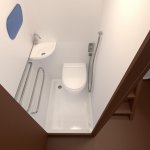
Here is how I've planned the bathroom, all of 135x95cm, only partially standing height.

bathroom.jpg

I have since moved the planned location of the shower drain to the right hand side, to make it easier to access (from outside the bathroom) in case of issues. The bulkhead behind the toilet is 6mm steel, and I've been tempted to use it for a wall mounted toilet seat (e.g. Vetus "Hato", Sanimarin "Sanistar", Jets "Charm", etc).

Edit: The toilet in the picture is based on the dimensions of the Sanimarin Sanistar.
 
Last edited:
I am curious about the option of having an electric diaphragm pump perform the evacuation - are you saying a Gulper 320 might work well for this? Wouldn't really be a "vacuum" toilet, though it seems to me such a design should be able to deal with anything that fits down the pipe, as long as it's not sharp enough to puncture the diaphragm!

The Lavac has seals around the seat and lid. With both closed you operate the pump and it empties the bowl. As the lid and seat are sealed a vacuum is formed, or tries to be formed, so water gets sucked in. It'll cope with anything that you've eaten, but they don't like things like baby wipes, sanitary towels etc (what pump would ?).

It's a really simple and reliable setup, the hand pump is handy if short of power or as a backup for the electric pump, but is not a must fit thing, you could fit the electric pump on its own. That way, all you'd have in the heads would be the toilet bowl, although the hand pump can be fitted behind a bulkhead.
 
The Lavac has seals around the seat and lid. With both closed you operate the pump and it empties the bowl. As the lid and seat are sealed a vacuum is formed, or tries to be formed, so water gets sucked in. It'll cope with anything that you've eaten, but they don't like things like baby wipes, sanitary towels etc (what pump would ?).

I hear a lot of good things about the Lavac toilets, here and elsewhere. Not quite what I would call a "vacuum toilet" though - the idea with these is that they build up a vacuum upstream and use that to shift the ****. You know, like on trains and aeroplanes: *SCHLOOMPF* Expensive, but if you can afford it... The Jets "Charm" has a very compact 900W 12V pump, and always empties the bowl on first flush, while only using one litre of water. That translates to significant black water tank savings compared to the 1 1/2 litre flushes on lesser loos which frequently require double flushing. The downside? A complete system costs £2,300.

It's a really simple and reliable setup, the hand pump is handy if short of power or as a backup for the electric pump, but is not a must fit thing, you could fit the electric pump on its own. That way, all you'd have in the heads would be the toilet bowl, although the hand pump can be fitted behind a bulkhead.

I do like the sound of that.
 
My LAVAC head setup is exactly the same as PaulRainbow and works very well providing as Paul said no baby wipes, Sanitary products, etc are put down the head.

My boat is an offshore sailing cruiser so I can and do discharge way offshore.

My Jabsco head I did convert it to an electric macerator pump but started to have problems plus the noise so converted it to use the same electric pump as my LAVAC plus a separate flush water pump and now it works like a dream.
 
Top