
DIY conversion of halogen/incandescent deck light to LED

skyflyer

Well-Known Member
Joined
26 Jan 2011
Messages
1,433
Location
Worcester, UK
Visit site
Only really practical, I suspect, if you have the mast unstepped but last year when I was renewing standing rigging I noticed that the old halogen holder and reflector in my aqua signal deck/steaming light was corroded and pretty much useless. I had already decided to re-cable and fit LED lights to the masthead lights, so wondered at my options for a new deck steaming light. Obviously the steaming light could be a simple LED bulb replacement but the deck light was more of an issue

I could have fitted a new unit for around £75 but instead I bought a Cree LED reversing bulb, which is completely watertight and has a lens, similar to
$_12.JPG
this at £6 for two, a lamp holder for the same lamp, like
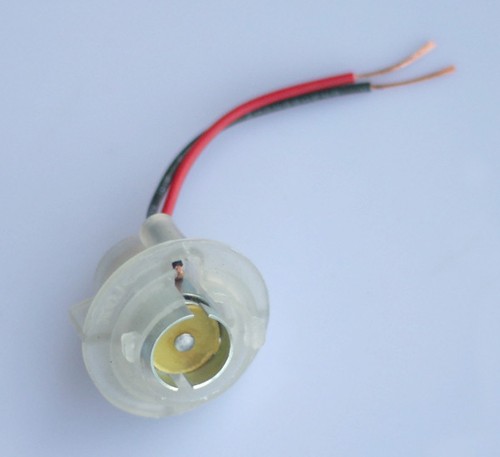
$_12.JPG
this for 99p and using some epoxy with micro balloons and a bit of carving and fettling with a stanley knife, fixed it all in place, so that the bulb can still be easily changed.

I was relucatnt to post this until it had at least a season of use and exposure to the salt spray etc, so far its been absolutely faultless and gives a really good bright light that illuminates the entire foredeck on my 32 footer.

Total cost under £10 (if you dont have to buy epoxy especially)) and about an hour of your time.

I'll get a photo at haul out next week!
 
Funnily enough, I've just converted the hurricane lamp I've been using as an anchor light in a similar way. I used an 'all round' LED. I hope mine will last as well as yours.

Will be doing the same to the mast-head light during the winter.
 
Last edited:
Only really practical, I suspect, if you have the mast unstepped but last year when I was renewing standing rigging I noticed that the old halogen holder and reflector in my aqua signal deck/steaming light was corroded and pretty much useless. I had already decided to re-cable and fit LED lights to the masthead lights, so wondered at my options for a new deck steaming light. Obviously the steaming light could be a simple LED bulb replacement but the deck light was more of an issue

I could have fitted a new unit for around £75 but instead I bought a Cree LED reversing bulb, which is completely watertight and has a lens, similar to
$_12.JPG
this at £6 for two, a lamp holder for the same lamp, like
$_12.JPG
this for 99p and using some epoxy with micro balloons and a bit of carving and fettling with a stanley knife, fixed it all in place, so that the bulb can still be easily changed.

I was relucatnt to post this until it had at least a season of use and exposure to the salt spray etc, so far its been absolutely faultless and gives a really good bright light that illuminates the entire foredeck on my 32 footer.

Total cost under £10 (if you dont have to buy epoxy especially)) and about an hour of your time.

I'll get a photo at haul out next week!
How many hrs a day do you have them on, is it worth the friggin about
 
How many hrs a day do you have them on, is it worth the friggin about

Your choice - this thread is posted for the benefit of those that have already decided they would like to convert to LED deck lights to save them £70-odd. It was not posted as an ivitaion to all and sundry to discuss whether or not LED lights are worth the cost or effort. However...

The old style halogens and incandescents tend to fail not only through usage but as a result of corrosion and vibration, necessitating trips up the mast at inconvenient times!

By converting to LED, as well as reducing power consumption, extending bulb life (fewer trips up mast), because the bulbs draw less power you can use thinner (and thus cheaper) cable without suffering any voltage loss. Or in my case, tinned cable at a similar price to the untinned factory fitted heavier cable.
Also the brightness of the light far exceeds any halogen deck light I have ever seen.
 
this thread is posted for the benefit of those that have already decided they would like to convert to LED deck lights to save them £70-odd.

It was this that motivated me to convert my anchor light to LED. It took me less than an hour and saved me £50+. Not a bad hourly rate when you're semi-retired! There was the additional benefit of having a modern anchor light housed in a brass hurricane lamp and therefore in keeping with a classic yacht. £18.00 well spent
 
I used a sealed enclosure LED (MR16 I think) with wire tails to avoid a bayonet connection, as that's often where the contact fails, dissimilar metals in a salty environment with a weak contact.
 
Now I'm interested, I thought the original was a 40W so a 21W equivalent would be less bright.

Have you got links for the items?

Nigel

A large part of energy that goes into an incandescent bulb produces heat not light. That is why the LEDs, being more efficient and thus less hot, produce a greater luminance than the equivalent wattage incandescent bulb.
The currently accepted measurement of brilliance seems to be lumens
a 40W halogen bulb typically gives one 400 lumens
a 20W Cree LED produces 500 lumens

Herae are photos of the installation - the lamp holder was fixed in place with a stiff mix of epoxy and micro balloons

mhv980.jpg


and

s4q5jq.jpg
 
There was the additional benefit of having a modern anchor light housed in a brass hurricane lamp and therefore in keeping with a classic yacht. £18.00 well spent ��

A very nice idea, sir. Does it have a trailing lead, or did you adapt the anchor light to take batteries?
 
No, the lamp holder has two wires out of it, I fed these through to the rear of the fitting and crimped on ring terminals which enabled me to connect them to the similar terminals on the end of the cable up the mast, using the original terminal blocks that were part of the fitting.
This was where the fettling was required. When you remove and dis-assemble the aqua signal deck/steaming light unit, it all comes apart into sections quite easily but I needed to do a bit or paring with a stanley blade to make a cut-out through which the wires could pass to the rear of the holder.
I coated all connections (including bulb terminals) with Contralube 770 (available in small sachets in Maplins) which protects against corrosion and tarnishing etc.
In order to get the lamp holder embedded in the micro balloon paste whislt it set, I tilted the entire unit on its back so that the paste would flow level and thus be at the correct angle when it was put back on mast - sorry if this isn't clear - its tricky to explain. However there must be 101 other ways that it could be done.
The bottom line is that if you buy the bulb and the holder it doesn't take a great deal of ingenuity to find a way of fixing it in place!
 
Personally I'd be a bit wary of ending up with a bright deck light. Ours is just about right as it is. If you're turning it on to get the fenders and mooring lines ready for a night approach then you could find that your sailing into inky blackness. Worth trying it out at night when your eyes are adjusted.
 
Nigel

A large part of energy that goes into an incandescent bulb produces heat not light. That is why the LEDs, being more efficient and thus less hot, produce a greater luminance than the equivalent wattage incandescent bulb.
The currently accepted measurement of brilliance seems to be lumens
a 40W halogen bulb typically gives one 400 lumens
a 20W Cree LED produces 500 lumens

Herae are photos of the installation - the lamp holder was fixed in place with a stiff mix of epoxy and micro balloons

mhv980.jpg


and

s4q5jq.jpg

A very neat conversion.

I don't currently have a deck light. Was wondering about something like this...

http://www.ebay.co.uk/itm/2x-10W-Cr...se-Lamp-WFR-/281724593851?hash=item41981826bb
 
Personally I'd be a bit wary of ending up with a bright deck light. Ours is just about right as it is. If you're turning it on to get the fenders and mooring lines ready for a night approach then you could find that your sailing into inky blackness. Worth trying it out at night when your eyes are adjusted.
Agreed. I wouldn't ever use a deck light for that sort of deck work. Mostly gets used alongside and it's a great way of lighting the headsail at night if you're worried you haven't been seen!
 
Top