DIY Central Marine Computer with Raspberry Pi — featured in PBO

Yacht Topaz

New Member
Joined
6 Apr 2021
Messages
8
Visit site
In the October 2024 edition of Practical Boat Owner, there was an article on building a DIY central marine computer for under £400. That article was based on a system I’ve been developing and running on my own boat for the past few years.

The concept is straightforward: instead of spending thousands on proprietary monitoring systems, you can use a Raspberry Pi, a few ESP32 modules, and affordable sensors to create one central hub for your boat.

✅ Engine monitoring — temps, oil pressure, tachometer, fuel
✅ NMEA 0183 & NMEA 2000 — depth, wind, GPS, heading
✅ Batteries & solar — SOC, charge/discharge, tank levels
✅ Safety — bilge, leak, smoke, fire alarms
✅ Anchor alarm & remote access via phone/tablet
✅ Automations — e.g. anchor light at sunset if the boat is stationary

Everything runs locally on free, open-source software (Home Assistant + ESPHome). No subscriptions, no lock-ins — just dashboards, alerts, and full control of your boat’s systems.

I’ve published the build docs with wiring diagrams and code here:
👉 Central Marine Computer Build Docs

Has anyone here tried starting their own version of this central marine computer since reading the PBO article?
 
I haven’t tried the Central Marine Computer idea but I do have a few Arduino devices on board monitoring some things. I hadn’t thought of using Home Assistant to centralise the outputs though. Thanks for the link to your website which looks very helpful.
 
Sorry I don't use your system but do have my own on an old Pi 3B+ that provides:
- AIS receiver, using an RTL-SDR dongle, transmits NMEA over UDP to Android nav. tablet
- images or video streaming of the boat interior using the PI camera module
- ditto of exterior via a pushpit mounted IP camera
- monitoring; bilge, battery level
No router as the Pi is a hotspot and uses a 4G dongle for net connection, so very low power consumption.
I use MQTT over mesh-VPN for remote access e.g. bilge, streaming on/off etc.

I think there are quite a few Pi with OpenCPN users on here, but I didn't need the navigation/plotter functions.
I don't take the magazine so didn't see your article, but will take a look - looks good.
 
In the October 2024 edition of Practical Boat Owner, there was an article on building a DIY central marine computer for under £400. That article was based on a system I’ve been developing and running on my own boat for the past few years.

The concept is straightforward: instead of spending thousands on proprietary monitoring systems, you can use a Raspberry Pi, a few ESP32 modules, and affordable sensors to create one central hub for your boat.

✅ Engine monitoring — temps, oil pressure, tachometer, fuel
✅ NMEA 0183 & NMEA 2000 — depth, wind, GPS, heading
✅ Batteries & solar — SOC, charge/discharge, tank levels
✅ Safety — bilge, leak, smoke, fire alarms
✅ Anchor alarm & remote access via phone/tablet
✅ Automations — e.g. anchor light at sunset if the boat is stationary

Everything runs locally on free, open-source software (Home Assistant + ESPHome). No subscriptions, no lock-ins — just dashboards, alerts, and full control of your boat’s systems.

I’ve published the build docs with wiring diagrams and code here:
👉 Central Marine Computer Build Docs

Has anyone here tried starting their own version of this central marine computer since reading the PBO article?
i dont understand why you would use Home Assistant when Signal K, Node Red and Grafana/Kip seem better solutions. Give me the $64000 reason why i should use Home Assistant?
 
I wouldn’t say Signal K, Node-RED, or Grafana are better — just different. They’re powerful, but Home Assistant has some big advantages:

One platform instead of juggling 3 separate installs

2M+ users, updated monthly → future-proof & well supported

Native dashboards, mobile app & notifications out of the box

Event-driven automations (anchor light, bilge alerts, over-temp siren, etc.)

Integrates NMEA 0183/2000, ESP32 sensors, Zigbee, Victron BLE all in one place

No Linux knowledge needed — HA manages the Raspberry Pi with menus, updates & backups

Still flexible: you can pull in Signal K data if you want

The $64,000 reason?
It’s not just a data logger — it’s a modern, open-source automation hub that works for both non-tech boaters and power users.
 
Been there and done that ... got fed up maintaining it. For some reason every time I go open source, be that desktop at home, or a plethora of Raspberry Pi projects involving Venus OS and most recently Home Assistant, when something changes or breaks, the fix ends up being tedious and complicated.

The more you immerse yourself in it, the easier it gets .... but I find, I get the system working, it runs for a few months and then something breaks. I then have to refresh my knowledge before I can fix it ... and in my case, this always seems to happen when I want to use the boat, and I end up tinkering with electronics and software when I actually want to be sailing.

Than doesn't happen (very often) with my Raymarine system - and usually an automated SW update fixes the problem.
 
I get where you’re coming from. But HA today is very different:

Modern HA is much more stable (2M+ users, monthly release cycles, quick fixes).

You don’t need to touch Linux – HAOS manages the Pi fully via menus.

Fail-safe: a full SD/SSD image backup means a 5-minute restore if anything breaks.

Openness = future-proofing. Features and integrations keep coming, not stuck with what a manufacturer allows.

Cost: base system with NMEA 0183/2000, engine monitoring, tanks, solar, bilge/fire alerts etc. for ~$400, no subscriptions.

Raymarine is solid, but nowhere near the functionality: wireless bilge/fire sensors, phone notifications, remote access (4G/Starlink), dashboards, automations, anchor alarms, engine temps, solar SOC, and more.
 
but Home Assistant has some big advantages:
My marketing colleagues would tell me most of those are features not advantages, and people buy benefits not advantages.

I have a Pi on board and like a bit of tinkering but I have to say I think @Baggywrinkle is right. I should be the target audience, and I’m not convinced these things actually serve a NEED. $ 400 + the install effort for curiosity’s sake could be white elephant and whilst there 2M users of HA they aren’t all using this system for boating stuff so with no customer loyalty concerns they can essentially leave you on a branch with only geek support if something else is preferable for the mainstream.

If I was going to spend $400 there’s probably a list of other things I’d do; even if it was sensors/monitoring type stuff I’d fit a holding tank level sensor, cooling water flow meter/alarm, and proper engine block temp sensors before I was interested in sitting at home checking if my solar panel was putting in more power than my automation kit was drawing!


My marketing colleagues would tell me most of those are features not advantages, and people buy benefits not advantages.

I have a Pi on board and like a bit of tinkering but I have to say I think @Baggywrinkle is right. I should be the target audience, and I’m not convinced these things actually serve a NEED. $ 400 + the install effort for curiosity’s sake could be white elephant and whilst there 2M users of HA they aren’t all using this system for boating stuff so with no customer loyalty concerns they can essentially leave you on a branch with only geek support if something else is preferable for the mainstream.

If I was going to spend $400 there’s probably a list of other things I’d do; even if it was sensors/monitoring type stuff I’d fit a holding tank level sensor, cooling water flow meter/alarm, and proper engine block temp sensors before I was interested in sitting at home checking if my solar panel was putting in more power than my automation kit was drawing!
Rich (BB code):
There really aren’t any proprietary systems that even come close to these features — not at this price point, and not with this flexibility. 

 Real-World Benefits I actually use on my boat:Bilge & fire safety – leak & smoke sensors trigger sirens + phone alerts 
• Engine protection – 4 temps (coolant, thermostat, raw-water elbow, alternator) + oil pressure + tachometer. Example: elbow > 42 °C → early warning of blocked intake/impeller failure 
• Full NMEA 0183/2000 integration – depth, wind, GPS, compass, speed with custom alarms 
• Power & solar – battery voltage/current/SOC + solar production 
• Tanks & pumps – fuel, water, grey tanks + pump activity 
• Anchor security – GPS anchor watch + automatic anchor light at sunset 
• Onboard security – siren with strobe + intrusion alerts 
• Dashboards anywhere – multiple tablets onboard + remote monitoring from shore 
• Custom alerts & automations – all under your control 
• History & trends – spot wear or unusual usage patterns before they become problems 

All this runs fully offline, no subscriptions, and the core system cost is about $400. 
For me, the advantage is simple: proactive safety, situational awareness, and control that no closed system (Raymarine, B&G, etc.) even attempts to cover.


Rich (BB code):
There really aren’t any proprietary systems that even come close to these features — not at this price point, and not with this flexibility.

 Real-World Benefits I actually use on my boat:Bilge & fire safety – leak & smoke sensors trigger sirens + phone alerts
Rich (BB code):
- OK but smoke detectors are dirt cheap and have an inbuilt siren.  If you aren't on board a phone smoke alarm is probably only marginally helpful, its not going to save your boat in 99% of cases.
- Audible bilge sensors are widely available for low cost.  I can see it MIGHT be reassuring to know your boat isn't leaking - but mine is bone dry.  If you have leaky bilge it might be interesting to monitor if the bilge pump runs.


Engine protection – 4 temps (coolant, thermostat, raw-water elbow, alternator) + oil pressure + tachometer. Example: elbow > 42 °C → early warning of blocked intake/impeller failure
This I think has SOME merit, but when I was worried about cooling water at the start of the season I bought 4 little digital thermometers on amazon for a tenner and manually tracked them until I found the issue. You can easily get thermometers with max temp alarms.
For me, the advantage is simple: proactive safety, situational awareness, and control that no closed system (Raymarine, B&G, etc.) even attempts to cover.
But I think all of those things are available wth simple electronics (e.g. I can buy a temp alarm, or leak alarm for <£10), my quite old raymarine depth gauge has alarm settings built in, I have a free anchor alarm app, my anchorlight has a daylight senor. The advantage, if there is one, has to come from bringing all that information together in one place, in logging all that data indefinitely, or in being able to access it "off boat". I have considered doing those things with my existing Pi set up. There may be value in the engine monitoring stuff with graphs looking at temp/pressure/revs for early warning, everything else I don't see, although I'm sure those with leaky boats or who leave lots of stuff turned on want to know about bilge and batteries.

Feature - monitor coolant temp
Advantage - get warning about possible impeller problems
Benefit - avoid changing your impeller before it wears OR react before bits of impellor are lost inside the heat exchanger (needs evidence that you get sufficient advance warning).
 
I think the Raspberry Pi is excellent, and using it or an equivalent to DIY your control and monitoring systems on boats, campervans, houses etc. is a hobby in and of itself. Combining that with boating is great application of the tech, but I don't have the passion for it, or the time for it among my existing hobbies. I guess I'm a casual dabbler, I do it out of interest when I have the time, and each time I pick it up it has been "improved" and doesn't work quite like it used to last time, so there's that learning curve I usually have to go through before I'm competent again.

We had related problems at work, when using Linux as the OS for some of the embedded vehicle controllers, finding someone who would take the responsibility to deliver a working and supported OS and BSP so we could get on with the automotive bits was not easy. We ended up on Android, which has it's own challenges, and interestingly, more and more chart plotters are now Android based. It's a compromise between the straight-jacket of Google and the flexibility of self development.

... funnily enough it's one of the reasons I admire Microsoft - they've stayed laser focussed on business PCs and the rollout and maintenance of such - so their offerings generally just work. Haven't done any major bios or OS related stuff since I built my current PC 3 years ago.

Unfortunately for me, I'm a boater primarily and an electronic hobbyist when I've nothing better to do.

To quickly compare the advantages of various solutions ......

Real-World Benefits I have on my boat:

Bilge & fire safety – leak & smoke sensors trigger sirens + phone alerts

My Marina provides an app called Sense4Boat which is bundled with the annual marina fees ... boat is fitted with a smoke/heat/humidity sensor, voltage monitoring on the batteries, and a water float sensor in the bilge. Allows remote monitoring and relays any issues to me and the marina. The app also gives weather at the marina (Windy) and provides webcam views of the pontoons. It keeps a log of the values over time.

Sense4Boat - The world's simplest boat monitoring solution

Engine protection – 4 temps (coolant, thermostat, raw-water elbow, alternator) + oil pressure + tachometer. Example: elbow > 42 °C → early warning of blocked intake/impeller failure ...

I make do with the VP supplied sensors and alarms which is not as good as your monitoring (VP = water temp, oil pressure switch and alternator voltage), I relay the VP info to NMEA2000 network with an NMEA2000 Gateway and have screens for the motor parameters on my Raymarine MFDs and Plotters.

Full NMEA 0183/2000 integration – depth, wind, GPS, compass, speed with custom alarms

Covered by Raymarine components (I have no NMEA0183)

Power & solar – battery voltage/current/SOC + solar production

Covered by Victron components, including all functionality of Ekrano GX including VRM. Also available on Axiom Plotters.

Tanks & pumps – fuel, water, grey tanks + pump activity

Fuel on NMEA with VP Gateway, Water/Grey tanks supplied with Boat panel - pump activity and water/grey tanks definitely room for improvement, need NMEA sensors fitted.

Anchor security – GPS anchor watch + automatic anchor light at sunset

Covered by Sense4Boat or Navionics or Axiom Plotters, Anchor light driven by Victron MPPT.

Onboard security – siren with strobe + intrusion alerts

Not needed in my cruising ground so I have no solution. Would implement using Raymarine Yachtsense Link

Dashboards anywhere – multiple tablets onboard + remote monitoring from shore

Control Axiom plotters over WiFi from Tablet/Phone. Axiom provides custom screens based on all available NMEA2000 data. Sense4Boat/Yachtsense/VRM provide remote monitoring and activation.

Custom alerts & automations – all under your control

Raymarine Yachtsense Link / Sense4Boat

History & trends – spot wear or unusual usage patterns before they become problems.

Feature to log NMEA and then post process exists on Axiom plotters, but I've never used it.

All this runs fully offline, no subscriptions, and the core system cost is about $400.

Same, but system cost was two orders of magnitude higher. Does include everything from 11kWh of Lithium to the smallest sensor.

For me, the advantage is simple: proactive safety, situational awareness, and control that no closed system (Raymarine, B&G, etc.) even attempts to cover.

Now that most new plotters are Android based I'm not sure that is the case any more.

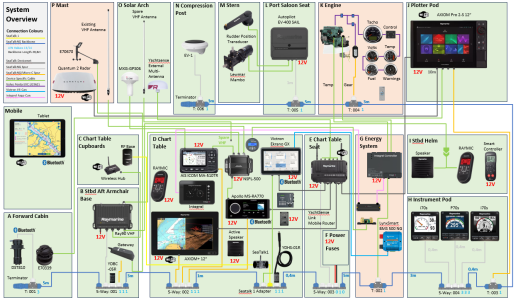
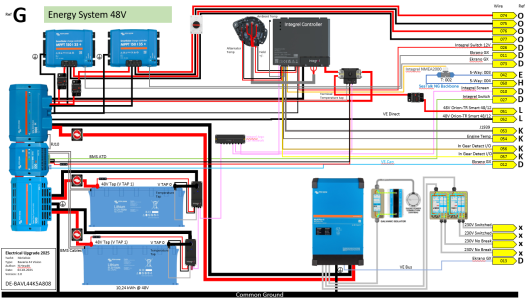
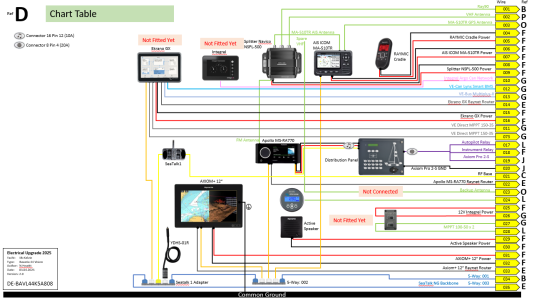
For reference ... this is the system I have on board - Overview and a couple of the wiring diagrams ...

1756465118372.png
1756465184453.png
1756465277101.png
 
Rich (BB code):
- OK but smoke detectors are dirt cheap and have an inbuilt siren.  If you aren't on board a phone smoke alarm is probably only marginally helpful, its not going to save your boat in 99% of cases.
- Audible bilge sensors are widely available for low cost.  I can see it MIGHT be reassuring to know your boat isn't leaking - but mine is bone dry.  If you have leaky bilge it might be interesting to monitor if the bilge pump runs.

This I think has SOME merit, but when I was worried about cooling water at the start of the season I bought 4 little digital thermometers on amazon for a tenner and manually tracked them until I found the issue.  You can easily get thermometers with max temp alarms.
But I think all of those things are available wth simple electronics (e.g. I can buy a temp alarm, or leak alarm for <£10), my quite old raymarine depth gauge has alarm settings built in, I have a free anchor alarm app, my anchorlight has a daylight senor. The advantage, if there is one, has to come from bringing all that information together in one place, in logging all that data indefinitely, or in being able to access it "off boat". I have considered doing those things with my existing Pi set up. There may be value in the engine monitoring stuff with graphs looking at temp/pressure/revs for early warning, everything else I don't see, although I'm sure those with leaky boats or who leave lots of stuff turned on want to know about bilge and batteries.

Feature - monitor coolant temp
Advantage - get warning about possible impeller problems
Benefit - avoid changing your impeller before it wears OR react before bits of impellor are lost inside the heat exchanger (needs evidence that you get sufficient advance warning).
Rich (BB code):
You’ve clearly got a good setup already — but it’s even better when everything is linked together and integrated in one place, instead of separate gadgets.

• Bilge/leak sensors – not just about a leaky hull. They also pick up freshwater pump leaks, watermaker failures, or burst hoses.

• Anchor light – mine only comes on automatically when the boat is stationary, not when under way. I can also switch it on from shore if needed.

• Anchor alarm – runs on the boat’s NMEA GPS, so it’s more accurate than a phone app. It also works from land without juggling two phones.

• Remote access – beyond just alerts, it can trigger the mast horn or strobe to warn nearby boats, and lets me see the whole boat status (depth, wind, power, GPS track) from anywhere.

• Convenience – I can even turn on my deck lights from the dinghy when coming back late at night.

The real benefit is having it all integrated, logged, and remotely accessible — situational awareness and control whether you’re on board or ashore.
 
Been there and done that ... got fed up maintaining it. For some reason every time I go open source, be that desktop at home, or a plethora of Raspberry Pi projects involving Venus OS and most recently Home Assistant, when something changes or breaks, the fix ends up being tedious and complicated.

The more you immerse yourself in it, the easier it gets .... but I find, I get the system working, it runs for a few months and then something breaks. I then have to refresh my knowledge before I can fix it ... and in my case, this always seems to happen when I want to use the boat, and I end up tinkering with electronics and software when I actually want to be sailing.

Than doesn't happen (very often) with my Raymarine system - and usually an automated SW update fixes the problem.
i am tempting fate i know it, but fitted Venus over a year ago on a RPI and havent had to touch it, it just works.
 
I wouldn’t say Signal K, Node-RED, or Grafana are better — just different. They’re powerful, but Home Assistant has some big advantages:

One platform instead of juggling 3 separate installs

2M+ users, updated monthly → future-proof & well supported

Native dashboards, mobile app & notifications out of the box

Event-driven automations (anchor light, bilge alerts, over-temp siren, etc.)

Integrates NMEA 0183/2000, ESP32 sensors, Zigbee, Victron BLE all in one place

No Linux knowledge needed — HA manages the Raspberry Pi with menus, updates & backups

Still flexible: you can pull in Signal K data if you want

The $64,000 reason?
It’s not just a data logger — it’s a modern, open-source automation hub that works for both non-tech boaters and power users.
Event driven automations is the only one i concede would be handy. When you say no Linux, you are just replacing it with Yaml which i dont have and would be a learning curve.
 
Topaz,

You are trying to sell a solution. I’m a potential customer for that solution, and in many ways should be more willing to embrace your tech than the average octogenarian on here! You are convinced of your value and I’m suggesting that it doesn’t resonate.

The real benefit is having it all integrated, logged, and remotely accessible — situational awareness and control whether you’re on board or ashore.
I’m not sure that is a benefit - will it save me on maintenance, make me sail faster, etc? I’m not sure I’ve ever been worried about situational awareness and thought - what I need is more digital information - usually that is a euphamism for people having become too task/screen focussed and forgetting to look out the window!

There’s some nice gimmicks there like turning on the deck lights remotely but what you inevitably do is add complexity and effort debugging any wiring fault. I think some of your claims are probably exaggerated too - why is the boats GPS inherently more accurate than a mobile app? I want to like your tech but it’s missing a compelling reason.

Probably the killer for most people leaving all that running 24/7 unless on shore power is the battery drain - your tech, all the sensors, all your instruments GPS/Wind etc - no wonder you need to measure battery SOC!
 
i am tempting fate i know it, but fitted Venus over a year ago on a RPI and havent had to touch it, it just works.
Therein lies the problem ... not everyone has the same experience and the difference between your experience and mine can be down to something as simple as a choice of peripheral, because no two systems are ever quite the same.
 
Top