DIY antifouling advice?

ChasB

Well-Known Member
Joined
11 Nov 2006
Messages
543
Location
Limehouse
Visit site
Hi,

The advice here has always been friendly and helpful , so I'm back with more questions :) :

I have a 10m cruiser. I plan to take it to a boatyard nearby, crane it out, clean the underside, then appy anitfouling. I need to book the craning in and out, so I need a good estimate of time.

Never done it before. :oops:

The boat got its last antifoul a decade ago, in freshwater, and has barely moved from its Thames marina mooring since.

1) Cleaning - that should only take a few hours? Will I likely be using a regular pressure-washer?

2) Do I then have to leave a period for the boat hull to dry?

3) How much antifouling will I likely need? How much does that cost? What equipment will I need? There will be two of us - so how long should I give it?

Any other tips?

Thanks a lot! ;)
 
Usually the boatyard does the cleaning with a pressure washer. Have a talk with the boatyard but I suspect if the last antifoul is 10yrs old it will be so heavily fouled as well as the prop that you may need a tow... The yard will also be able to advise the best antifouling for your boat and quantity. I'm assuming you are a motor boat? Applying the antifouling is easy with paint rollers and brushes. Prepare to get dirty and mucky depending how easy it is to get at the underneath. Or you could just get the yard to do the painting! Good luck.
 
Have it jet washed by the yard on lift out. Otherwise the dried fouling will be unpleasant and difficult to remove.

Don't underestimate the time required. Do you really just want to clean it as preparation ? Don't you want to wet sand it to make the surface as even as possible ?
Preparation allow two to four days for wet sanding , maybe more depending on what you find the surface of the old antifoul to be like . This may be weather dependent .
Leave it a week to dry.
I applied a first coat of barrier coat/primer and a coat of antifoul - one day each coat. This is weather dependent. One day each coat.
I spent about £130 on paint but the cost can be very variable depending on the product you select and probably a further £40 on PPE , rollers etc. You may need to spend more . I had some old waterproofs I used for the wet sanding and abrasive papers I already had a stockpile. Rollers were binned after use rather than buying expensive thinners.

Don't forget other jobs while the boat is out eg anodes and cleaning props etc.

Preparation

Primer

Antifoul

.
 
1) As per previous reply, the yard would normally do this however if they lift the boat with slings you may find that the strips under the slings are still furry. You could use your own pressure washer or, what I do is to just scrape those strips with a decorator's stripping knife. I normally don't sand or remove the old paint - there isn;t too much there after 2 years in the water and a good pressure wash but if you do have to, or decide you want to strip back to the gelcoat, that will likely take many hours, if not several days, and is a truly filthy job. Wrap up well as the paint is toxic and the dust will get everywhere.
2) Not unless a surveyor tells you that you have excessive damp in the hull. My boat, which I lift out every other year, dries within an hour or so.
3) Calculate the square metres of hull that will need painting - difficult to give a definitive way of doing this but waterline length x draught x 2 is your starting point and then probably reduce it to allow for upward curves forward and aft. My 9m sailing boat (WL length about 7.2m, long fin, draught 1.5m) needs 2.5 litres per coat and I apply two coats. Cost will depend on which antifoul you buy. Ask others who keep their boats in your area for recommendations about what works. You will need standard 9" rollers to apply most of the antifoul, plus some throw-away brushes to do the bits the roller doesn't do so well (e.g. edges) and the best quality low-tack masking tape you can find to give a clean edge above the waterline and to mask any boot line(s). It takes me about 3 hours to apply a single coat and I leave it to dry till the following day when I apply the second coat.
 
Aeolus said "You will need standard 9" rollers".

Everyone here including the yard use 4 inch rollers on long radiator handles. There is less wasted in the rollers, it is easier to apply and gives you more reach. The first time I used a 9 inch roller because that is what I had, I am a convert to 4 inch rollers now. Each to there own.

A sheet of this to lay on is much more comfortable than the gravel:

Proplex Black Surface Protection Sheet 1200 x 1000 x 2mm

Proplex Black Surface Protection Sheet 1200 x 1000 x 2mm | Wickes.co.uk
 
If you're going to sand the old paint, I strongly recommend sanding mesh (not paper) on a pole sander. This setup is usually used for sanding plaster, so it's designed to let the dust through instead of clogging, and it can be used wet which is essential with old antifoul to prevent the toxic and staining dust floating around. I usually used both a hose to keep the hull wet, and a large bucket to rinse the sander in frequently. Having it on the end of a pole means you're using your back and shoulder muscles, not just your lower arms, which is less tiring than either hand-sanding with a block or, I find, even a power sander. You also don't need to grovel around under the hull, just reach in with the pole.

With our tubby 24-footer I could generally do all the sanding on a Saturday on my own, followed by applying two coats of antifoul with my parents' assistance in a short day on the Sunday. I wasn't sanding back to bare gelcoat, but I took off a reasonable thickness to avoid build-up and give a smooth surface.

We did mostly use the full size rollers. We'd have one radiator roller for getting behind the bilge fins without crawling around, but otherwise didn't see any disadvantage to the big ones. Definitely buy the cheap rollers, trays, etc in expectation of throwing them away, life's too short for trying to wash this stuff.

I wouldn't allow any specific time for drying the hull beyond what happens naturally in the scheme of things. We did aim to start the painting on the sunny side of the boat just so that the dew would have evaporated. The paint (usually Jotun workboat paint, though I'm not sure you can buy it retail any more) seemed to dry fast enough that we didn't really need to wait much beyond a few minutes for tea and cake before going back to where we'd started.

This is all in the past tense because the current boat has Coppercoat ;)

Pete
 
Thanks hugely for the advice so far.

The last time this was done was in Shepperton by the boatyard, so I didn't see the whole process. Hence my naivety. It's a bit more involved than I realised. But not that much. Very do-able it seems.

Looks like I need to go to the boatyard to talk to them - unless they chime in here. I'm based in Limehouse, and would nip across to South Dock. https://www.southwark.gov.uk/leisure-and-sport/south-dock-marina/boatyard-and-other-services I want to get this done within a few weeks.

Martyn, I see you were up on jacks of some sort - how did you paint the bits that were obscured? How did you know where to put the jacks?

Pete, the pole sander sounds great. How did you avoid scraping away or damaging the gelcoat? I assume gelcoat just continues around and under the hull.

Must to bed now. ;)
 
+1 re mesh pads, otherwise wet sanding is recommended so as to prevent breathing in the toxic dust or staininng neighbouring boats. (Use full PPE)
Use a scraper to get rid of the barnacles.
+1 re 4" rollers on radiator roller frames. True, you will have to reload them more often, but the weight of a loaded 9" roller will really tell on your forearms by the time you get finished.
Use the wooly ones designed for coarse surfaces, the foam ones will disentegrate very quickly.
If you prefer not to throw plastic roller trays in the skip, buy disposable liners for them, or cover them with plastic bags or cling film before pouring the paint.
If you use cheap masking tape on the waterline, remove it as soon as you have applied a coat of paint. Do not leave overnight in the expectation of using it for a second coat, as it will present removal difficulties. A second coat is best applied as soon as the first has been finished (Forth Bridge ?) Or you could uy the more expensive tape that can be left on for longer.
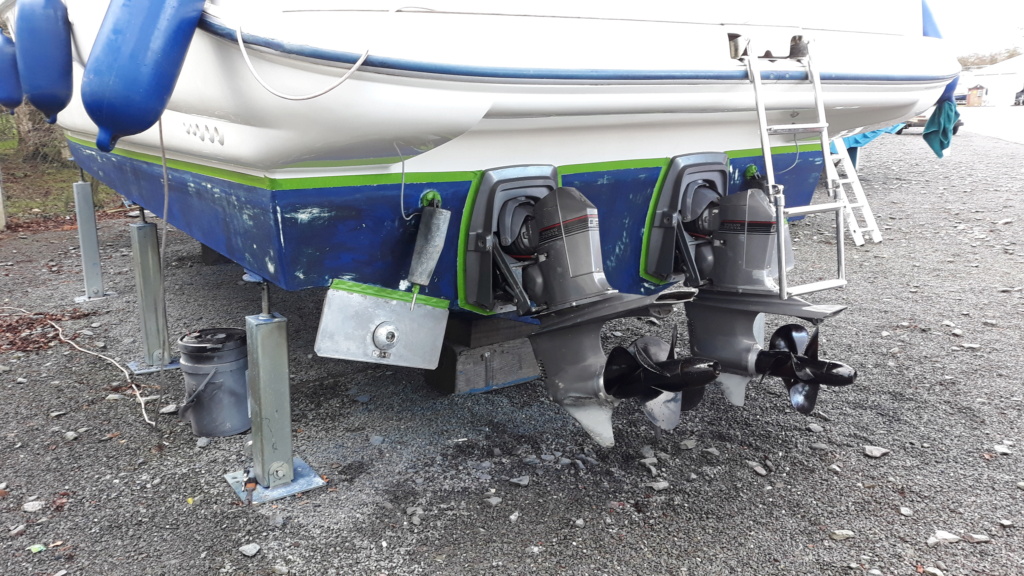
While your boat is on the hard, there are other things to be attended to. It has been in the water for 10 years you say? The seacock assemblies will have suffered dezincification in this time and will have to be replaced. Using the "search" facility on this forum will elicit plenty of information on this subject. If it's a motorboat woth outdrives, there will be a requirement for special antifoul for these metal parts.
 
Pete, the pole sander sounds great. How did you avoid scraping away or damaging the gelcoat?

Just don't keep sanding endlessly in one spot ;). It'll be very obvious if you've gone through all the antifoul, it's not something you need to worry about.

Pete
 
All good advice already given. However I would say that anti fouling your boat is a terrible job. Do not seek to do a perfect job. It is usually only good for a year so you can catch up next year. However this does not apply to sea cocks and anodes. So you scrape it smooth. If it is really fouled try a dutch hoe or I use a bricklayers bolster (wide chisel) has enough weight to smash barnacles. Need heavy gloves. You will probably end up sanding it to a point where you run out of time or energy. That is ok. The painting part is easy.
Depending on your support structure You may be able to move jacks to paint /clean under primary support. Take jacks and blocks with you.
If all else fails you may be able to get the crane driver on lift back in to hold it up while you touch up the parts under the supports. Even if you miss those bits it does not matter so much. Paint is expensive and usually sold in like 4 litre or 5 litre tins. I would guess 5 litres should do it. One maybe 2 coats.
As for days in the yard. Assuming you can spend all day of each day then 3 days might do it. Around here they charge a fair bit per day. Depends a bit on parts needed etc for sea cocks and anodes.
Just remember next time you can improve with experience. ol'will
 
Before you go to the effort of sanding the old antifoul, have a good look at it. If it’s in reasonable condition and not flaking, then once the yard has jet cleaned (they’ll almost certainly insist on doing this as pollution regs now prohibit jet washing antifoul unless the washdown area has a trap to capture washed off antifoul) I just put new antifoul on. Seawater antifouling is an annual activity so provided the stuff is adhering nicely, just paint over it. I’ve only ever bothered to remove the antifoul completely from a boat once (and will pay someone to do it if it ever needs doing again) and never bothered to sand down old antifoul that has been subjected to a boatyard jet wash. No point unless you’re heavily into racing (and then you polish the hull through the season anyhow....)
I favour 4 inch rollers. They’re lighter to handle and easier on the back, but that my personal preference. An added advantage of using a long handle with a small roller under a power boat is that you can cover a larger area before you need to move: it’s not such a problem on a sailing boat where access is much better. Don’t bother to try cleaning the roller, just chuck them away: may seem a bit wasteful but the solvents needed to clean them properly are not very environmentally friendly and expensive.
Do wear PPE, especially when working on a powerboat, as you‘ll need to work right under the hull on your back. I use disposable heavy duty coverall with a hood, decent safety goggles (to fit over my specs) and I’d consider using a proper solvent respirator rather than a simple mask. Buy a box of disposable gloves and change them regularly.
The yard, if it’s any good, will apply antifoul to the spots where the cradle props went if you leave them the remains of the antifoul and a brush. My yard actually keeps tins of antifoul on their hoist which they use on client boats so you don’t need to leave a partially empty tin for them!
 
9" rollers are quick and easy. All you need is an extension pole @ circa £4.99 and two arms make light work of it. No bending or stretching. You cover large areas and the fewer overlaps means less wastage.
 
9" rollers are quick and easy. All you need is an extension pole @ circa £4.99 and two arms make light work of it. No bending or stretching. You cover large areas and the fewer overlaps means less wastage.
Works well on a sailing boat, where the access to the hull is good. Not so easy on a powerboat with a relatively flat hull. For Much of the hull you need to get underneath the boat, hence smaller roller and long handle. Just my opinion....
 
You have some excellent advise, if you take note.

I may have missed it but I think you need a hard antifoul. Yachts tend to use an ablative AF and it performs by wearing away slowly and constantly presenting a new fresh surface to the creatures that foul. At speed this AF wears away quickly and as I believe you are a MoBo you will not use your yacht at sailboat speeds. So use a hard AF.

All AFs, or most of them, really only work if you use your yacht - it it sits idle for long period of time it will foul quite quickly, it will collect slime (that normally would be washed of by vessel movement), the slime provide a protective barrier over the AF and the fouling creatures (being very intelligent) immediately, or slowly, find ways to adhere to the slime.

All AFs work by offering offensive chemicals to the fouling organisms and the more you apply, of these chemicals, the longer the AF will last. If you think you will save money by spreading the AF thinly over your hull - you will regret it and be ready for a lift - sooner then you expect - to enjoy the pleasures again. Be generous with the coats you apply and apply at least 2 coats.

You can apply copious amounts of AF and the find your stern gear, prop etc, fouls quickly - you will almost definitely need a different AF chemistry for the stern gear and the options seem to be Prop Speed or Velox. Scroll through the thread on both of these products here on YBW, PBO.

I think you will find that if the yard is slick, lifts you first thing, power washes you, then by the time you tape up, get rid of any flaking AF - you have enough time for one coat of AF. The following day (you may need to tape up again - because you took the cheap tape off) you should have time to apply a second coat and ream out the hull fittings. You should also be able to prepare the stern gear. The next day - finish of any remnants of AF, waterline (extra coat) and give a top coat to the stern gear.

You could train monkeys to apply AF but if you have good help you might cut my 3 days down to 2.

If you apply 2 coats on 2 consecutive days, stick the rollers whether 4" (is that the same as 100mm in the modern world :) ) or larger in a polythene bag - and use them the next day - then chuck them.

Its not difficult - and when you finish it really looks, and feels, good!

Jonathan
 
All the talk of 4" and 9" rollers overlooks the middle option of 7" ones. For those seeking a smooth finish I can recommend the Anza felt sleeves but make sure you get a frame that fits. They don't fall apart nor do they absorb half a tin of paint.

If the last time the boat was antifouled is 10 years ago, there won't be much (any?) left. Hopefully having been in fresh water it will be fairly free of fouling.

After being in the water all that time, look carefully for any osmosis blisters. Not convinced a damp test is going to prove anything if there is no visible evidence of a problem. You should deal with the blisters if there are any.

If the boat is not going to be lifted again for a while, go for a harder antifoul and maybe an extra coat or two. Equally, worth getting it clean back to gel coat.
 
Thanks again!

This is going to be interesting... I would asume the amount of marine life on the hull is going to be about the same as on the neighboring jetee, most of which brushes off fairly easily. So maybe the journey will remove most of it? And I would have expected that what's on there would, to some degree, protect the AF underneath. If the boat hasn't moved then surely the old AF would still be there..?

Blistering is indeed a worry. But the boat was built in 1981, Back then they were more cautious about GRP than now and built the thing like a tank! It never showed any signs of blistering in its first 19 years, so hopefully... And if the old AF is indeed intact... Fingers crossed.

The props are a worry. I'll jet clean them as best I can from the jetee. Hopefully they don't fall off! o_O

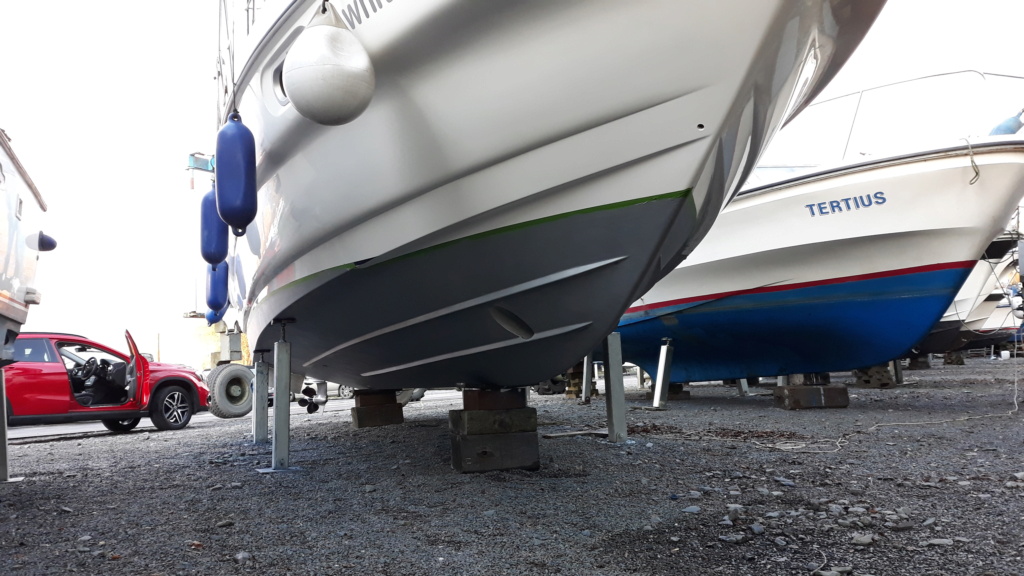
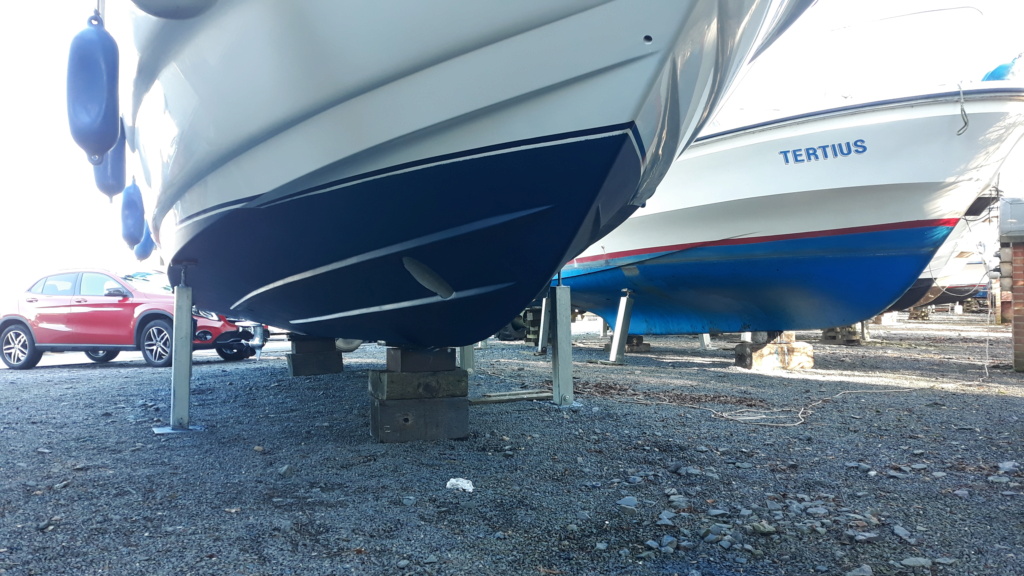
We shall see when it comes out of the water. I'll post some pics ;)

I've booked into South Dock. Out of water Monday, back in Fiday. They'll lift and jet wash, and will provide jacks, but will leave me to organise the rest. A worrying complication is that they then close for 3 months for lock maintenance, so any probs need to be dealt with very quickly, or I'm stuck there for the winter (while still having to pay my mooring fees at Limehouse!).

Currently looking for a surveyor to give the hull exterior a once-over. That should be straight after the jet wash shouldn't it?

There seems to be a bit of a limescale deposit around the waterline. Does that require a particular chemical?
 
Last edited:
Oxalic acid is your friend for stains on the topside. Any acid even lemon juice might move it also. Do take soiem acetone with you also for cleaning off the grease etc on hull.
ol'will
 
Cheers! I keep plenty of both. Great stuff!

Here 's a tip - cheapest source of already mixed oxalic acid is Bar Keeper's Friend. Can be got from Amazon, or even cheaper from Buck & Ryan. Like, dirt cheap. Don't bother with the brands made for boats. This is the same stuff. Made from rhubarb.

Bar-Keepers-Friend.jpg

From back in the days when your mother would store some very toxic chemicals under the sink. These days it comes as a liquid.
 
Last edited:
Hi,

The advice here has always been friendly and helpful , so I'm back with more questions :) :

I have a 10m cruiser. I plan to take it to a boatyard nearby, crane it out, clean the underside, then appy anitfouling. I need to book the craning in and out, so I need a good estimate of time.

Never done it before. :oops:

The boat got its last antifoul a decade ago, in freshwater, and has barely moved from its Thames marina mooring since.

1) Cleaning - that should only take a few hours? Will I likely be using a regular pressure-washer?

2) Do I then have to leave a period for the boat hull to dry?

3) How much antifouling will I likely need? How much does that cost? What equipment will I need? There will be two of us - so how long should I give it?

Any other tips?

Thanks a lot! ;)
The boat hasn't been out of the water for 10 years?? Is it fiberglass?
 
Top