Dismasted? How old was your rig?

JohnGC

Well-Known Member
Joined
21 Oct 2011
Messages
907
Location
Plymouth
Visit site
Following up on the thread about the use bolt croppers verses other methods of detaching a rig after dismasting;
http://www.ybw.com/forums/showthread.php?469070-Has-anyone-been-dismasted-and-used-bolt-croppers

A number of people replied with first hand experience of dismasting and I wonder how old their rigs where at the time.

I'm curious to see if there is any correlation with the oft quoted 10 year insurance figure.

I'm also interested to know if they where able to identify a cause for the failure and if there where any warning signs.

John.
 
In the case of Violablu, this page https://coxengineering.sharepoint.com/Pages/Fatigue.aspx I don't actually know the age of the cables but I do know that it was inspected thoroughly every year, As my article says, the problem was not the cables at all, but the mast tang. The lower shroud failure, in the article above that one, was undoubtedly due to slackness of the rig. The age is not known but it would have made little difference whether 2 or 20 years.
 
It is perhaps worth mentioning that my insurer is happy for the rig to be inspected every year by a pro rather than a 10 year replacement of all standing rigging. They even put that in writing, mind you I am with Pants who are more realistic than most.
 
The only dismasting I have much information on occurred to a Trapper 501 which was then about ten years old. It was the tang that failed, and on inspection three of the four sections had been parted for some time. The owner was a careful type and an engineer but I don't know how closely it had been inspected. Being a bilge-keeler, I believe the mast had not been dropped annually.
 
Don't know about dismasting, but when I inspected my 10-year-old standing rigging the forestay was in a BAD state. This wasn't obvious until I removed the jib roller reefing. Incidentally if your jib roller reefing becomes a little stiff and difficult to operate, be suspicious.
 
In my dismasting, it was a spliced loop in the Dyneema line on the backstay that broke. The insurance company was reluctant to cover the claim because they said that it was part of regular maintenance. It was only because I offered to reduce the claim by a whole bunch (as described in the other thread) that they finally agreed to cover the costs. The dyneema line spliced loop was about 8 years old at the time.
 
We had four rig inspections and the rig was 8 years old - but it still failed. The rig is in 3000m so don't really know.

What went wrong - we "think" that the tang at the lower shrouds attachment to the mast failed on the port side of a single spreader mast, conditions were 15 knots, dusk, setting for a "wing and wing" sail plan for the night having put the Parasailor away, fair seas given we were 190 NE of Barbados. Both "tangs" were photographed and inspected using magnifying glasses, and by 4 different riggers. Not sure what else, other than a complete rig replacement we could have done.

Anyway, Insurance Company were great, though we had to "contribute" a betterment fee, but we are still sailing.

Hope this helps.
 
Interesting discussion.
How much of a factor is rig design in all of this? You would assume that a lightweight multi-spreader deck-stepped rig on a racing boat would be far more vulnerable than... ooh say a moderately powered keel stepped masthead rig (like wot I got).

Or in other words, what are the chances I could lose a stay and not lose the rig?

(Incidentally, the only rig failure I have suffered to date was when a clevis pin worked out of the shroud on my Wayfarer. The mast bent alarmingly but we crash tacked and no damage was done, other than to our pride).
 
I now remember the occasion when we were on our first main trip of the year and were on our way up the Wallet on a beat. Suddenly, the mast started thrashing around. It turned out that I hadn't got around to wiring the bottle-screw on a lower shroud and it had worked loose, although adequately tightened earlier. I was surprised at how much mayhem was caused by the temporary loss of what I had thought was a less important rigging member.
 
I now remember the occasion when we were on our first main trip of the year and were on our way up the Wallet on a beat. Suddenly, the mast started thrashing around. It turned out that I hadn't got around to wiring the bottle-screw on a lower shroud and it had worked loose, although adequately tightened earlier. I was surprised at how much mayhem was caused by the temporary loss of what I had thought was a less important rigging member.

I have been greeted by a loud clang as a cap shroud less the bottlescrew body struck the mast - also in the Wallet and also on the first sail of the season and for the very same reason... it was 2 am and light conditions and I tacked fast and retrieved the situation... luckily the bottlescrew body was still on the chainplate... this was a 12 ton gaff cutter..
 
I have been greeted by a loud clang as a cap shroud less the bottlescrew body struck the mast - also in the Wallet and also on the first sail of the season and for the very same reason... it was 2 am and light conditions and I tacked fast and retrieved the situation... luckily the bottlescrew body was still on the chainplate... this was a 12 ton gaff cutter..
The Wallet is a boat-killer. Well-known fact.
 
Where do I start.....
22 years ago and only 3 weeks after I bought my present boat the mast fell down.... port lower tball fitting failed within the mast..... found out about a year later that the previous owner had bottle screw at foot of stbd lower explode and he came within an inch or so of losing the mast... he only replaced the stbd lower... goose.
(Sorry Andrew I don't recall how we cut the rig loose.)
Boat was 8 years old but first 4 years were with Westerly Sailing School and the next 4 had been spent finding her way to Thailand ... so she had been hard used.

At least 2 other boats of the class ( Westerly Sealords ) had experienced failure of the deck staples on the lowers ( one of them , Brilliance , being abandoned near Tristan de Cunha as a result ) so in BA in 2010 I replaced them. 2014 south of Tonga one of them failed just inside the deck.. came close to losing rig..

So, in NZ I changed all the staples from 14mm to 16mm, sofa so good

All standing rigging replaced in Chile in 2013.... on returning to Chile in Feb of this year ( voyage Chile/Tahiti/Tonga/NZ/Chile... 15000 miles ) I found two broken strands where the wire exited the swage at the top of the stbd lower. Lower T-balls since replaced with tangs from The Rigshop, Southampton.

In a low earth orbit just now... photos to follow..
 
Last edited:
Where do I start.....
22 years ago and only 3 weeks after I bought my present boat the mast fell down.... port lower tball fitting failed within the mast..... found out about a year later that the previous owner had bottle screw at foot of stbd lower explode and he came within an inch or so of losing the mast... he only replaced the stbd lower... goose.
(Sorry Andrew I don't recall how we cut the rig loose.)
Boat was 8 years old but first 4 years were with Westerly Sailing School and the next 4 had been spent finding her way to Thailand ... so she had been hard used.

At least 2 other boats of the class ( Westerly Sealords ) had experienced failure of the deck staples on the lowers ( one of them , Brilliance , being abanded near Tristan de Cunha as a result ) so in BA in 2010 I replaced them. 2014 south of Tonga one of them failed just inside the deck.. came close to losing rig..

So, in NZ I changed all the staples from 14mm to 16mm, sofa so good

All standing rigging replaced in Chile in 2013.... on returning to Chile in Feb of this year ( voyage Chile/Tahiti/Tonga/NZ/Chile... 15000 miles ) I found two broken strands where the wire exited the swage at the top of the stbd lower. Lower T-balls since replaced with tangs from The Rigshop, Southampton.

In a low earth orbit just now... photos to follow..

A very cautionary tale..

Thanks Frank, look forward to the pictures, and if you would care to meander over to the "reflections on trip lines" thread on the PBO forum I have just taken your name in vain on the subject of swivels...:rolleyes:
 
Last edited:
Following up on the thread about the use bolt croppers verses other methods of detaching a rig after dismasting;
http://www.ybw.com/forums/showthread.php?469070-Has-anyone-been-dismasted-and-used-bolt-croppers

A number of people replied with first hand experience of dismasting and I wonder how old their rigs where at the time.

I'm curious to see if there is any correlation with the oft quoted 10 year insurance figure.

I'm also interested to know if they where able to identify a cause for the failure and if there where any warning signs.

John.

Its a good few years ago now when I lost the mast on my Sonata racing in an open meeting in Dovercourt Bay off Harwich in about 25 to 30 Knots. The previous winter I had replaced all standing rigging - none of it failed. We were going down wind with the spinnaker up when the bows drove into the back of a wave. The boat slowed down - the rig didn't. As it was a small boat I managed to recover the sections of the mast - big mistake. The surveyor found that the cause of the failure was a weakness in the weld where the S/S band round the mast had sockets to take the spreaders. One had given way causing the spreader to fracture and the mast to collapse. The other was showing signs of failure.

If I had not recovered the mast there would have been nothing for the surveyor to comment on. For a year my insurance company refused to pay claiming that it was a failure due to wear and tear and inadequate maintenance. I argued that I had replace everything that I could reasonably be expected to have done only a few months before and that to detect incipient failure in a stainless steel weld would have required NDT that not even a professional rigger would have undertaken.

During that year I came across several other owners whose rig had failed - all of whose insurance companies were refusing to pay. Most were due to failures in ball terminals. That year I had joined the RYA. I eventually wrote to their legal department to ask their opinion. I received about a four page response from their lawyer which effectively boiled to to the fact that if a mast fell down something had to have failed and was it reasonable for the owner to have been able to prevent it.

I sent that letter to my insurance company and got a cheque for my full claim more or less by return of post.
 
Last edited:
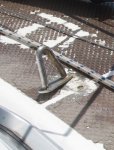
As promised, probably in reverse order... Failed deck staple ( yes I know the treadmaster was a mess.. since renewed). Failed when going to windward in v. heavy conditions.
Also the jury lash up... fortunately light conditions for the 3 days until town...deck fittings like that are not designed to take vertical loadings...DSC_0977.jpgDSC_0976.jpg
 
I've been wondering about this issue.
My rig is a fractional one and is now 16 years old , so i'm thinking about replacement.
My issue is I have had the boat for 11 years and know what sort of duty the rig has done over that time and also know the first owner did not do that much.
So my musing is about if rig failure is mainly a function of duty or is it a function mainly of time.
One would think time based failures are all about corrosion and duty based failures are all about fretting and micro movement coupled with design and construction.

Of course one can not really make a an accurate judgement between these two conditions.

Incidentally my insurer has not mentioned it during the last 11 years but like others i'm sure there would be a position if I had a rig failure , i'm with 'Y'
 
I'm curious to see if there is any correlation with the oft quoted 10 year insurance figure.

You inspired me to check my own insurance policy (GJW) as our boat is ten years old.

There's no mention of the age of the rigging. Is this unusual?

Does anyone know a ballpark cost in any case for replacement of standing rigging on a 39' Beneteau, and is it usual to replace the furling forestay in the same event?
 
You inspired me to check my own insurance policy (GJW) as our boat is ten years old.

There's no mention of the age of the rigging. Is this unusual?

Does anyone know a ballpark cost in any case for replacement of standing rigging on a 39' Beneteau, and is it usual to replace the furling forestay in the same event?

We have just had ours done on a 44 - masthead, quite heavy gauge (14/12mm), including forestay (but not foil), all new fittings including backstay insulators - haven't received bill yet but based on indication of cost, expecting £5k and a bit.
 
Top