discoloured internal joinery - possible causes

I don't the exact formula he used, although it is a satin acrylic based lacquer with a stain, there is some light fine sanding required but not all the way back to the veneer, just enough to remove most of the 'milking'. It's labour intensive and needs great care, we had all the galley done, saloon table & other areas and various areas of the bedrooms, cost was in the region of £10k. The guy works for a super yacht refit company, it's took us months of wait to get him and had to do the work over 2 seasons because he is so busy. I will try to find details of what he used, but it may be something he wants to keep to himself, he never told me the detail of his work.
 
reacted to the suggestion that our solution was not possible and forum member suggested he could make a lot of money using my contacts or knowledge for his own gains! Maybe tongue in cheek, but the inference was I was talking out my ........****
I'm not even trying to explain why I believe that the tongue in cheekness of my previous comment was pretty obvious.
You might just re-read it tomorrow morning, maybe...? :rolleyes:
 
there is some light fine sanding required but not all the way back to the veneer, just enough to remove most of the 'milking'.
Hang on a minute, what you are now saying seems to me very different from "not necessary to sand the original lacquer off, the specialist used a lacquer with specific colouring over the top of the original"... :confused:
 
My original quote was intended to mean that not all the lacquer was removed because that would likely damage the veneer behind, only the top surface. I have no intention of trying to 'prove' it can be done, nor do I wish to enter into some sort of 'picky' argument, as I am very happy with the results which are illustrated by the photos.

My intention was to show to the thread originator that it can be rectified and therefore the boat may be worth consideration.
 
I have no intention of trying to 'prove' it can be done, nor do I wish to enter into some sort of 'picky' argument, as I am very happy with the results which are illustrated by the photos.

My intention was to show to the thread originator that it can be rectified and therefore the boat may be worth consideration.
Sorry if you perceived my post as picky, I was just confused.

And at risk of appearing picky again, if your intention was only to SHOW something, fine.
But in the OP boots, I wouldn't be very reassured by knowing that on this planet there is one unknown gentleman which, using some secret recipe, can solve his problem.
Would you?
 
For chrissakes M, have you had a bad day? you alluded that the problem cannot be rectified, I have shown it can be! I don't believe the techniques are unique and are probably used by competent 'french polishers' around the world (except it seems Italy), we also got quotes from the SOF who were able to do it, but decided to get it done in Mallorca as the price was better and it was where the boat was to be based.

If the OP sends me a PM I will be happy to provide the technicians details, but being based in Mallorca may not be much use in Croatia.
 
Whoa! I understood it was your day that was bad.
No worries, I was wrong and you are right.
And yes, I was trying to get rich by stealing your specialist, because in Italy nobody has a clue about how to work with boats.
Sleep well.
 
Pan, do you have any more detaild photos?

MapisM, I think there's some consensus that sanding is required. I guess he interesting but is how far back. Is it feasible that all the lacquer doesn't have to be removed to effect the repair?
 
In a previous life I manufactured furniture, this was probably the result of poor conditions when the lacquer was originally applied, (usually too chilly) It needs taking right back to the wood / veneer & re doing. Get a french polisher in, pay once not twice. I used to be rather good at this but having had 30 years off I would get a pro in, to try with no experience could end in disaster. Its all about feel, takes time to acquire or remember for that matter.
 
Last edited:
Dear experienced forumites.
I am interested in views on possible causes of internal teak discolouration which shows as a 'white' stain' in various internal joinery areas of a boat I am interested in buying.
Is this damage caused by poor ventilation in off season or is it a possible sign of more significant problem, for example a leak from flybridge. I have not been able so far to remove ceiling panels to inspect for evidence and am keen to receive any opinions before deciding how to proceed.
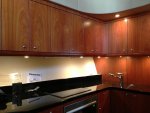
The boat is 7 years old and currently based in Croatia. The photo attached shows only one area but a similar affect is seen in several areas of the saloon and cabin.

View attachment 66534

Any thoughts gratefully received

Hi, After 14 years, Play d'eau's woodwork was showing 'bleaching' as you describe, in some places. Yes, it's caused by UV, but almost all has been able to be restored. How? By using gently rubbing compound the affected surface can be removed leaving an 'as before' finish.

But, where the bleaching was severe, we needed to rub back and use the same varnish as the manufacturer used. Fleming didn't have proper records so we had to make best guess. We used Epifanes two part satin and clear using their thinners as well. If we needed a clear shiny finish, 4 coats of satin and two of clear, Otherwise we just used the satin. Looks really 'spot on.'
 
Yes, it's caused by UV
Well, I said in my first post of this thread that it's pointless to discuss the technicalities behind this issue, and TBH I wouldn't be able myself to report them as accurately as they were explained to me by someone who REALLY knows them. But since UV has been mentioned several times, I'll say it again: this specific effect has nothing to see with UV.

And the funny thing is that it's pointless to discuss the matter with all the folks you normally would think to ask:
Boatbuilders, third parties supplying interior joinery to boatbuilders... Geez, even the coating producers might struggle to understand it!
Not that I pretend to know better than any of those folks, but I had the opportunity to talk directly with three different boatbuilders, and I got three different versions in return.
Which is the reason why I decided to get in touch with someone who REALLY knows the ins and outs of this issue: a PhD chemist (German, for pan's peace of mind :)) who works in the largest chemical corporation that produces coating additives, and wrote books on coating protection.
Now, what really matters (well, that's all I thought to be relevant for me as a boater, anyway) is that there are literally thousands of boat wooden panels and bits around the world which were already ill-fated the moment they came out of the spray cabin, depending on several complex and different factors. But the speed and the extension of the future degradation was impossible to predict, back then - and still is.
So, there's absolutely nothing that can be done to avoid it appearing at some point in time in the future, or to slow down (let alone reverse) an already evident effect.
Aside from sanding and recoating of course, which as I understand is the technique that also the superyacht specialist which was mentioned applied (with excellent results, chapeaux to him!), and which I agreed from the beginning that is the only option, albeit extremely hard to use effectively.

Btw, the explanations I was given match very nicely my first hand experience during the search of my boat, when I found more boats than I can remember, built by dozens of different yards, where the effect was present to some extent (more so with high gloss finishing, but not only), and also in places not exposed to direct sunlight.
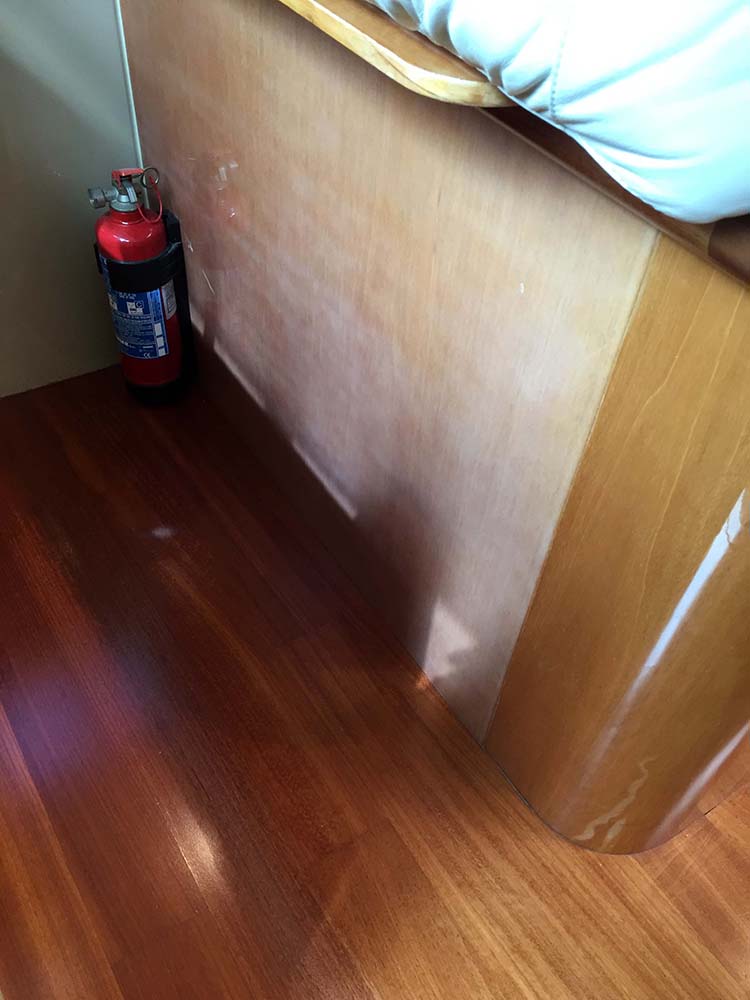
I think I still have somewhere one of the pics I sent to the previously mentioned chemist as an example, taken on a panel of a F165 which I don't think has ever seen one bit of direct sunlight in its 20 years of life, and in spite of that is BADLY affected. I'll dig in my files later and post it.

All that said, it's still a good idea to protect the interiors from direct sunlight.
I do have the habit of covering the wooden bits more exposed, particularly on the dashboard.
In fact, wood does get lighter after years of exposure, even with the best UV protected coatings known to mankind.
But this effect has nothing to see with the milking trapped between the veneer and the transparent coating which is being discussed.

Edit: took me less that I thought to find the pic, here it is. F165, 1997 vintage, panel under the p/house seat.
When seen in flesh, the milking was progressively worse going down towards the bottom, near the floor - which obviously denies the theory that UV rays have anything to see with that.
nfD1guQA_o.jpg
 
Last edited:
Pan, do you have any more detaild photos?

MapisM, I think there's some consensus that sanding is required. I guess he interesting but is how far back. Is it feasible that all the lacquer doesn't have to be removed to effect the repair?
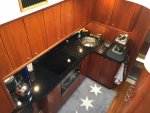
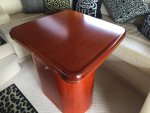
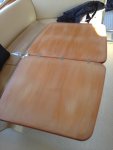
Attached before & after photos, the galley before photo doesn't really show how bad it was, mainly around the edges of the panels. One thing to note is that the final finish is slightly darker than original, but 3 years on there has been no 'milkiness' returning and the colouring has remained stable.

IMG_2157.jpgIMG_2146.jpgIMG_1926.jpgIMG_1927.jpg
 
Attached before & after photos
Amazing job indeed - makes the £10k cost inexpensive, sort of! :encouragement:

Just for statistical curiosity, if you don't mind me asking:
when was the boat built, and after how many years did the milking become evident?
 
Correct.
As I was explained, humidity level upon application definitely is one (of several) factors affecting the coating stability over time.
Actually, low humidity alone does not assure a perfect result, because it's a combination of humidity, temperature, time of drying out between layers, coating preparation...
I don't even remember all factors - as I said, I'm happy to leave lab tests and preparation of application instructions to chemists! :D
 
Amazing job indeed - makes the £10k cost inexpensive, sort of! :encouragement:

Just for statistical curiosity, if you don't mind me asking:
when was the boat built, and after how many years did the milking become evident?

Boat is a SS manhattan 50 built 2007, we bought it 2013 & the 'milkiness' was prevalent then, I don't know exactly when this started, but suspect about 4-5yrs from new, don't know whether previous single owner had aircon de-humidifiers running in winter, we have always done.

We viewed a number of 2006/7 models of same boat and the majority had a similar issue to a greater or lesser degree, we already knew that we could deal with the issue, but it was a good negotiating position for us when purchasing!

The issue didn't seem to be as big a problem with Princess boats of similar age.....
 
Boat is a SS manhattan 50 built 2007, we bought it 2013 & the 'milkiness' was prevalent then, I don't know exactly when this started, but suspect about 4-5yrs from new, don't know whether previous single owner had aircon de-humidifiers running in winter, we have always done.

We viewed a number of 2006/7 models of same boat and the majority had a similar issue to a greater or lesser degree, we already knew that we could deal with the issue, but it was a good negotiating position for us when purchasing!

The issue didn't seem to be as big a problem with Princess boats of similar age.....

Well if you can get a £20k discount (or whatever) and spend £10k on getting it fixed, it is indeed a good solution! Looks like the boat is pretty mint.

Incidentally, I did notice some milkiness on my lacquer today, directly above where a kettle would boil. So I'm pretty convinced there is some environmental thing going on here.
 
We noticed the issue was prevalent in galleys, which would suggest that humidity is a strong factor. One marine guy suggested we take a door off & expose it to strong sunlight (Med) for a day... needless to say it didn't work, but thought we would test it out!


Interesting snap that MapisM.

The floor is perfect though it may have been finished differently. The laminated corner is also perfect and, presumably, this was lacquered in exactly the same way as the flat panel.
Could it be something linked to the veneer thickness, I wonder. Those flat panels are veneered relatively thinly whereas the laminated uprights are quite thick to prevent problems with splitting.
It's a theory for want of anything better.
 
Find a non marine french polisher, antique restoration is a good place to start, way way less than 10k to do that.
If I was still in it you'd be looking at around 3 days, say £1500 + materials tops. Its just a question of using just enough abrasive (feel), followed by knowing the right stain (if needed) & finish to apply, a good polisher will know just by looking
 
Top