discoloured internal joinery - possible causes

chrisgil

Active Member
Joined
14 Jul 2011
Messages
53
Visit site
Dear experienced forumites.
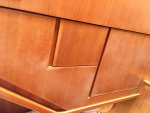
I am interested in views on possible causes of internal teak discolouration which shows as a 'white' stain' in various internal joinery areas of a boat I am interested in buying.
Is this damage caused by poor ventilation in off season or is it a possible sign of more significant problem, for example a leak from flybridge. I have not been able so far to remove ceiling panels to inspect for evidence and am keen to receive any opinions before deciding how to proceed.
The boat is 7 years old and currently based in Croatia. The photo attached shows only one area but a similar affect is seen in several areas of the saloon and cabin.
IMG_2408.jpg

Any thoughts gratefully received
 
Quite a common problem with boats of that era, we had some similar areas when we bought ours 5 years old, perceived wisdom it's caused by strong sunlight damaging the lacquer, although I have seen it before on furniture if the wood had a high moisture content before lacquering. Solution for us was a specialist lacquer guy who does work on super yachts, he re-finished the affected panels and they are superb now (like new)... be warned not cheap though!
 
I had wondered this but should have said in my post that the saloon is well shaded by side decks and the 'fogging' is most;y in the centre of the boat. Having said that I hope you are correct!
 
Does not look like water damage which normally starts at an edge where the water enters. As suggested it is either poor application of the original finish or UV degradation. Probably the former as UV would affect a wider area, and this seems local to only some panels.
 
I suspect the issue is what I would call blooming. It could be moisture caught under the lacquer or a deteriorating lacquer affected by UV light.

The obvious solution would be to remove the lacquer sand the veneer (be careful) and re-apply. Before undertaking this time consuming and difficult job it might be worth experimenting with lacquer / solvent / alcohol solutions on top of the affected areas. Try on an a concealed surface first.

Henry :)
 
Doesn't look like teak either, more like lacquered cherry.
Affected lots of boats late 90's through to the late 00's from most manufacturers
Spot on.
Also ref. not being teak, though it's difficult to be 100% positive on cherry.
I made a rather extensive research on this topic - up to involving a chemist highly specialized in additives for coatings.
It's pointless to bother anyone with the details, but the bottom line is as follows:

1) it is absolutely NOT worth trying any trick like air guns, solvents, or anything else.
It's like hoping to reverse engineering salami into a live pig, so to speak.

2) sanding the lacquer and re-applying is the only possible cure, and if properly done it can last forever.
Trouble is, I disagree with henryf when he says that it's a difficult job, because "difficult" is a massive understatement.
It's actually almost impossible, because:
Do it only on removable panels (which is easy), and you will always notice the difference with the other parts;
Try to remove all joinery, and depending on the boat you probably must take half of her to bits;
Try to do it onboard for all the non-removable parts, and you will make a complete mess of the boat interior.

I do have some milking (which as I was told is the correct term for this issue) in places on the DP, which has plenty of wood everywhere in her interiors.
Not too bad, but if it will change in the future, it surely will not be for the better.
And it's rather likely that it will, though how fast and how widely is anyone's guess.
We were well aware of that, and decided to call it a characteristic of the boat - show me a perfect one, if you can! :cool:

For those who can't live with it, there's one and only solution: avoid buying a boat where that type of lacquer (nitro-combi, for the records) was used for the joinery. It's that simple.

Mind, the fellow forumite Vas might have a different view, because for him taking the whole boat apart is a piece of cake... :cool:
 
We did :encouragement:

View attachment 66538

It started to happen on our " high gloss cherry " 2003 Sunseeker -- not in high uv areas , also wife said ( with kids finger marks ) the whole interior nice at boat shows etc was a right PITA to live with .
An easier to live with interior was in the top 10 on the list of next boat .

A fair trade off for lack of guard rails. Which thus far has been easy to live with .
They do, --- moved away from it to to oiled walnut + melamine combo .But as is the norm , one lives n learns -- never again - " high gloss "
 
Last edited:
one lives n learns -- never again - " high gloss "
I also have white lacquer panels onboard, but only in the bathrooms.
And even if I'm all for practicality onboard, TBH I'd rather be surrounded by natural wood in all other areas - even more so with semi-matt finishing, as I used to have in my old lady, and still have in the DP.
But let's leave the aesthetic preferences aside, because that's firmly an each to their own matter.

Ref.this "milking" malarky, don't be mistaken: it is NOT associated with high gloss finishing - though high gloss contributes to emphasize the problem.
It is associated with the type of lacquer which became popular around the late 90s because of the very nice appearance, emphasizing the natural look of wood, and faster production process/lower costs.
Both good reasons for the popularity of this finishing among almost every builders, including top ones like SL, for instance.

On top of the lacquer, also the application technique played a role, because how widely and how fast this milking appeared over time very much depends on how carefully the producer (which usually was NOT the boatbuilder) applied the lacquer (humidity conditions, drying times, etc.).
This is the reason why you can find two identical boats of the same yard, built in the same year, with significantly different levels of milking. Most brokers explain that with how careful the owners were with not letting direct sunlight come inside, but that's plain BS: UV can and does affect wood color over time, but that's a radically different effect, which has nothing to see with milking.

Anyway, as I said the technicalities and the chemistry behind this issue are rather boring and useless.
All I'm saying is that if you like high gloss finish (I don't), you can have it, AND you can have it longlasting, if done properly - i.e. with correctly applied 2K PUR coatings, which are different from those behind milking effects.
 
Last edited:
The odd thing is that my boat, unlike its siblings, has no milking at all. Perhaps the conditions when the lacquer was applied were perfect. Or maybe lack of heat and/or UV has made a difference.

But I agree with others, most boats have the problem and you can't fix it so just live with it.
 
It can be rectified, we did it, not necessary to sand the original lacquer off, the specialist used a lacquer with specific colouring over the top of the original, I can assure you it's as good as new... best thing is most people don't know how it can be done and lose interest in the boat.... opens the door for a buyer who wants to save money!
 
the specialist used a lacquer with specific colouring over the top of the original
Hang on, do you mean a coloured paint, or a TRANSPARENT lacquer (possibly slightly coloured, but still transparent)?
I'm asking because if by adding another transparent layer (regardless of its colour) the effect disappeared, then it must have been something different from milking, because that sort of whitening/fading is trapped between the transparent lacquer and the wood surface.
How can possibly any additional transparent layers rectify the problem...?!?

Anyway, if such product does exist, could you put me in touch with that specialist?
I have a dozen of boats in mind, if not more, which I would gladly buy to have their joinery rectified and resell them at a profit! :cool:
 
The interior woodwork on my last boat was quite faded, and I was thinking about how best to deal with it.

Separately I had some interior screen covers made to keep the day light out when the boat was not being used to reduce UV damage to the upholstery.

Amazingly over a period of about 6 months the wood naturally darkened back down, to the extent that it then did not require any further treatment beyond an occasional dust over with some household furniture polish.
 
You are right ..apologies! Bit late after a long day, reacted to the suggestion that our solution was not possible and forum member suggested he could make a lot of money using my contacts or knowledge for his own gains! Maybe tongue in cheek, but the inference was I was talking out my ........****
 
Looks like a very good result. I have seen loads of boats with this issue, I considered using a high quality self adhesive 'wallpaper' from the furniture industry to resolve, although obviously a different look. I am sure many of us are interested in the overpaint technique with the appropriate specialist 'tint'. If you can point us in the right direction I am sure it would be appreciated :)
 
Top