Diesel tank installation?

vic008

Well-Known Member
Joined
18 Aug 2007
Messages
507
Location
CHCH. NZ
Visit site
New boat with Volvo 2003 3 cyl. Has two fuel tanks ( seperate fillers) and lots of joinery around them. Second tank is maybe a meter lower than tank #1. Havent yet found how they are connected. Will there be a 12v pump between? Cant depth stick(?) to find gallons as too many bends in the filler pipe. Any other way they could be connected? If can remove them, would sight tubes be best to instal?How many hours would she go on 100 liter?
 
I'm no expert on fuel tanks so I'll leave discussion on the pump to some else.

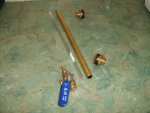
I have two tanks and they are both irregular shaped so a normal fuel tank gauge would be worthless. I've priced sight gauges and the prices they want are horrendous so I'm making some up myself. There is no urgency at this stage so I am just feeling my way. I am buying up different parts on eBay and (they are very cheap) I'm almost there.

The acrylic tubes fit within the brass tubes so I'll have to drill small holes in the brass tube so I can see where the level is. The tanks are aluminum and the fittings are bronze (brass?) so that is a bit of a worry. But with "O" rings and rubber gaskets that should solve the problem. Last night I ordered F/M reducers so the through tank fittings fit the ball valves (they were only $A3 each-maybe less) and hose barb elbows for the top of the tubes.

IMG_1743.jpg

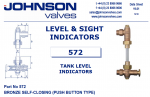
The alternative is around $A300 each

Screenshot_2019-10-19 19_Level Sight Indicators - Data Sheet No 19 01 - 572 Level Sight Indicato.png

https://www.johnsonvalves.co.uk/Data/Data Sheet No. 19.01 - 572 Level & Sight Indicator.pdf
 
Last edited:
Are the fillers and vents at the same level? They would need to be if the tanks are freely connected. Is the lower tank pumped up to the higher one? Is there a levelling pipe between them? You need to have a thorough look. When you fill the upper tank does the lower one fill, albeit slowly?
Broad rule of thumb consumption, 5 litres per 20hp per hour.
 
Are the fillers and vents at the same level? They would need to be if the tanks are freely connected. Is the lower tank pumped up to the higher one? Is there a levelling pipe between them? You need to have a thorough look. When you fill the upper tank does the lower one fill, albeit slowly?
Broad rule of thumb consumption, 5 litres per 20hp per hour.
That seems pessimistic. My 2030 does about 2l/hr, maybe 2.5 for a 5-ton boat at about 2500 rpm in smooth conditions. A 2003 is probably less economic, but something like 2.5 should be normal I would think.
 
That seems pessimistic. My 2030 does about 2l/hr, maybe 2.5 for a 5-ton boat at about 2500 rpm in smooth conditions. A 2003 is probably less economic, but something like 2.5 should be normal I would think.

But what use is knowing the consumption in 'smooth conditions' when you're relying on the motor in rough conditions and worrying about fuel consumption?

Guidance for ltr/hp-hr is out there, but to be any use, you need to be talking about HP used, not the max load power capacity of the engine.

If you can't make a dipstick work, then possibly a couple of float switches, so you know you've got >1/2 tank, 1/4 tank or something?
Or maybe organise the tanks so you pump from the big one to the small one and keep track of how much you've taken from reserves.
 
I would trace the fuel feed and return back from the engine and check if there are any change over valves in the line to enable the engine to run on one tank at a time. Either way you are going to have to do a bit of investigating, you need to know what way the fuel system is plumbed.
My 2003 uses 2.2 ltrs an hour at 2500 rpm, doing 6.25 knts.
 
New boat with Volvo 2003 3 cyl. Has two fuel tanks ( seperate fillers) and lots of joinery around them. Second tank is maybe a meter lower than tank #1. Havent yet found how they are connected. Will there be a 12v pump between? Cant depth stick(?) to find gallons as too many bends in the filler pipe. Any other way they could be connected? If can remove them, would sight tubes be best to instal?How many hours would she go on 100 liter?

You need to find out urgently how the system is plumbed. Do you select which tank supplies the engine? Do you select which tank the excess fuel returns to?

I have two tanks, but they are at the same level, so I can cross level, simply by opening the outlet valve on both tanks. My tanks have small dirt/water sumps, so I fitted small bore clear plastic tubing to each drain valve. To determine the level in each tank, I merely hold the relevant tube up against the side of the tank, which is marked off for every 20 litres. Having read it, I then shut the valve and empty the tube, so that it is never left with fuel in it.

Regarding fuel use, it depends on lots of things, but my 9 ton boat with a 59hp 4 cylinder Volvo MD22 (Perkins Prima) averages about 2.75 litres per hour.
 
New boat with Volvo 2003 3 cyl. Has two fuel tanks ( seperate fillers) and lots of joinery around them. Second tank is maybe a meter lower than tank #1. Havent yet found how they are connected. Will there be a 12v pump between? Cant depth stick(?) to find gallons as too many bends in the filler pipe. Any other way they could be connected? If can remove them, would sight tubes be best to instal?How many hours would she go on 100 liter?
My old HR352 had two tanks, one under a saloon berth, the other about a metre lower in the keel. They had separate fillers and vents. The engine was supplied from the keel tank. There was a pipe from the saloon tank to the keel tank, with a quarter-turn ball valve in it. So, to all intents and purposes, the saloon tank was a "reserve" tank, the contents of which could be added to the keel tank easily by gravity.
 
So common practice will be a 12v pump between the 2? If have to remove to drill (cant leave swarf inside) will get a pair of elbows welded on that will take a clear hose between
 
So common practice will be a 12v pump between the 2? If have to remove to drill (cant leave swarf inside) will get a pair of elbows welded on that will take a clear hose between

Surely you should first investigate what you actually have. There is probably already be some form of connection, if both or either tank can be used to supply the engine. Or it may be as described by pvb in #9, in which the upper tank is used as a reserve. Only you can check to see your layout. What makes you think that you need a pump, when the system has presumably been working prior to your ownership?
 
Because you can see the no 1 tank where it feeds the engine. Then no 2 tank is about 2 feet lower and on other side. So some how it must be connected. I dont make any presumptions about yachts.
 
I dont make any presumptions about yachts.

You definitely don't want our presumptions about your yacht, then, given that we can see even less of it than you.

As advised in posts #7, #8, and #11, you're going to need to start tracing some pipes and working out what you have. We don't know.

Pete
 
Top