Diesel engine room blowers

Yes it interesting to get to the bottom of ER blowers in liesure boats .
Some have none like me , some have both blow n suck and use them intermittently, some just either blow or suck .
Is there anybody out there that absolutely need a blower ie the engines seem to have impaired performance when they are not working ? Just curious.
Never heard of that. I'm aware of boats whose E/R gets awfully hot right after the engines are turned off, unless you leave the fans on for some time.
But if that would happen underway, to the point of affecting engines operation, the least thing that the builder should do is fit an alarm that goes off whenever blowers are defective - something I never came across in any pleasure boat.

That said, I disagree with Amati's choice to not fit any blowers, for two reasons:
1) as already mentioned, they are useful if for any reason you wish to enter the e/r after coming back to your marina, unless enjoying a sauna inside it is your thing.
2) they can indeed be useful also underway, whenever you want to (or you must, as when cruising in a channel) keep a very low speed for some time. In such conditions, the engine-driven air exchange is reduced to a tiny fraction of what it is at higher rpm and with the turbos working, with the result of increased e/r temp - which btw is something on which also the engine manufacturers put restrictions, at least in terms of desired (possibly even mandatory, not sure) installation requirements.

For the records, the way DP tackled these needs is rather peculiar (at least, I never found it on any other boats), but I think it makes good sense.
The blowers are automatically turned on/off by two thermostats, one of which is active while the engines are on, and the other while they are off.
Both can be set at any temperature, but the recommended setting is 45°C for the first and 55°C for the latter.
The rationale is that it's more important to cool the air the engines are breathing, rather than keep the blowers running upon arrival just for the sake of cooling down the e/r faster (you can always turn them on if you need to go down, of course).
I never saw the blowers warning light popping up on the dashboard while cruising at P speed, but they are often on after some slow speed cruising, depending obviously also on external temperature: if it's 35°+C outside, it doesn't take much to reach 45°C inside the e/r...

Another thing while we are on ER ambiance temp ,have you ever touched the fuel tank after a long run or a couple of days running .
It’s like a radiator on full in the winter .This is because of the 80 or what ever % fuel returned eventually heats up the tank .
True, and that's precisely the reason why coolers on the fuel return are fitted as standard in some engines.
They are also retrofittable anyway, as already debated in this thread, whose subject was just about the same as in this one, btw.
Highly recommended, because the engines are grateful, first and foremost. Improved e/r comfort is just a by product, so to speak.
 
Last edited:
It's early after a long night but...

All our fans are on the 'ceiling' of the engine room or high up. If they fail the engines don't still running, they just draw air through the fan, you can't stand in them due to the design.

As I said if they fail the engine temps and certainly the engine room temps go up. At the end of the day after switching to shore power and shutting down the fans personally I like to get the last engine room walk through done ASAP as it get hit down there really quickly - even at night.

I'm not an engineer but I'd suggest that the fans (at least in our case), are more for cooling than providing combustion air?

W.
 
the 4 blowers in BA's engine room are in the 4 corners on the ceiling,
all 4 blow air out,
on the 2 forward vents, there is a hose, bringing the air to the vent opening in the hull downstream of the main central E/R air inlet opening / grid
the 2 rear vents, blow straight outside, also downstream of the main air inlet.

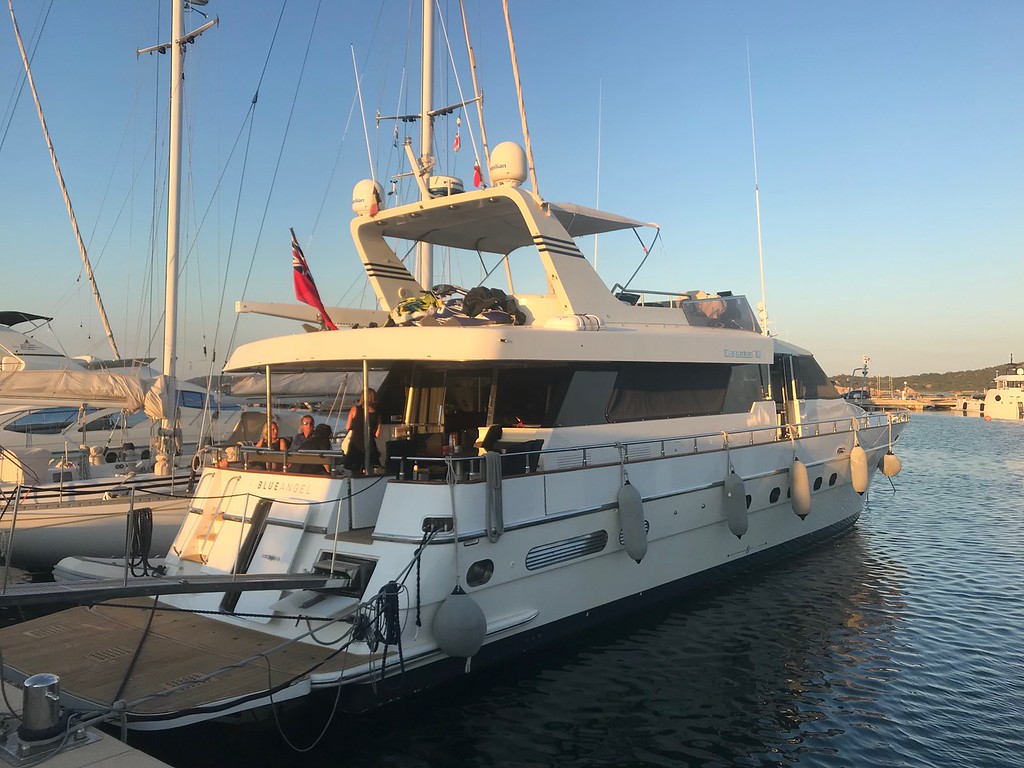
here on this pic, these two air oulets are in the rear half of that long SS grid. (on each side)

the first half of the long grid, and the grid behind the fender are the air inlet to the E/R

 
I'm not an engineer but I'd suggest that the fans (at least in our case), are more for cooling than providing combustion air?
Thanks for the interesting insight of what happens on large vessels/engines, W.
I'm somewhat surprised to hear that the higher e/r temp when fans are not working (which is understandable) can also affect the operating temp of the engines.
I mean, of course when engines breath warmer air there's more overall heath to dissipate, AOTBE.
But I would have thought that their cooling circuit should be designed to cope with that, also because, whenever external temp is VERY hot in summertime, there's only so much fans can do, to cool down the e/r.
Though the relevance of this depends on where the vessel is located, of course.
 
here on this pic, these two air oulets are in the rear half of that long SS grid. (on each side)
the first half of the long grid, and the grid behind the fender are the air inlet to the E/R
B, what are those white grills inside the walkaround for, then?
Their placement looks much better (=less exposed to salt spray) for feeding the air needs of the engines while underway.
 
B, what are those white grills inside the walkaround for, then?
Their placement looks much better (=less exposed to salt spray) for feeding the air needs of the engines while underway.

these are additional air inlet openings,
there is sort of a wooden panel behind that grill, acting as a siphon (avoiding water to go in).
The size of the "nett" air duct section here is less than the side openings,
this, in combination with the resistance from the siphon,
makes that the contribution to air intake through these openings is much less than from the side grills. (I think)

when stopping the engines after navigation, one can feel hot air coming up through these grills (air moving from convection)

edit, I forgot there is two of them on each side,
the second, is hardly visible on the inside (above the scuba compressors) almost above the side grill air inlet (so again, not much air will go up and down that sifon (i think)
 
Last edited:
interesting thread!

I don't have any fans anywhere in the e/r but I do have 2Xapprox 0.15X0.70m grills above deck facing forward with air rammed in as the boat moves. Air is driven to the side of the engines at the forward most part of the e/r.
Then I do have 8X approx 0.15X0.20m holes on the mid to read of the e/r ceiling level (actually above ceiling...) with a scoop over them facing backwards, getting air out of the e/r.

Leisurely moving about at 7-9kn temps down there are okayish (when ambients are above 30C anyway...)
When engines stop, it's getting hotter down there and I don't think the Trojans are going to be particularly happy about it.
So, if I wanted to fit a couple of fans to a couple of these outlets 0.15X0.20 what sort of sizes, volume shifted per min and prices would I be expecting to see?
I remember some where mentioning 220V jobs, not keen on that though, would rather have 24V kit but not 20A jobs!
Engine room volume is approx 3.2m wideX 1.3m high, X 2.3m long or around 10m^3

any ideas?

cheers

V.
 
Thanks for the interesting insight of what happens on large vessels/engines, W.
I'm somewhat surprised to hear that the higher e/r temp when fans are not working (which is understandable) can also affect the operating temp of the engines.
I mean, of course when engines breath warmer air there's more overall heath to dissipate, AOTBE.
But I would have thought that their cooling circuit should be designed to cope with that, also because, whenever external temp is VERY hot in summertime, there's only so much fans can do, to cool down the e/r.
Though the relevance of this depends on where the vessel is located, of course.

Not sure what AOTBE is...

We don't have an engineer on board so monitor EGT and coolant temps on the bridge/in the wheelhouse.

We're also in California where to a Brit its hot anyway ::). Although as an aside i'm feeling cold now when it drops below 65F!

I had a fan failure about 3 months ago and when I went to the engine room it was hot, shone my torch up and saw one of the two fans was inop, when we compared figure from previous day everything was hotter.

Engineering suggested we leave left the hatches open...

W.
 
interesting thread!

I don't have any fans anywhere in the e/r but I do have 2Xapprox 0.15X0.70m grills above deck facing forward with air rammed in as the boat moves. Air is driven to the side of the engines at the forward most part of the e/r.
Then I do have 8X approx 0.15X0.20m holes on the mid to read of the e/r ceiling level (actually above ceiling...) with a scoop over them facing backwards, getting air out of the e/r.

Leisurely moving about at 7-9kn temps down there are okayish (when ambients are above 30C anyway...)
When engines stop, it's getting hotter down there and I don't think the Trojans are going to be particularly happy about it.
So, if I wanted to fit a couple of fans to a couple of these outlets 0.15X0.20 what sort of sizes, volume shifted per min and prices would I be expecting to see?
I remember some where mentioning 220V jobs, not keen on that though, would rather have 24V kit but not 20A jobs!
Engine room volume is approx 3.2m wideX 1.3m high, X 2.3m long or around 10m^3

any ideas?

cheers

V.

Well I've just bought 46m of 100mm diameter ducted hosing (a roll) and two fans at 330 cfm for £150. You will need the ducting hose grill up front too. I already had those behind the vents. I bought my hosing from building supplier for peanuts. Marine suppliers by comparison were asking truly stupid money by the meter for it.

Edit. Which to protect the batteries I think reasonably good value
 
Last edited:
Not sure what AOTBE is...
Apologies, that was meant to stand for "All Other Things Being Equal".

Whereabout in CA are you based? Its southern (and coastal, of course!) part gets my vote as the best place to live in the US.
In fact, around this time next year, I'll probably spend one month and a half in San Diego.
And even if I'm much more used than any Brits to warm (if not hot!) weather, right now your 65F is enough to make me envious! :cool:
 
Apologies, that was meant to stand for "All Other Things Being Equal".

Whereabout in CA are you based? Its southern (and coastal, of course!) part gets my vote as the best place to live in the US.
In fact, around this time next year, I'll probably spend one month and a half in San Diego.
And even if I'm much more used than any Brits to warm (if not hot!) weather, right now your 65F is enough to make me envious! :cool:

Long Beach. We love San Diego, went for my birthday a couple of years back - if I could have found similar work we'd probably have moved there. Pretty sure you'll enjoy it, lots to do and see boaty and not.

When I first came here I'd never wear a jacket at work, moan when my room mate turned heating on in the 40Fs. It was 64F the other day and I had the heating going, and I now wear a jacket on the early morning sailings!

W.
 
Using that calculator 29000 litres per minute at cruise revs
Each fan pumps 7650 litres per minute theoretically
So If I used all 4 instead of just 2 I would theoretically just exceed demand at cruise revs.

That is of course if Assassin is correct.

All that of course is if you were trying to charge air directly into the engine. I'm not sure about that. I think the fans are either to maintain a close to ambient temp during cruise or to extract heat after shutdown. Problem is the owners manual doesn't even mention fans in a diesel context. Only the warning for petrol engined variants.
Trouble is I am not sure exactly how hot my engine room is getting when underway considering the amount of air it is sucking in. My I/R gun thermometer is useless for that. What I can say is if you enter the engine room on shut down via it's access hatch rather than open the engine bay door it's hot enough to immediately drench you in sweat. So 50C plus which cant be good for that battery banks.

My boat isn't a large passage maker but a 34 foot sports cruiser with a cramped engine bay.

Bruce, you have to factor in the ram air effect of the boat at speed and how much air this forces into the engine room and the fans merely increase this as opposed to providing the full volume of air, and as you have stated that you have a small and compact engine room with batteries fitted and this is an added complication. By blowing air into the engine room you are passing pure air and nothing else, by extracting air you are potentially extracting any expelled gases from the constant charge/discharge cycles, over the fan; in the majority of cases extraction fans suck out air and any gases directly over the motor, which in most pleasure applications aren't flameproof (FLP) motors and can cause a small explosion. Commercial craft are different as most commercial craft in most parts of the world are specified with FLP fans for extraction and they generally extract at higher levels due to hot air rising and the temperature fluctuations which can be great.

There are many factors to consider, the volume of the engine room, what size and how many batteries do you have, are the constantly charging/discharging, and what natural ventilation do you have.

You can get temperature loggers which are small battery powered items with a built in clock, you set them running and they monitor the engine room temperature over the programmed period which can generally be over 1 week for cheaper items and they take spot readings every set period you programme into the logger, generally from 1-30 minutes and you simply remove the logger and plug it into a computer USB port and this gives a time X temperature graph for the prescribed period.
 
Last edited:
Pretty sure you'll enjoy it
Yeah, I'm sure we will, because we already arranged a home exchange in that area (as we will next time), and decided to come back for more.
Long Beach is pretty far from being a bad place to live though, you can't complain too much! :encouragement:

Btw, in our next trip we are thinking to spend a few days driving N, up to SF.
I will drop you a pm in due course, it would be nice to catch up if there will be an opportunity, and talk of boats in front of a beer rather than a keyboard, for a change!
 
Yeah, I'm sure we will, because we already arranged a home exchange in that area (as we will next time), and decided to come back for more.
Long Beach is pretty far from being a bad place to live though, you can't complain too much! :encouragement:

Btw, in our next trip we are thinking to spend a few days driving N, up to SF.
I will drop you a pm in due course, it would be nice to catch up if there will be an opportunity, and talk of boats in front of a beer rather than a keyboard, for a change!

Please do.

There are some nice places between SD and SF to visit too.

SDG
 
Bruce, you have to factor in the ram air effect of the boat at speed and how much air this forces into the engine room and the fans merely increase this as opposed to providing the full volume of air, and as you have stated that you have a small and compact engine room with batteries fitted and this is an added complication. By blowing air into the engine room you are passing pure air and nothing else, by extracting air you are potentially extracting any expelled gases from the constant charge/discharge cycles, over the fan; in the majority of cases extraction fans suck out air and any gases directly over the motor, which in most pleasure applications aren't flameproof (FLP) motors and can cause a small explosion. Commercial craft are different as most commercial craft in most parts of the world are specified with FLP fans for extraction and they generally extract at higher levels due to hot air rising and the temperature fluctuations which can be great.

There are many factors to consider, the volume of the engine room, what size and how many batteries do you have, are the constantly charging/discharging, and what natural ventilation do you have.

You can get temperature loggers which are small battery powered items with a built in clock, you set them running and they monitor the engine room temperature over the programmed period which can generally be over 1 week for cheaper items and they take spot readings every set period you programme into the logger, generally from 1-30 minutes and you simply remove the logger and plug it into a computer USB port and this gives a time X temperature graph for the prescribed period.

Not trying to argue but our batteries are in the engine rooms, engine and generator start - no house batteries as always on generator or shore power. They're not vented separately. Our big engines (relative to most leisure craft) will run without fans on albeit hotter. I'm inclined to suggest unless the engine room is air right the engines will draw air through any opening to the outside and the fans are there primarily for cooling.

W.
 
Bruce, my boat has a similar layout to yours and has fans in the engine bay which I assume suck and blow. across the engines. They start when the ignition is switched on and and can be left running by flocking a switch on the dash. But the odd thing is I have never really noticed much heat build up in the engine bay. for example, I've never noticed the air from the vents being particularly hot and when lifting the hatch after a run I have no recollection of it being particularly hot down there (even if I haven't run the fan). Now I could be totally mistaken, but as I say there are my recollections.
 
Bruce, my boat has a similar layout to yours and has fans in the engine bay which I assume suck and blow. across the engines. They start when the ignition is switched on and and can be left running by flocking a switch on the dash. But the odd thing is I have never really noticed much heat build up in the engine bay. for example, I've never noticed the air from the vents being particularly hot and when lifting the hatch after a run I have no recollection of it being particularly hot down there (even if I haven't run the fan). Now I could be totally mistaken, but as I say there are my recollections.

Pete if you could confirm what your fans are doing that would be great. If I open my engine bay door no it does not feel particularly hot. The engine bay door being very large. If I climb in via the small access hatch (2 foot by 2 foot) leaving the main door down it's a completely different story. The air is stifling as you'd expect from a cramped space with two engines radiating out 80C temps.

To be honest I have wondered just how close I must be getting to have the fire extinguisher set off as it is designed to at 80C
 
.............. extracting any expelled gases from the constant charge/discharge cycles, over the fan; in the majority of cases extraction fans suck out air and any gases directly over the motor, which in most pleasure applications aren't flameproof (FLP) motors and can cause a small explosion. Commercial craft are different as most commercial craft in most parts of the world are specified with FLP fans for extraction and they generally extract at higher levels due to hot air rising and the temperature fluctuations which can be great...

.

As the fans I have are designed bilge blowers and suitable for petrol powered craft I am assuming they would be FLP.... is that assumption a step to far?

Thank you for the pm link to the temp data logger. What a great piece of kit for no money. You should post it up here, I am sure others may find it useful too :encouragement:
 
Top