Diesel bug opinion

tgiannak

New Member
Joined
5 Feb 2016
Messages
4
Visit site
hi,
im hoping to post in the right section :)

i must say i dont have a boat but i thought to ask your opinion since you have the most experience in this area and the forum has many posts about this..

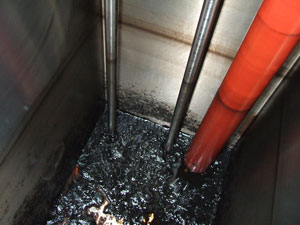
just changed my diesel filter in my pick up truck after 15.000km and it has this black goo and is awful black .. is this diesel bug??

filter is a stanadyne 2 micron filter

photo


video

 
What was the last filter you took out 15k km ago like and how long ago was that?

If the last filter was OK I can't see what else the black could be unless you've filled up somewhere which has filthy storage tanks.

Either way, there nothing to lose by strongly dosing the tank with biocide and checking the filter in another 10k miles. I assume that it was still running before you removed the filter in the photo?

Unless the tank is easily removed and can then be properly cleaned out with detergent I wouldn't bother with that at this stage.

Richard
 
Was the body of the filter full of black, or is it just what's on the element?
If it's just what's on the element, I'd say it's at the dirty end of normal.
Does the truck stand around a lot or is 15k done in a year?
I've seen worse on oldish vehicles, but a lot of people let their fuel filters go a lot of miles... or a lot of years...
 
What was the last filter you took out 15k km ago like and how long ago was that?

If the last filter was OK I can't see what else the black could be unless you've filled up somewhere which has filthy storage tanks.

Either way, there nothing to lose by strongly dosing the tank with biocide and checking the filter in another 10k miles. I assume that it was still running before you removed the filter in the photo?

Unless the tank is easily removed and can then be properly cleaned out with detergent I wouldn't bother with that at this stage.

Richard

richard last filter was before 30.000 (i change every 15.000km) and was just like that! it was my first cut open! so when i cut this one open that got me suspicious that maybe is a bug, because it was the same as the last one ! yes the car was still running ok except some diesel knocking and white smoke on cold!

Was the body of the filter full of black, or is it just what's on the element?
If it's just what's on the element, I'd say it's at the dirty end of normal.
Does the truck stand around a lot or is 15k done in a year?
I've seen worse on oldish vehicles, but a lot of people let their fuel filters go a lot of miles... or a lot of years...

in the body it had 2 black-brownish chunks..15k in a year!
 
Hopefully the truck has a bottom of tank drain plug. Remove this and collect what comes out into a glass jar or bottle.
If it looks like clean fuel then perhaps you don't have a problem. (make sure it is not pure water in the jar).
If no drain plug you will need to siphon or suck fuel from the bottom.
If it is sludgy with a water interface then you should at least drain it until it does come out clean. After 24hrs of settling you can decant the good fuel off the top to return to the tank. Yes use a biocide in the fuel. Yes Check your filter condition more often. good luck olewill
 
richard last filter was before 30.000 (i change every 15.000km) and was just like that! it was my first cut open! so when i cut this one open that got me suspicious that maybe is a bug, because it was the same as the last one ! yes the car was still running ok except some diesel knocking and white smoke on cold!

I agree with your assessment. If the last filter was like that then you do have bug. If you can easily drain and flush the tank then do that. However, it's unlikely to be that easy so load the tank with the maximum % of biocide recommended by the biocide manufacturer and check the filler cap and any seal very carefully and apply some silicon grease or vaseline to any seal to make absolutely sure that no water is getting into the fuel either from rain or tyre spray.

As the engine seems to be running OK you have time on your side so just keep doing the filter changes after adding the biocide.

Good luck ... and welcome to the Forum!

Richard
 
Probably the commonest way water gets into the tank is condensation. Modern vehicle design has all but eliminated rain or spray ingress. If you habitually run around with mostly air in your tank and only add a tenner's worth when you have to you are asking for trouble. It is far better to habitually fill the tank when you need to. Boats tend to suffer from the bug because so many are left for months at a time with a near empty tank. Full tank = little air = little condensation. And vv.
 
i will try and to use a pump and see whats on the bottom! i have already dosed with biocide ofcourse!!

thank you all guys for your help!
 
Probably the commonest way water gets into the tank is condensation. Modern vehicle design has all but eliminated rain or spray ingress. If you habitually run around with mostly air in your tank and only add a tenner's worth when you have to you are asking for trouble. It is far better to habitually fill the tank when you need to. Boats tend to suffer from the bug because so many are left for months at a time with a near empty tank. Full tank = little air = little condensation. And vv.

There are two opposing schools of thought on the Forums about whether a meaningful amount of condensation could every occur in a virtually sealed environment where there is no possibility of a sudden temperature gradient ever happening. As you can guess, I'm in the other school! :)

Richard
 
i will try and to use a pump and see whats on the bottom! i have already dosed with biocide ofcourse!!

thank you all guys for your help!
You can use one of these, a Pela Vacuum Pump, to sample the bottom of your tank. Designed for oil, but you can extract any liquid from anywhere you can get the tip of the wand into.
2041903_l.jpg

This is what diesel bug debris at the bottom of a tank looks like.:(
Tank1.jpg
 
There are two opposing schools of thought on the Forums about whether a meaningful amount of condensation could every occur in a virtually sealed environment where there is no possibility of a sudden temperature gradient ever happening. As you can guess, I'm in the other school! :)

Richard

thanks Richard, i thought about it the same way :encouragement:


You can use one of these, a Pela Vacuum Pump, to sample the bottom of your tank. Designed for oil, but you can extract any liquid from anywhere you can get the tip of the wand into.
2041903_l.jpg

This is what diesel bug debris at the bottom of a tank looks like.:(
Tank1.jpg

i dont have a pump like this but i have a small 12v one! i will try and see!
 
There are two opposing schools of thought on the Forums about whether a meaningful amount of condensation could every occur in a virtually sealed environment where there is no possibility of a sudden temperature gradient ever happening. As you can guess, I'm in the other school! :)

Richard

I quite agree if the environment is sealed and there is no temperature gradient (I assume you mean no significant tempereature changes).
However a fuel tank is not sealed and undergoes daily temperature variations which cause expansion and contraction of air within the tank, thus drawing in moist air in where it condenses as it cools. I don't think there is any real doubt about this being a major cause of water in fuel tanks. It has been known in aviation for decades that keeping tanks full overnight greatly reduces water in the fuel - and that is a business where water id checked daily and so gathers a lot of first-hand experience of it.
The only time I got the bug in 12 years was after leaving the tank empty over a winter, and lots of water found where virtually none had been before. Only one example I know, but still...
 
I quite agree if the environment is sealed and there is no temperature gradient (I assume you mean no significant tempereature changes).
However a fuel tank is not sealed and undergoes daily temperature variations which cause expansion and contraction of air within the tank, thus drawing in moist air in where it condenses as it cools. I don't think there is any real doubt about this being a major cause of water in fuel tanks. It has been known in aviation for decades that keeping tanks full overnight greatly reduces water in the fuel - and that is a business where water id checked daily and so gathers a lot of first-hand experience of it.
The only time I got the bug in 12 years was after leaving the tank empty over a winter, and lots of water found where virtually none had been before. Only one example I know, but still...

I agree that the fuel tank is not sealed and hence my phrase "virtually" sealed.

However, I don't think that daily temperature variations are relevant to the condensation issue which is why I used the term "gradient". What is needed for condensation is a significant temperature difference between the fuel/air space in the tank and the air outside the tank to arise and, in a boat or a car, that just isn't going to happen quickly enough or for a sufficiently sustained period for meaningful condensation to form.

Aircraft are an entirely different matter as the fuel tanks may be in an environment of +30 C one minute and -30 C a few minutes later, and vice versa. If I had to put up with that as a yottie I'd give up sailing as my temperature range goes from about +15 C to +35 C. Outside that range and I'm out of there!

Richard
 
You can get a fair bit of condensation forming on the pump nozzle at the petrol station sometimes.
A certain amount of water in fuel is inevitable.
 
hi,
im hoping to post in the right section :)

i must say i dont have a boat but i thought to ask your opinion since you have the most experience in this area and the forum has many posts about this..

just changed my diesel filter in my pick up truck after 15.000km and it has this black goo and is awful black .. is this diesel bug??

filter is a stanadyne 2 micron filter

Possibly but I wouldnt worry about it. Firstly you will have a decent sized engine and pump etc - the boat engines that suffer most are relatively tiny. 30 bhp when you will be way more. Plus the filter has done 15k. And you will have put a lot more diesel through the tank than our boats use .

Have you ever heard of a diesel car or truck suffering because of the bug? I havent.
 
Top