Detroit engines

MarineA

Member
Joined
27 Dec 2011
Messages
38
Visit site
Hi, i am looking at buying a boat with twin GM Detroit engines (550hp each) - can anyone advise what they are like, anything to watch out for or look closely at during survey and also who provides spares in the UK.

thanks in advance
Paul
 
Hi MarineA, and welcome to the madhouse, I am not an expert but have also been looking at DD powered boats. The resident guru is Alf (Divemaster 1) and he always does his best to help with DD problems. My opinion FWIW is that the simplicity (Ha) relatively, of the DD's give a hands on type a good opportunity to maintain and even repair the engines.

If you look at Alf's profile and at the threads he has been active on you will pick up a lot of great info, I have been clipping bits for a while and offer this to get you started:

"Just seen this thread and thought I may offer some help in respect to those Detroit Diesels (DD) before I head off to Houston...

These engines will be 8V and 92 series (8V92's)... 92 indicates that each cylinder is 92 Cubic Inch in volume, whiche equates to approx 1502 Cm3 (or 1.5L per cylinder).... so will be 12 Litres + each. This means that you'll take out about 63 Hp per litre which is on the high end for the DD's. Count on a engine re-build after each 1000 - 1500 hrs (New liners, piston rings etc.)... but the good news is that you can re-build these engines at a very affordable cost. Simple engines and if you can wield a spanner, you could actually do it yourself... Parts will be "cheap" as the 71 series and the 92 series from DD share the majority of parts, which makes part production higher volume and thus cheaper....

DD's are often mis-understood in the leisure market, where speed has become a major driver and short term ownership means that stressing engines with minimum attention to them has become a norm and passing on problems to the next owner.... and evantually "Big Bill" will come knocking...

The boat witht he DD's is cheaper as it is lower HP and the engines are known to be "thirsty".... but when in tune, they are actually not much more thirsty than the equivialent 4-stroke... (understanding the engines again)..

Now, there are a couple of issues with the DD's you need to know...

1) They do not like to be run slow ... so run them warm, then push those throttles forwards for a good operating temperature.... they do not like hours at idle ... get load on them and they will sing for you...

2) Test the engines with proper load !!! ... you need to reach full WOT and make sure you test this!!!... and that temperatures are stable... at this rating, cooling system needs to be healthy ...

3) If boat is good, you could play on the "less desirable engines" and count in the fact that they will have to have a re-build at some stage... (approx £1800 per cylinder with a professional doing it)... but you will have "factory spec engines" after this... (that is £28,000 off the price of the boat !!!)....

Nothing wrong with DD's, but is less desirable in the leisure market,.... and boat is harder to sell as a result.

Cannot comment on the MAN's ... good engines I believe, but nor sure about how easy they are to rebuild, parts, reliability etc...

Good luck !!
Last edited by Divemaster1; 02-03-13 at*22:39.

DD 2-strokes are 1 base engine in different configurations ... all with individual cylinder volumes the same. So all 92 series will have same single cylinder volume weather a V6 or a V16... makes parts simple.

Then there comes the issue of how air is introduced.. Natural Aspireated DD's are not "natural" ... they have a roots komppressor (blower) that forces air in to the cylinders through scavenging ports in the cylinder and this force does two things ... get's rid of exhaust gases and gives new air for the compression& ignition stroke in one function. This allows for injection of fuel and combustion each time the piston moves upwards (2 strokes -- 1x Ignited powerstroke downwards & 1x compression stroke upwards).

As fuel / air combination drives power, DD introduce fuel through injectors which are a combination of seperate fuel pumps and injector in one (keeping these in sync is key to fuel economy and if not "in-tune" she will not perform as designed...). As each injector therefore is a fuel pump, DD can size up/down the pumps with ease.. Bigger injectors = more fuel .... more fuel = bigger bang = more HP... Injetors for the 71 & 92 series engines are interchangable so easy to replace at approx £100 a piece (or less if you do a part exchange. This means you can easly and quite reasonable tune up or down a DD engine by simply buying bigger / smaller injectors.

At the higher HP ranges (bigger injectors), one introduce turbo chargers (perhaps one for each cylinder bank) and intercoolers to provide more air into the combustion chamber for a clean combustion (this as the roots blower itself is not big enough to provide enough air for the fuel delivered by the bigger injectors to combust properly and thus give you extra HP.
... based upon this you get a base engine (71 series for example).. that was made in everything from a single cylinder to V12's and each of the cylinder numbers ... let's say a straight six was delivered with a range from around 200 HP ("Naturally Aspirated) and up to 485 HP... and the V12 between 400 and up to over 700 HP

I have seen a pair of 8V92's with injectors called 9260, which are bigger than stock engines was delivered with, and these were pushing about 780 HP .... and there are bigger injectors out there that can be used ... and you can introduce more air into the cylinders for even more power ... (not that i would want those engines as thewy will require frequent re-builds, but is an indication of what you can do with these engines for a relatively small sum of money).. Ie a 550 HP 8V92 with turbo and intercooler is the same as a 700 Hp one .. but the 700 hp one have bigger injectors and a uprated cooling system.

You will find that the main difference between a low rated engine vs a high rated in the same series are the cooling systems (to get rid of heat .... actually the injectors and the extra fuel they can pump... read diesel returned to the tank ...... form part of the cooling system), turbo's and intercoolers.... turbo charged engines do have different pistons when compared with Naturally aspirated ones....

A bit piecemeal, but may answer your questions on the ratings ... but I have not covered the engines with lower governed RPM in here ... these are also same base engine, but with max RPM restricted...
Last edited by Divemaster1; Yesterday at*05:49.

Was not Sunseeker .... those were stock engines from DD with that configuration... may have been a JT Marinising kit on it (good stuff) ... and a governor setting that gave WOT @2500 RPM... to give that rating ... count in a re-build as I said if the boat is good otherwise... it is all in the use of the engines ... run them at 1800 - 2000 RPM at long runs (4hrs +), and they will last a lifetime ... run them at 2300 and you will face another rebuild after 1000 - 1500 hours..

Tyne Class used DDEC V6/92's at 425 and 525 HP ratings ant 2300 RPM (DD Marinised) ... some 8V92's were also used... but did not think wthe Tyne pushed 700 Hp plus....

Interesting thing is that the first Tyne class that was retired was done so after 20 years of service, so engines are reliable and well tested... a V6 @ 525 rating is about 58 HP per litre vs 63 Hp per litre on a V8 with 760 Hp rating.... which is bound to affect wear & tear when pushed towards max... but still not high wen compared with Volvo's 43 series which pushed 72 Hp per litre...

Edit : Believe some of the ARUN class lifeboats were re-powered with DDEC 8V92's...
Last edited by Divemaster1; Yesterday at*18:09."

Good luck

David
 
... and since we're copying :) ... here's a copy of my response to PM yesterday evening ...

No problem Paul,

This all depends on the series of two strokeDetroit Diesels (DD)...

There are 3 main types .... 53, 71 & 92 series ... number indicates volume of each cylinder in cubic inches...

I presume we can dispel the smaller 53 series (if it is consider them write off as parts are getting harder to get hold of) ...

That leaves 71 & 92 series...

The 71 series (one of the most reliable DD ever made) at a 550 Hp rating would be a V8 or V12 configuration ... if they are V6 ... then walk away ... they are not factory spec...

the 92 series could be V6 or V8 .... or a real lazy V12 at coommercial rating....

Both 71 & 92 series are fully re-buildable up to factory specification (tolerances as if they were delivered from the factory), so rarely are write-offs ... re-build will set you back about £1500 - £2000 per cylinder ....

So if boat is good, and fit you, but engines bad, knock off the price of a re-build (approx £25K for a set of V6 and £32K for a set of V8's).

Basically you want to hear them running from cold ... and when I say cold, I mean cold exhaust manifold .... so do a walkabout first, open engine compartment and touch the engine before you ask for them to be started.... if it is warm, they may be trying to hide low compression, which will mean slow/difficult starting from cold (see Syd's thread on DD non starter) ... or they can be out of tune (easy to fix, but suspect the worst). Engines should crank quite fast, and fire up almost immediately ... (if slow cranking, the batteries may be knackered). Once they fire, there will be white smoke out of exhaust ... this is unburnt fuel as the engines give "full fuel" at starting moment..(blue smoke = oil and you'll face a re-build at some stage ... calculate this into the price as above.... engine(s) may hunt for a short while, but should settle down after a short minute.... Look for between 500 - 650 RPM at stable idle.... The engines (particularly the 71 series) will have streaks of oil around blower and a few other parts ... but that is expected of DD's of this era ... basically you do your regular engine checks and always carry a 1/2" spanner to check the odd bolt as routine...

Once engine is settled, you should in principle manage to balance a 50 pence piece on the edge of the governor and it not falling off ... so should be very smooth ... but sounding like they idle very fast (two stroke engines fire at each stroke). Should be an instrument panel down in the engine room as well... so check that those gauges work as well ... these are usually mechanical, so should be more accurate than the ones at the helm...

Stop one engine, before firing up the other .... this may sound slightly different when cranking as DD's were "handed" and in effect have one running forwards and the other backwards ... just the way they were made...

Expect to have all servicable item between the engines and not on the outside ... (the joy of "handed" or "morrored" engines), so no excuse for not replacing filters etc.

Look to see if there is spare lubrication oil around .... and ask if this is for engine ..... the oil for the engines shuld be monograde oil ... SAE 40 is most used .... if you see SAE 50 oil, they may be trying to hide poor compression by thicker oil, which will hide this for a while, but not forever.... Multi-grade oil, such as 15W-40 is not good for these engines and do more damage than good ....so if that is what you find, calculate with a re-build again...

Basically good engines made for commercial and military use ... so heavy for HP rating and will have a destinct and more pronounced exhaust note than a 4 stroke .... Good engines when treated well and will as all other engines kick back when you don't.....

Hope this helps ...
 
Alf, how many rebuilds are to be expected before an engine finally gives up the ghost?

as far as I remember from Alf's rebuilt thread, a cylinder rebuilt is just that: liner, piston & crown. so each cyl. is practically new.
The only other item that I expect could render an engine scrap is the crankshaft (unless a conrod decides to have a look outside...). Alf's never mentioned them so I assume they're indestructable or seriously overengineered...

interested to hear Alf's view as well.

V.
 
Guys that was excellent help and advice thank you very much. Just been to see the boat and she does look good, now just have to keep my fingers crossed that she passes the inspection.

regards to all
 
as far as I remember from Alf's rebuilt thread, a cylinder rebuilt is just that: liner, piston & crown. so each cyl. is practically new.
The only other item that I expect could render an engine scrap is the crankshaft (unless a conrod decides to have a look outside...). Alf's never mentioned them so I assume they're indestructable or seriously overengineered...

interested to hear Alf's view as well.

V.

Everything is replaceable .... crankshafts etc. a full rebuild is bringing the engine back to the same spec(or better) then when it left the factory...... oh, and you can pick up a block from the scrapyard, and put it in a acid bath (or buy from reputable dealer).

No real limits ... we throw these engines out in the North Sea .... run them at 100% load 24/7 for weeks/months on end ... bring them back again, re-build as a precaution and throw them out there again ... year after year ... some of the engines are 1980's origin, still going strong and are still out there running at 100% loads....

Engine will only throw a rod etc., doe to poor maintenance / lack of service / neglect and thus having a "runaway"... or someone hot-rodding the engine OTT .... (think I have seen a 7 litre somewhere pushing towards 800 HP.....
 
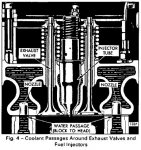
The thing that killed our V71's on the rigs was water leaks I believe at the injector pockets. Alf might
enlarge on what the cause might be!!!

Struggle to see how the injector pockets & waterjacket is joined in the 71's ....

...more likely an injector (or tip) failure or a head gasket though overheat ..causing leak beween head and block (71 series has dry liners) damaging a valve or damaging injector tip ...

Suspect you guys were running hard, pushing the envelope over considerable time .... and propably causing over fuel at given RPM ... Carbon buildup would cause injector tip failure and probably result in fuel being dumped into cylinder with the inevitable result.... Plumes of black smoke, vibration, under performance etc...

Injectors themself are cooled by the excess fuel carried through them and returns to the fuel tank...
 

Attachments

  • Injector.JPG
    Injector.JPG
    62.5 KB · Views: 2
Last edited:
as far as I remember from Alf's rebuilt thread, a cylinder rebuilt is just that: liner, piston & crown. so each cyl. is practically new.
............
V.

Let's clarify in case there are any confusion around the terms...

When I say Re-build of a DD, this usually is engine out and to workshop to bring engine back to factory spec ... the lot...the whole thing dissasembeled ....gauged, cleaned, measured etc., and re-assembled with new parts, springs, bearings, seals, as if you were building a new engine from scratch...

I did a single cylinder re-build ... from conrod bearing upwards ....

I could have done a crown (was damaged) ...and piston ring replacement...

if crown etc., is OK, but you have compression issues, you could replace just the piston rings ..... but liner and conrod bearings are advised ....

I have seen people claiming "re-build", but when you look at it it is just injector checks (or replacement) and valve clearences etc.

... so the term re-build appears to mean several things ... however, a proper one brings engine back as if she just left the factory (or better as upgrades and improvements will be applied during the re-asembly).
 
Welcome to the club. You're the first guy I've seen who has specified the engine before the hull. Smart thinking. I have DD 671TI's in a Bertram so best of both. However I do get fed up with having holiday makers walking past my transom and wanting me to stop whichever job I'm doing to chat about the DD's and how they had them for years etc etc. hope you get the boat and good luck.
 
These engines are not popular with boaters, or more specifically with boat specifiers as they are inherently reliable and they like to make a few bucks off the servicing and maintenance of engines.

All the major points and issues have been covered, but being two strokes means they like working hard and are designed to work hard; while warming them from cold its advisable to give them some throttle to minimise tick over times, warm them fully and give them some hammer once fully warmed, speed is not really the issue, the working load is, so pile some load on during a trip for at least a few minutes.

Because they aren't a popular marine engine there is not the breadth and depth of knowledge that there would be with more popular units, so learn their little quirks and you will have robust engines that will see you and your boat out; many criticise these engines, but I know Alf now knows better through him working on them.
 
Top