Detect the gps signal in a cable

alisdair4

Well-Known Member
Joined
18 Jan 2004
Messages
690
Location
Isle of Bute
midnightdrifter.net
Have now taken possession of new boat, and we are trying to restore the GPS connection to the VHF. The work had been done by the previous owner, but the cables have been disconnected. I sort of know how to do this - but the cabling is both complex (GPS is a long way from the VHF, the cable runs are not clear and there are number of other, possibly redundant cables in the way of the VHF) and unmarked. The GPS is definitely outputting a signal, because it is going to the autopilot. So the exam question is "can I detect a GPS signal by using a multimeter". If so, I can narrow down the cables which I need, and discard those which I don't. If so, I am assuming I should be looking for a very small voltage?
 
It'll be 4.8Kb, so not really.

Is it that difficult to trace? If it were really messy wiring I'd be tempted to run new cable in the short term with a longer term plan of sorting out the instrumentation wiring.
 
with a modern LCD multimeter - not a hope! with a analogue you **MIGHT** pick up a twitch on the needle - but I'd not bank on it...

So I assume you don't have say a brown and green cable going behind a panel near the plotter and emerging near the VHF?

From the kit list on your boat are you sure its not coming from another bit of kit. There was a seperate GPS IIRC! It feels like it would be easier to get a length of cable and connect up fresh. I would do that with the cable in the "open", get it running and then once working run the cables and make joints permanently...

If you don't want to do that but can get the the cables coming out the plotter you can multimeter there and see what you can see...

If you know what cable is which and just need to identify them from one end of the run to the other I'd disconnect them and put a 9V PP7 battery on them and volt meter at the other end...
 
with a modern LCD multimeter - not a hope! with a analogue you **MIGHT** pick up a twitch on the needle - but I'd not bank on it...

So I assume you don't have say a brown and green cable going behind a panel near the plotter and emerging near the VHF?

From the kit list on your boat are you sure its not coming from another bit of kit. There was a seperate GPS IIRC! It feels like it would be easier to get a length of cable and connect up fresh. I would do that with the cable in the "open", get it running and then once working run the cables and make joints permanently...

If you don't want to do that but can get the the cables coming out the plotter you can multimeter there and see what you can see...

If you know what cable is which and just need to identify them from one end of the run to the other I'd disconnect them and put a 9V PP7 battery on them and volt meter at the other end...

Yes, the "fresh approach" option is what I initially thought of. However, I was hoping to jump that step! Thanks for the info.
 
If you set the multimeter to Volts AC you may see it.
Other wise cable tracing with the 9V battery is a fair approach.
Or use a resistance range (there's often a low one with a buzzer) and a long lead to complete the circuit.

HTH?
 
measure signal to screen
If the connection is:
NMEA 0183
Vdc 0V or 3V in a scruffy implementation
Vac 3V
NMEA 2000
Vdc 2.5V
Vac 1.25V

any meter should work digital ones my show fluctuating readings on dc setting.
 
Have now taken possession of new boat, and we are trying to restore the GPS connection to the VHF. The work had been done by the previous owner, but the cables have been disconnected. I sort of know how to do this - but the cabling is both complex (GPS is a long way from the VHF, the cable runs are not clear and there are number of other, possibly redundant cables in the way of the VHF) and unmarked. The GPS is definitely outputting a signal, because it is going to the autopilot. So the exam question is "can I detect a GPS signal by using a multimeter". If so, I can narrow down the cables which I need, and discard those which I don't. If so, I am assuming I should be looking for a very small voltage?
Ive noticed that using a digital multimeter you can see a fast flicker up to 5ish volts on my B&G nmea output. Set the meter on a lowish scale, mine is good on 0-20
Stu
 
with a modern LCD multimeter - not a hope! with a analogue you **MIGHT** pick up a twitch on the needle - but I'd not bank on it...

My analogue meter does a quite distinctive flicking of the needle when connected to NMEA 0183. Obviously it's not going to reflect individual bits, but I assume each flick is a sentence going past.

Pete
 
Have now taken possession of new boat, and we are trying to restore the GPS connection to the VHF. The work had been done by the previous owner, but the cables have been disconnected. I sort of know how to do this - but the cabling is both complex (GPS is a long way from the VHF, the cable runs are not clear and there are number of other, possibly redundant cables in the way of the VHF) and unmarked. The GPS is definitely outputting a signal, because it is going to the autopilot. So the exam question is "can I detect a GPS signal by using a multimeter". If so, I can narrow down the cables which I need, and discard those which I don't. If so, I am assuming I should be looking for a very small voltage?

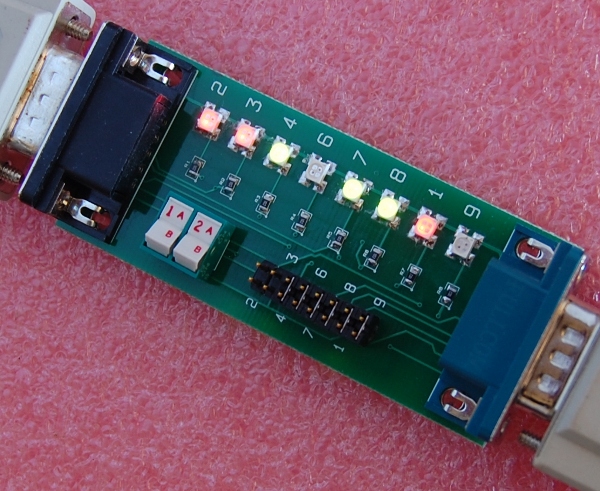
This is what you need is one of these to detect RS232

de9m-lit.jpg


https://www.google.co.za/search?q=r...2&ved=0ahUKEwjW5Z2wk63PAhXnCsAKHc3JA9IQsAQIMA

If its the same signal going from a GPS to both the auto pilot and to the radio you need to split the signal to go to both units. I have done this with both a GPS mouse and my AIS engine but it may not wotk depending on the signal loading.

RS 232 is only point to point unlike NMEA 0830 by you can get a way with it quite often. I made up a box with one input 9 pin D Type connector and 2 output 9 pin D Type connectors,

This kind of thing

https://www.google.co.za/search?q=r...nCsAKHc3JA9IQsAQIMA#tbm=isch&q=rs232+splitter

b-b-9pmds-9-pin-rs232-modem-data-splitter_464060.jpg
 
I normally use a tone tester as used for networking and phone cabling. Works overtime :)

But other than that, as lw395 says, use a cable tester obviously disconnected from any equipment!

My answer to continuity testing/wire tracing is to use a 9v battery and an old headlamp bulb.
Once you have identified a wire that terminates at one end near the GPS and at the other end near the VHF you can use it to make the connection.
 
Last edited:
Top