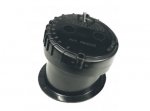
Depth sounder that does not need a hole drilled in boat?

+1 for NASA clipper inside an oil filled tube glassed in against the hull. Avoids the issues of placement in turbulent areas, and reads to >80m depth OK despite the attenuation of the hull.
 
I have had a NASA Clipper like that for almost 20 years and it works fine. I installed it while the boat was afloat.

Another vote for the NASA Unit. We actually set ours initially in a big blob of silicone, just cleaned a spot on the inside of the hull and stuck it vertically into it; the reasoning was, if the unit didn't work, or the chosen position proved inconvenient, it would be easier to move/clean-up and re-use. It was still sat and working in that same blob of silicone when we sold her nine years later.
Having also used a NASA unit through the hull, the only slight negative to the internal installation is that it 'lost' the depth at around 70-80m, rather than somewhere just beyond 100m.
 
Last time I did it I epoxied the tube to the inside of the hull and when it had gone off, added the oil and the pinger. Seemed to work just fine.
 
I have a NASA depth sounder and a fishfinder side by side, both with the transducer siliconed to the inside of the hull. Both work well and read virtually the same at all depths. You could also put the sounders in a tube glassed to the hull and filled with a liquid such as cooking oil. These are sold as kits but easy enough to do yourself.
 
Silicone is soft and will absorb the signals sent out by the unit. Epoxy is fine. Most fish finders can be installed inside the hull this way.
 
Silicon is not recommended, by the manufacturers. It will work, but accuracy can be unreliable.

Not what NASA say. They don't mention silicone in this context but do for sealing the log impeller. "The transducer face can be bonded directly to the inside of the hull. (Some energy is lost to the hull but the loss in performance is, for most G.R.P hulls, hardly noticeable)." No mention of loss of accuracy. There is no other mention of the bonding agent other than testing location with chewing gum. http://www.nasamarine.com//wp-content/uploads/2015/12/Clipper-Duet.pdf
 
Not what NASA say. They don't mention silicone in this context but do for sealing the log impeller. "The transducer face can be bonded directly to the inside of the hull. (Some energy is lost to the hull but the loss in performance is, for most G.R.P hulls, hardly noticeable)." No mention of loss of accuracy. There is no other mention of the bonding agent other than testing location with chewing gum. http://www.nasamarine.com//wp-content/uploads/2015/12/Clipper-Duet.pdf

Airmar advise against it's use, suggesting that slow drying epoxy should be used. I once temporarily fitted a Garmin (Airmar) through hull with silicon to test some wiring repairs and it differed in depth to when it was fitted properly.
 
Airmar advise against it's use, suggesting that slow drying epoxy should be used. I once temporarily fitted a Garmin (Airmar) through hull with silicon to test some wiring repairs and it differed in depth to when it was fitted properly.

I do know that NASA and Airmar have very differing views on sealant materials. I have always used Sikaflex 291 with Airmar but NASA specify silicone and not anything containing solvent.
 
I've got a Clipper on silicone too - it's a pretty thin layer and the display is completely accurate as far as my keel touching the bottom is concerned. I did try epoxy, but didn't get a decent bond and consequently got the 'out' error signal. Turned out that the bond had failed after gentle disturbance because the transducer face was too shiny. (It's not something that I really wanted to abrade).

Silicone may well be 'soft', but it's not as soft as the water or oil that the transducer is also designed to work in...
 
I do know that NASA and Airmar have very differing views on sealant materials. I have always used Sikaflex 291 with Airmar but NASA specify silicone and not anything containing solvent.
Different matter - NASA say not to use solvent based sealants for through-hull skin fitting due to type of plastic. I don't think it would be so critical for face of depth transducer. Having said that, I'd go with silicone well bedded down for temporary trial for location then epoxy or oil/antifreeze pool for permanent fix.
 
Look at the Airmar P79 transducer which can fit a number of different echo sounders. It is designed to be mounted inside on sloping hulls. You glue the tube to the hull and fill the inside with cooking oil or antifreeze.
paddedimage380280-P79.jpg
 
Both my trannies are inside the hull. The original from 1976 is in a ply/grp box filled with....I don't know, oil? The last one which I fitted is in a brown polypipe drain waste connector glassed to the hull, with an end stop fitted which has the tranny in it, it is filled with anti freeze.
 
Top