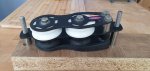
Deck organizers

coopec

N/A
Joined
23 Nov 2013
Messages
5,211
Visit site
The halyards come out of the bottom the mast. I think to negotiate the step in the deck I need vertical pulley deck organizers like the one in the photo. Harken make them but they are about $A1000 each and I need 4 of them. I'm now considering making them up myself as I could make them up in an afternoon.

Gymnasium equipment pulleys are rated for about 170kg. Does anyone know what the approximate sideways force would be on a deck organizer on a 43ft yacht? (I'm trying to work out what sort of pulleys I would need. Are brass bushes OK or do they have to be ball bearings?)

PS The ropes on the lower part of the deck would go under the pulleys and on the higher part of the deck would go over the pulleys and then on to the rope clutches.

INKEDScreenshot 2021-11-19 at 20-09-25 _IGP7370.png


INKEDScreenshot 2021-11-20 at 11-02-19 harken big boat deck organizers - Google Search.png
 
Our deck organisers are all custom made - simple stuff. Anodised aluminium plates, with off the shelf sheaves, stainless pins for the sheaves and whole thing assembled with stainless rods (interscrews). We have a flat assembly at, or near the mast base and then the cordage runs over sheaves to 'go down' a step and then under another assembly to orientate for the clutches. They would be easy to make up in 316.

I don't have a photo - it never seemed interesting :(.

We only bring the mainsail controls to the cockpit, reefing 2, 3 and halyard, Outhaul and reef 1 is at the mast All the headsail halyards, Genoa, screecher, spinnaker, are on the mast (but we are a cat) with 2 mast based winches.

Jonathan
 
Our deck organisers are all custom made - simple stuff. Anodised aluminium plates, with off the shelf sheaves, stainless pins for the sheaves and whole thing assembled with stainless rods (interscrews). We have a flat assembly at, or near the mast base and then the cordage runs over sheaves to 'go down' a step and then under another assembly to orientate for the clutches. They would be easy to make up in 316.

I don't have a photo - it never seemed interesting :(.

We only bring the mainsail controls to the cockpit, reefing 2, 3 and halyard, Outhaul and reef 1 is at the mast All the headsail halyards, Genoa, screecher, spinnaker, are on the mast (but we are a cat) with 2 mast based winches.

Jonathan

Both you and penfold have given me confidence to DI Myself (y) Thanks!

If I can design and install my chain/cable steering I can do this. (What a job that was)
One of the problems I had with the steering was visualizing the pulley angles in 3D. (Easy to visualize it in 2D)

When I was designing my cable steering one of the best bits of advice was given to by the rigger. He said to "use a length of string from the chain (in the pedestal) to the quadrant to ensure all pulleys are in alignment and then bolt them in place". Brilliant advice!:)

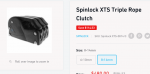
I'm using Spinlock XTS rope clutches so I presume it makes sense to have all the pulley blocks able to handle 14mm rope?


Screenshot 2021-11-20 at 15-13-36 Spinlock XTS Triple Rope Clutch.png
 
Both you and penfold have given me confidence to DI Myself (y) Thanks!

If I can design and install my chain/cable steering I can do this. (What a job that was)
One of the problems I had with the steering was visualizing the pulley angles in 3D. (Easy to visualize it in 2D)

When I was designing my cable steering one of the best bits of advice was given to by the rigger. He said to "use a length of string from the chain (in the pedestal) to the quadrant to ensure all pulleys are in alignment and then bolt them in place". Brilliant advice!:)

I'm using Spinlock XTS rope clutches so I presume it makes sense to have all the pulley blocks able to handle 14mm rope?


View attachment 126093

Why 14mm - why not smaller diameter dyneema (except for the spinnaker - which might be better NOT to be dyneema and have a bit of 'give'). Nothing wrong with 14mm - but then everything is 'bigger' and including the need for bigger hands to handle it all. 14mm reefing lines are monsters. Take in a 14mm halyard and a 14mm 3rd reef, having taken in the 1st and 2nd reef and you have an awful lot of string in the cockpit (not forgetting the mainsheet).

But then I'm a weight freak, especially reefing lines on a sail, and I like to cockpit to be clean and tidy.

Our main and screecher are both 45m^2 - its all largely 10mm dyneema. Our headsail halyards and sheets are the same size, 10mm dyneema - all different colours.

In the cockpit we have 2 sheet (screacher) winches, one of which is electric (essentially for the main halyard) and the mainsheet winch. We have one headsail (genoa, sometimes jib) sheet winch, one sheet is cross sheeted to the single winch. The main halyard (and reefing lines) is/are clearly marked for reefing positions. The topping lift is set up to ensure the boom clears anything during reefing. The only real issue is raising the main as with a decent main roach and the topping lift not allowed to fly free we need to be careful to ensure the battens do not foul the topping lift during main raising (just get the battens on the correct size for the first beat).

Its all geared up for single handed operation - the second person might be 'off watch' - no need to interrupt sleep

Jonathan
 
My new (14m) boat was delivered with lots of 14mm and 12mm polyester braid. Jib sheet swapped for 10mm dyneema before launch.
14mm X 50m main sheet will be swapped next season when I have saved some pennies.
Switching down a size or two significantly reduces friction (and weight?) Dyneema also appears to have a more slippery outer case further reducing friction. On our cruising boat we tend to handle the ropes on winches rather than by hand so I'm not too concerned about the ropes being soft on the hands.
 
I needed something similar for Jissel, so I got a local SS fabricator to make up a ring with eyes welded to it for the blocks. It may not be the cheapest option, but for $A1000, I'd expect turbine blade quality titanium with gold inlays
 
Why 14mm - why not smaller diameter dyneema (except for the spinnaker - which might be better NOT to be dyneema and have a bit of 'give'). Nothing wrong with 14mm - but then everything is 'bigger' and including the need for bigger hands to handle it all. 14mm reefing lines are monsters. Take in a 14mm halyard and a 14mm 3rd reef, having taken in the 1st and 2nd reef and you have an awful lot of string in the cockpit (not forgetting the mainsheet).

But then I'm a weight freak, especially reefing lines on a sail, and I like to cockpit to be clean and tidy.

Our main and screecher are both 45m^2 - its all largely 10mm dyneema. Our headsail halyards and sheets are the same size, 10mm dyneema - all different colours.

In the cockpit we have 2 sheet (screacher) winches, one of which is electric (essentially for the main halyard) and the mainsheet winch. We have one headsail (genoa, sometimes jib) sheet winch, one sheet is cross sheeted to the single winch. The main halyard (and reefing lines) is/are clearly marked for reefing positions. The topping lift is set up to ensure the boom clears anything during reefing. The only real issue is raising the main as with a decent main roach and the topping lift not allowed to fly free we need to be careful to ensure the battens do not foul the topping lift during main raising (just get the battens on the correct size for the first beat).

Its all geared up for single handed operation - the second person might be 'off watch' - no need to interrupt sleep

Jonathan
All my ropes were supplied with the sails and they are still in the box so I suppose there are some 10mm ropes among them.

I'd rather go up in size to 14mm (the max the clutches will handle) to keep my options open.
 
All my ropes were supplied with the sails and they are still in the box so I suppose there are some 10mm ropes among them.

I'd rather go up in size to 14mm (the max the clutches will handle) to keep my options open.
Jeeves and Ningallo are answering a different question, which I don’t believe you have yet asked - what is the optimum rope size ? (The answer depends on budget amongst other factors, as thiner dyneema cored is good but more pricey).

The question you actually asked -“I presume it makes sense to have all the pulley blocks able to handle 14mm rope?” Yes.
Mast foot blocks etc sized to handle 14mm can be used for 12 or 10mm rope. Vice versa not true.
 
Our Island Packet has a single Lewmar 40 power winch for outhauls, sheeting and furling. I needed to get a quad angled foot block - Ronstan - fot the solent rig reacher I have just installed. I fell over at the price of suitable kit.

By purchasing a piece of 3mm X 60mm S/S strip I made a sandwich plate, bought two plain sheaves and longer bolts, made up S/S plain bearings and installed the Ronstan top plate over the now quadruple angled foot block.

A bit of satin black aerasol and it looks like a shop bought job for less than 35 quid.

An Engineer is a bloke who can make for a Shilling what most buy for a Pound.

That bit of homespun truism from my old mate Bill H - the guy who invented and Patented pub optics.
 
Our Island Packet has a single Lewmar 40 power winch for outhauls, sheeting and furling. I needed to get a quad angled foot block - Ronstan - fot the solent rig reacher I have just installed. I fell over at the price of suitable kit.

By purchasing a piece of 3mm X 60mm S/S strip I made a sandwich plate, bought two plain sheaves and longer bolts, made up S/S plain bearings and installed the Ronstan top plate over the now quadruple angled foot block.

A bit of satin black aerasol and it looks like a shop bought job for less than 35 quid.

An Engineer is a bloke who can make for a Shilling what most buy for a Pound.

That bit of homespun truism from my old mate Bill H - the guy who invented and Patented pub optics.
You don't happen to have a photo of yours to upload do you because the one I have in mind is probably going to be similar to yours?

We've got a bit in common I see because you are an engineer too?

Screenshot 2021-11-20 at 20-37-32 6 munce ago i couldn spell engineer now i are one - Google S...png
 
I'm a handy mechanic who read 'The Amateurs Lathe' and practiced with a cheapo Clarke Metalworker Lathe/Mill I took as payment for the labour content of a 500cc Matchless twin engine rebuild. :cool:

An Engineer - of any qualified kind - I am not!

I have a picture of the modified foot block somewhere, mounted on a jig I used for assembly. I'll see if I can find it and post it here.
 
Sheaves - continuing on from my post on LFRs have a look here

Product Range

Are you sure you need ball bearings for deck organisers.

Jonathan
I have plenty of painted cast iron sheaves with brass bushings that I planned to use for the cable steering. I suppose they are bit heavy but only about 75mm diam. They'd never break or wear out!
 
Last edited:
Sorry but this photo was taken with a different focus

The black and yellow line is one half of our bridle. But largely ignore that.

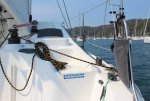
On the interface of the upper sidedeck and the step is one of the set of sheaves to take our mainsail controls, reefs 2 and 3 and main halyard to the clutches and then to one of our 3 cockpit winches. This organiser is welded and anodised aluminium (as is the organiser near the mast). This is the electric winch, the buttons are under the 'cover', dark grey next to the coil of snubber rope. This same winch is used for the screecher and spinnaker (sheets or guy). There are two blocks at the aft stanchion, I'm using one for the snubber (as we don't need them for a screecher when at anchor :) ).

The clutches and organisers are reinforced under the deck with, polished, plates

Imediately to the right of the winch is an angled sheave to ensure the lines on the winch are at the correct angle. The lines on the right, on the lower side deck are for the headsails.

IMG_9993.jpeg

I don't have detail of the main deck organiser where the mainsail lines turn - but I have a sneak image :)

Our mast is located in a 'recess' in the coachroof and our mainsail controls pass through the coachroof in a tunnel (rectangular down pipe).

The control lines emerge from the coachroof in the middle of the windows on the starboard side

IMGP5049.jpeg

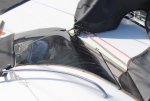
The deck organiser is 3 plates, as the reefing line sheaves are one over the other. The main halyard is hidden under the sun cover - but you can see (I hope) how the deck organiser is very simply constructed from plates of aluminium bolted together and the whole bolted through the deck. Its a brilliant trip hazard.

The inner red line is the second reef, 10mm dyneema, the green line is the tail of the third reef, its a 6mm dyneema spliced into 10mm dyneema and the other red line, it has a fleck, is the main halyard.

IMG_0188.jpeg


Hope this helps and gives you inspiration.

If you wanted better pictures - if it stops raining (we have a week of rain forecast) - I could take some - next week


I have plenty of painted cast iron sheaves with brass bushings that I planned to use for the cable steering. I suppose they are bit heavy but only about 75mm diam. They'd never break or wear out!

No don't do that :( - she is looking lovely, cast iron sheaves might be more than adequate but make me shiver (but only from an aesthetic point of view).

Jonathan
 
I bought Acetal sheaves from ebay, bored the centres on my lathe to the same dimension as the Ronstan ones I was duplicating, made S/S plain bearings by turning and boring a bit of scrounged heavy A2 bar, dimension again copied from the Ronstan OE unit.

Picture of the finished item sat on the bit of old kitchen worktop I used as an assembly jig.

I extended the sandwich plate each end so as to install extra support bolts - two of the four OE bolts were bent!

Simple spacers were made from S/S Tube for the sandwich block, taller ones with angled ends were hand filed for the extra ones - the block is angled in two directions so this was needed.block.jpg
 
Jon I'll have to study those photos tomorrow when I have a bit more time.

Some of these sheaves look interesting although I'd have to break a vow that I would only buy Australian.

rope pulley nylon | eBay
Screenshot 2021-11-21 at 19-30-30 rope pulley nylon eBay.png
I'm having second thoughts: What do they mean by "low load"? (Anyhow I've bought two of them just to have a look)


Metal Nylon Pulley Wheel Sealed U/V Grooved Ball Bearings Wire Rope Guide Roller

Description:
100% brand new and high quality

Material: As picture show(Bearing Steel OR High-carbon Steel OR With Plastic)
Color: Silver,Black, White, Orange
Size:Inner Diameter*Outer Diameter*Thickness

Package Quantity:According to your choice

Features:
1.This item is ordinary precision, adaptation to low speed, low load applications
2.Use to make steel wire rope, idler wheel, wheel roller, wire guide wheel, etc.
3.High sealing performance, high operation performance.
 
Last edited:
Top